 Beau
BeauTop 10 Reasons You’re Not Showing Up in AI Search
Someone just asked ChatGPT who to hire. It named your competitor. Here’s why — and what to fix first.
You’ve got a decent website. Reviews are good. Google still sends you some traffic. And yet when someone asks ChatGPT, Perplexity, or Google’s AI “who’s the best [what you do] near [where you are],” your name never comes up.
It’s rarely one dramatic thing. It’s usually three or four small things stacked on top of each other, and the AI quietly gives up and recommends someone else.
Here are the ten we see most, roughly in order of how often they’re the culprit.
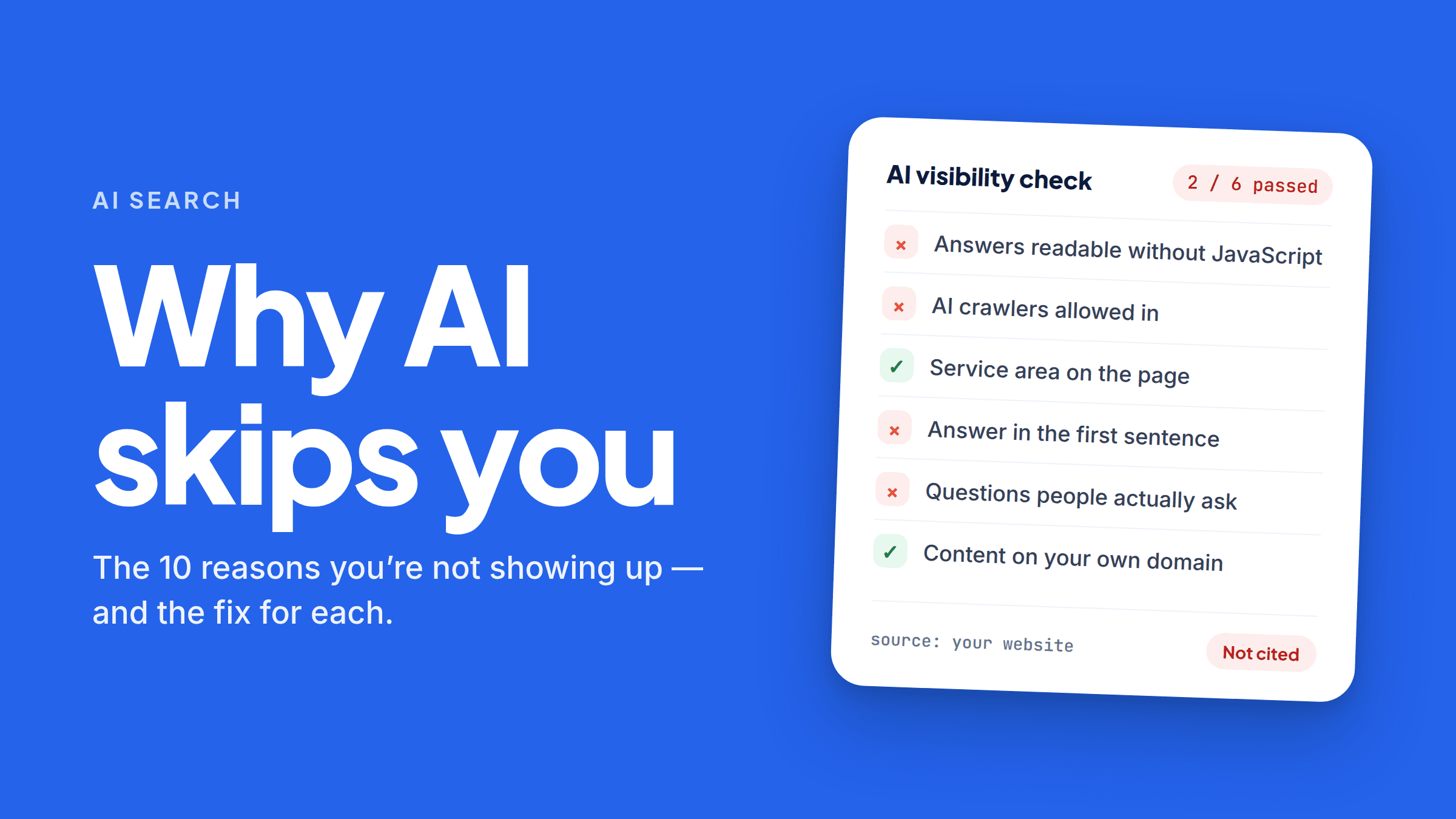
1. Your answers are hidden behind JavaScript
This is the big one. Most FAQ plugins, accordion widgets, and “smart” content blocks load their text with JavaScript after the page opens. Your visitors see it fine. AI crawlers generally don’t run JavaScript — they read the raw HTML and move on. So the exact answers you’d want quoted are, to them, a blank space.
Fix: Your questions and answers need to be plain text in the page the moment it loads. View your page source (right-click → View Page Source) and search for one of your FAQ answers. If it’s not there, the AI can’t see it either.
2. You’ve locked the AI crawlers out
Your robots.txt file tells crawlers which ones are welcome. A lot of themes, security plugins, and hosting defaults now block AI crawlers — GPTBot, ClaudeBot, PerplexityBot, Google-Extended — without telling you. You may have opted out of AI search without ever choosing to.
Fix: Open yourdomain.com/robots.txt and look for those names next to “Disallow.” If you want to
be cited, they need to be allowed in.
3. The basics aren’t on the page
“What does it cost?” “Do you cover my town?” “Are you open Saturdays?” If your site says “contact us for a quote” and “serving the greater area,” the AI has nothing to work with. It can’t recommend a plumber in Dover if it can’t confirm you work in Dover.
Fix: Put the plain facts in plain text: services, service area by town name, hours, starting prices or price ranges, response times. Specific beats impressive every time.
4. You bury the answer
A lot of pages start with a story, a mission statement, or three paragraphs about your founding year before they get to the point. Answer engines pull the cleanest, most direct sentence they can find. If yours is in paragraph four, they’ll take someone else’s paragraph one.
Fix: Lead with the answer. First sentence, 30–60 words, then the explanation. Think “Yes, we do same-day water heater replacement in Portsmouth” — not “For over 20 years, we’ve been committed to…”
5. Your content isn’t shaped like a question
People type questions into AI. Your site is written in headings like “Our Services” and “About Us.” There’s a mismatch, and the AI has to do the work of connecting the two. Often it doesn’t bother.
Fix: Add real question-and-answer content. This is why FAQ pages, done right, are one of the best AEO tools you have — they’re already shaped like what people ask.
6. You’re answering the wrong questions
You have an FAQ, but it’s the questions you want to answer: “What makes us different?” “Why choose us?” Meanwhile people are asking “Do you charge for estimates?” and “Can you come out tonight?”
Fix: Start from what people actually ask AI about businesses like yours in your area, and answer those. If you don’t know what those questions are, that’s the first thing to find out.
7. Your SEO foundation is shaky
AEO isn’t a replacement for SEO — it’s the next floor up. If your site is slow, has thin pages, missing titles, broken links, or hasn’t been touched since 2019, answer engines treat it the same way Google does: as something not worth trusting.
Fix: Get the basics right first. Clear page titles, a real page for each service, a working mobile site, no dead ends. Then build the AEO layer on top.
8. Your best info lives somewhere AI can’t use it
Your price list is a PDF. Your hours are in an image. Your latest work is only on Instagram. Your FAQ is embedded from another service inside an iframe. All of that looks fine to a human and reads as nothing — or as someone else’s content — to a crawler.
Fix: Anything you want quoted should be plain HTML text on a page you own. If it’s in a PDF, an image, a social post, or an embed from another domain, copy the important parts onto your site as text.
9. There’s nothing telling AI you can be trusted
Everything above is about what your own site says. This one is about whether anybody else agrees.
An answer engine is about to put your name in front of a stranger and, in effect, vouch for you. It would rather do that for a business the web corroborates than one that only vouches for itself. Your site claiming you’re the best roofer in town is an assertion. Forty recent Google reviews, an active profile, a mention in a local news piece, and a supplier listing you as an approved installer are evidence.
So the question isn’t just “can AI read me?” It’s “if AI goes looking for a second opinion about me, does it find one?” For a lot of small businesses the honest answer is no — and a competitor with half the craftsmanship but a visible footprint gets named instead.
The signals that matter most:
- Reviews, recent and plentiful. Volume, rating and how fresh they are. Four reviews from 2022 reads as a business that might not be trading any more.
- A profile that looks alive. Your Google Business Profile filled in and current — hours, services, photos, answered questions. Social accounts that have been posted to this year.
- Mentions you didn’t write. Local press, suppliers, trade associations, community pages, directories. Anywhere your name appears next to what you do, that you don’t control.
- Consistency across all of it. If your name is spelled three ways, your address is stale on two listings, and your hours disagree, every one of those signals gets weaker — because now the web doesn’t agree with itself either.
Fix: Ask every happy customer for a review, the day the job is done — it’s the highest-return habit on this whole list. Fill in your Google Business Profile properly and keep it current. Get listed wherever your trade lists people, and make your name, address, phone and hours identical everywhere. This is the same work that has always helped local SEO. It just happens to be what an AI reads to decide whether you’re a safe recommendation.
10. You’ve never actually checked
Most businesses have no idea whether they’re cited today, for what, or who’s being cited instead. So nothing gets fixed, because nothing looks broken.
Fix: Ask ChatGPT, Perplexity and Gemini five questions a real customer would ask. Write down who comes up. Then do it again next month. Better yet, track it automatically, because the answers change as your competitors’ content changes.
Where to start
Don’t try to fix all ten. Check the first two — can AI read your site, and are crawlers allowed in? If either fails, nothing else on this list matters yet. Once the doors are open, work down: real questions, direct answers, plain text on your own domain.
That’s the whole job. FaqFlo’s free check tells you in about a minute where you stand on the ones that matter most, and whether you’re being cited right now.
Frequently asked questions
How do I know if AI can read my website?
Open your page, right-click, and choose “View Page Source.” Search for a sentence from your FAQ or service description. If it isn’t in that raw HTML, AI crawlers can’t see it either — it’s being loaded by JavaScript after the fact.
Is being blocked in robots.txt really that common?
Yes. Many security plugins, hosting providers, and themes now block AI crawlers by default, and most owners never look at the file. Check yourdomain.com/robots.txt for GPTBot, ClaudeBot, PerplexityBot, and Google-Extended before you do anything else.
Do I need to fix all ten before I’ll get cited?
No. Crawlability and crawler access (reasons 1 and 2) are the gates — nothing works until those are open. After that, each fix improves your odds, and direct answers to real questions on your own domain do most of the heavy lifting.
Does good SEO already cover this?
Partly. A healthy, fast, well-structured site is the foundation, and it helps here too. But AEO adds things SEO alone doesn’t: answers written to be quoted, question-shaped content, and checking that AI crawlers can actually read it.
How long until I show up in AI answers after fixing these?
It varies by engine and how often your site gets crawled. Most engines find a changed page within hours to a couple of weeks, and the first AI answers quoting you usually land two to eight weeks after you publish. That’s why tracking matters: you want to see the change when it happens and catch the questions where a competitor is still getting named instead of you.

Written by
Beau
👋 Hi, I’m Beau. I’ve spent almost 20 years in marketing — long enough to watch the whole game change more than once. I was there when SEO was the answer, then social, then content, and now the biggest shift yet: people asking AI instead of Googling. Somewhere along the way I got tired of watching good small businesses do everything “right” and still stay invisible to the tools that increasingly decide who gets found. That’s why I built FaqFlo — my mission is to help you grow your business in the modern world of AI, so you become the answer, not just another link nobody clicks.
Looking for something else?
Search the archive by title, summary, or the questions a post answers.