 Beau
BeauDoes AI Use My Google Reviews? How Reviews Affect AI Recommendations
Yes — but not the way you’d hope, and not enough to carry you on its own.
You’ve spent years asking customers to leave a review. You’ve got 180 of them and a 4.8 average. So when someone asks ChatGPT for the best plumber in your town, surely that’s the thing that wins it, right?
Sort of. Reviews matter. They’re just not doing the job you think they’re doing.
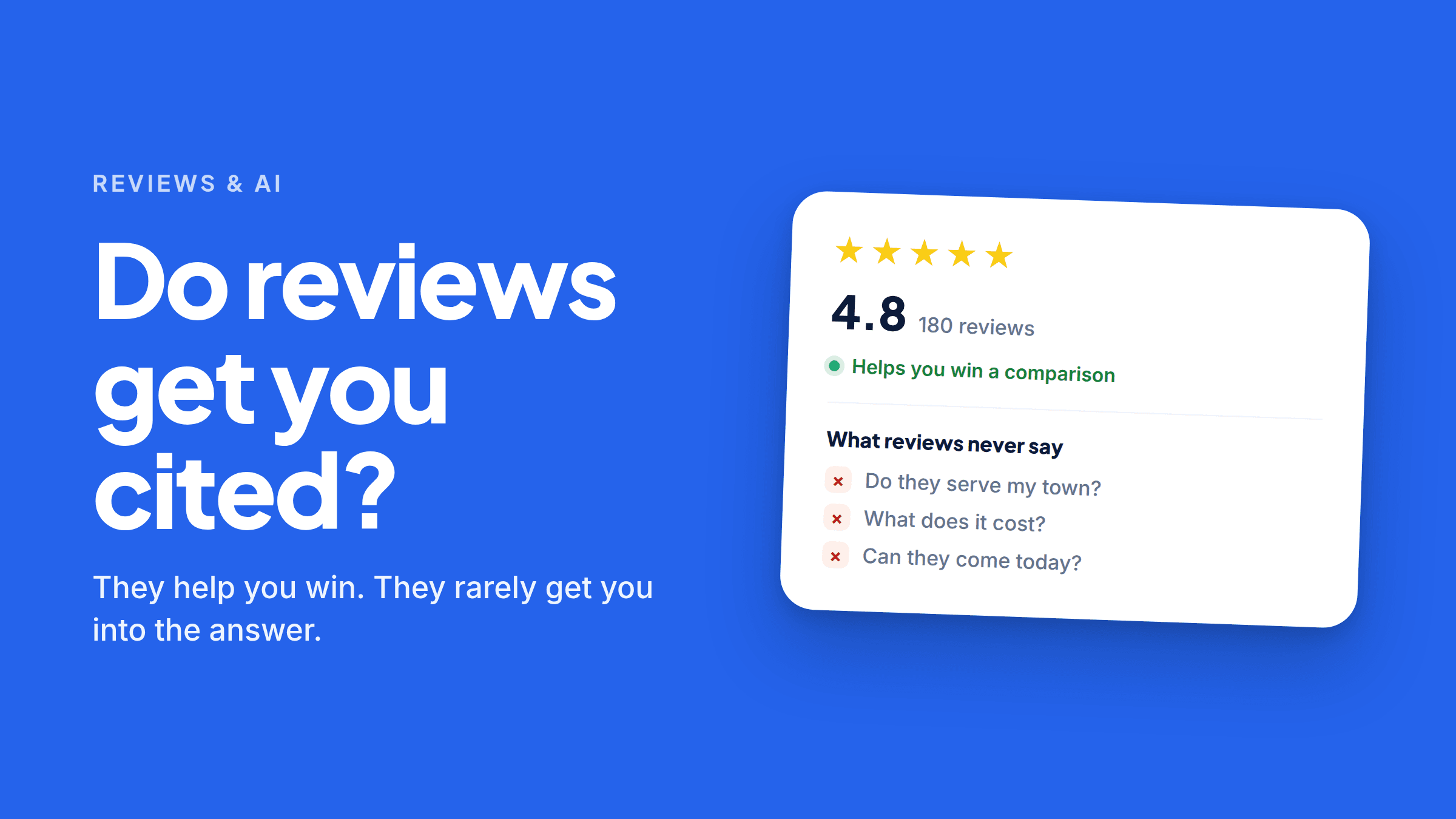
Here’s the short version: reviews help an AI decide between businesses it already knows about. They rarely get you into the conversation in the first place. Those are two different problems, and most business owners are only solving one of them.
What AI actually sees when it looks at you
When someone asks an AI assistant for a local recommendation, it’s pulling from a few different places at once.
Your Google Business Profile. Your name, category, address, phone, hours, and star rating. This is the backbone of local AI answers — Google’s AI Overviews sits directly on top of it, and other assistants lean on similar business listing data. If your profile is thin, wrong, or unclaimed, you’re already behind.
Review text — sometimes, and in pieces. Assistants don’t read all 180 of your reviews. They tend to work from summaries, star ratings, and whatever review snippets happen to be visible on pages they can crawl. So a common theme across many reviews (“always on time,” “didn’t upsell me”) is more likely to surface than any single glowing review.
Third-party sites. Yelp, Angi, Nextdoor, Reddit threads, “best X in [town]” listicles from local blogs. These get crawled and quoted constantly, often more than your own website.
Your own website — if it can read it. This is the part almost everyone gets wrong, and we’ll come back to it.
Where reviews genuinely help
Let’s be fair to reviews, because they do real work.
They’re a trust filter. A business with 8 reviews and a 3.9 average is less likely to get named than one with 200 and a 4.8. Ratings are one of the few hard numbers an AI can compare across businesses, so it uses them.
Review language becomes recommendation language. When an AI says “known for fast response times and fair pricing,” it often got that phrasing from patterns in your reviews. Your customers are, in a real sense, writing your AI description for you.
They’re the second look. Even in a zero-click world, plenty of people take the name the AI gave them and search it before calling. Your reviews are what they find. The AI got you the shot; your reviews close it.
Where reviews don’t help at all
Now the uncomfortable part.
Reviews don’t answer questions. Nobody’s review says “yes, they service Lakewood and Golden, and there’s no after-hours surcharge.” But that’s exactly what the customer asked the AI. If nowhere on the readable web states your service area, your pricing model, or your response time, the AI can’t say it about you — no matter how many stars you have.
Reviews are on Google’s property, not yours. You don’t control that page, you can’t add detail to it, and it’s structured for humans browsing, not for an engine extracting specifics.
Reviews can’t be your only crawlable content. If your website is a beautiful, JavaScript-heavy brochure with no plain text an AI can read, then your Google profile is doing all the work by itself. That’s enough to appear in a list. It’s not enough to be the one that gets recommended, because there’s nothing specific for the AI to say about you.
Here’s the pattern we see constantly: a business with excellent reviews gets mentioned as a name in a list, while a competitor with worse reviews gets the actual recommendation — because the competitor’s site answers the question and theirs doesn’t.
The fix is boring and it works
Do both. They’re not in competition.
Keep your Google Business Profile perfect. Claimed, correct category, current hours, correct service area, photos, and the Q&A section on the profile actually filled in. That last one is skipped by nearly everyone and it’s free.
Keep asking for reviews. And when you do, nudge people toward specifics. “If you have a second, it helps if you mention what we did and how fast we got there.” A review that says what you did is worth ten that say “great service.”
Then put the answers on your own site as plain, readable text. The questions customers actually ask — what it costs, which towns you cover, how fast you can come out, what you don’t do. In real HTML, on your domain, readable without JavaScript. That’s the material an AI builds a recommendation out of, and it’s the only part of this you fully control.
This is where regular SEO and AEO sit next to each other, by the way. A healthy website and a solid Google profile are the foundation — they always were. Answer Engine Optimization is the floor built on top: making sure the specifics of your business exist somewhere an answer engine can lift them from.
Where FaqFlo comes in
Your reviews prove you’re good. Your answers prove you’re the right fit. AI needs both, and most small businesses only have the first one.
FaqFlo finds the questions people are actually asking AI about businesses like yours, helps you answer them in the direct, factual way answer engines quote, and publishes those answers as crawlable HTML on your own website. Then it watches whether ChatGPT, Perplexity, and Google’s AI answers start naming you.
You did the hard part already — you earned 4.8 stars. This is just making sure the AI has something to say about you besides the number.
Frequently asked questions
Does ChatGPT read my Google reviews?
Not directly, one by one. It works from business listing data, star ratings, review summaries, and review text that appears on pages it can crawl. Your overall rating and the common themes across your reviews carry far more weight than any individual review.
Will more reviews get me recommended by AI?
More reviews help you win a comparison, but they rarely get you into the conversation. Answer engines need readable, specific content about what you do, where, and for how much — reviews almost never contain those details.
Do reviews on Yelp and Angi matter too?
Yes, often more than owners expect. Those pages get crawled and quoted frequently, so a strong presence there feeds the same pool of information an AI draws from. It’s still not a substitute for content on your own domain.
Can I get AI to quote my best review?
Not reliably, and you shouldn’t build a plan around it. What you can control is the factual content on your own site — service area, pricing, hours, specialties — which is what an AI uses to explain why it’s recommending you.
My reviews are great but AI never mentions me. Why?
Usually because there’s nothing readable about your business beyond the listing itself. If your site’s content is rendered by JavaScript or your details only exist in images and PDFs, an answer engine has your name and your stars but nothing specific to say — so it names a competitor it can describe.

Written by
Beau
👋 Hi, I’m Beau. I’ve spent almost 20 years in marketing — long enough to watch the whole game change more than once. I was there when SEO was the answer, then social, then content, and now the biggest shift yet: people asking AI instead of Googling. Somewhere along the way I got tired of watching good small businesses do everything “right” and still stay invisible to the tools that increasingly decide who gets found. That’s why I built FaqFlo — my mission is to help you grow your business in the modern world of AI, so you become the answer, not just another link nobody clicks.
Looking for something else?
Search the archive by title, summary, or the questions a post answers.