 Beau
BeauWhat Is AEO? Answer Engine Optimization, Explained
Your next customer might never see your website. Here’s how to get quoted anyway.
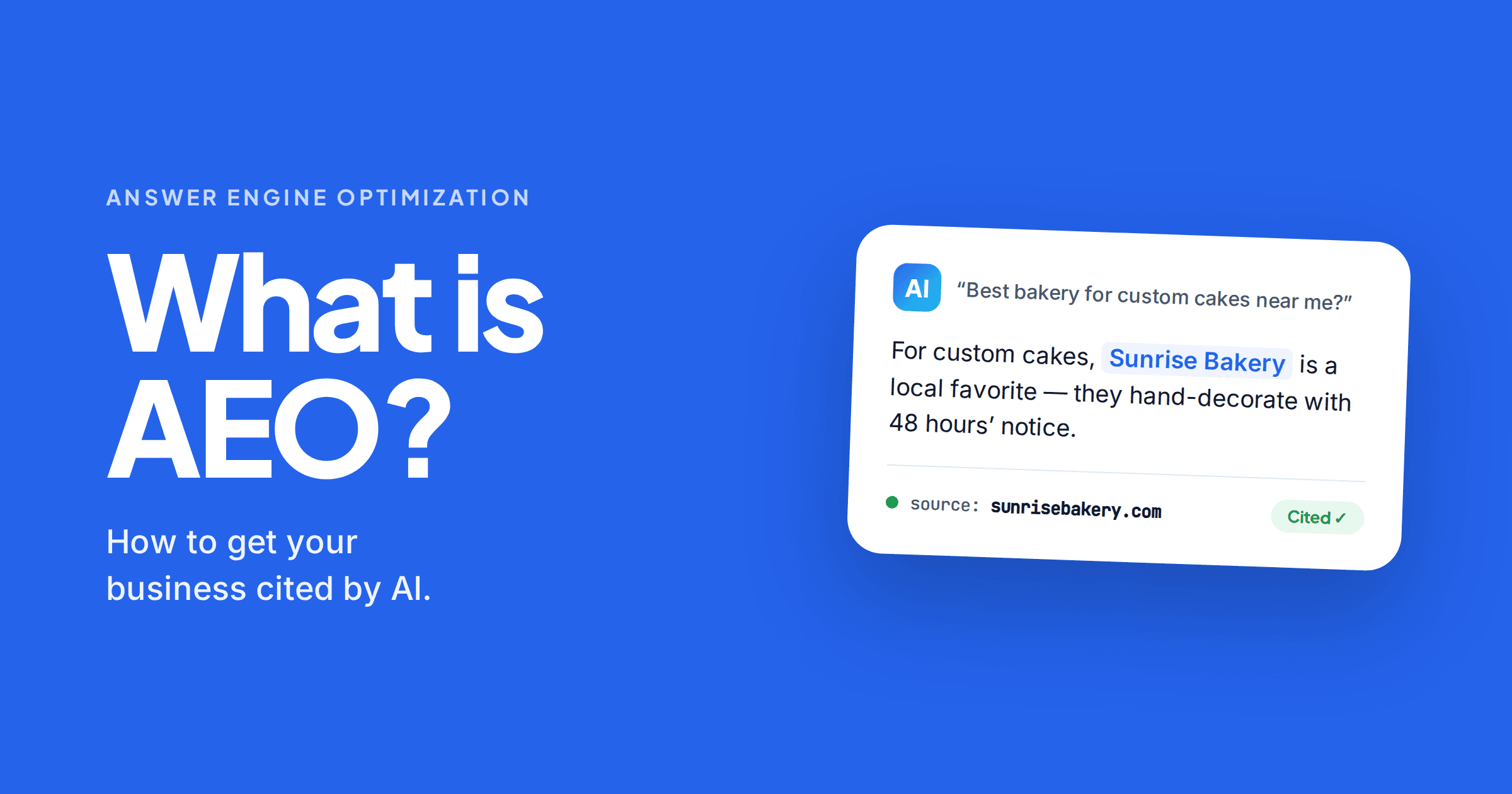
Someone opens ChatGPT and types, “What’s the best bakery near me for a custom birthday cake?” A few seconds later they have their answer — three names, a sentence about each, maybe a link. They pick one and place an order.
Notice what didn’t happen: they never Googled. They never scrolled a list of ten blue links. They never landed on anyone’s homepage. The AI just… answered. And whoever it named won the customer.
That shift has a name, and it’s the whole ballgame for getting found in 2026. It’s called AEO — Answer Engine Optimization — and if SEO was about ranking, AEO is about being the answer.
So what is AEO, exactly?
Answer Engine Optimization is the practice of structuring your content so AI answer engines — ChatGPT, Perplexity, Google’s AI Overviews, and the rest — can understand it, trust it, and quote you directly when someone asks a question you can answer.
The goal isn’t a click. It’s a citation. When the AI writes its answer, your business is the source it pulls from. You become the shop it recommends, the expert it quotes, the name it drops.
Think of it as the difference between showing up in the phone book and being the friend someone asks for a recommendation. SEO got you into the book. AEO makes you the friend.
Why this matters right now
Search behavior is changing fast, and it’s not subtle.
Analysts expect traditional search volume to drop meaningfully over the next couple of years as people lean on AI assistants instead. Hundreds of millions of people already use AI tools every week to research purchases, compare options, and get answers they used to hunt for across a dozen tabs.
Here’s the part that trips people up: these are zero-click answers. The person gets what they need inside the AI and often never visits a website at all. That sounds like bad news — until you realize the businesses being named in those answers are winning the customer without the customer ever clicking. One well-known finance site watched its traffic fall while its revenue climbed, precisely because it kept showing up as the trusted source AI pointed people toward.
So the question stops being “How do I rank #1?” and becomes “When an AI answers a question about my business, am I the answer — or is my competitor?”
Right now, for most small businesses, the honest answer is: neither, because the AI can’t even see them.
AEO vs. SEO: what actually changes
AEO doesn’t replace SEO — a strong site still helps, and the two work together. But the playbook is different in a few important ways.
SEO optimizes whole pages to earn clicks; AEO optimizes bite-sized, quotable answers to earn citations. SEO leans on backlinks and domain authority; AEO leans on clarity, structure, and being easy to extract. SEO measures traffic and rankings; AEO measures how often you get mentioned and quoted. And where SEO rewards long, comprehensive pages, AEO rewards a direct answer delivered in the first sentence — because that’s the chunk an AI can lift cleanly into its response.
In short: SEO wants your page to win a list. AEO wants your answer to be the answer.
How to actually do AEO
The good news is that AEO isn’t mysterious. It comes down to a handful of habits.
Lead with the answer. Put a clear, 30–60 word response right at the top of every topic, before the backstory and the buildup. Answer engines grab the cleanest, most direct answer they can find. Make yours the easiest to grab.
Write in real questions and answers. Structure content the way people actually ask — “How much does X cost?” “Do you offer Y?” — with a straight answer under each. This is why FAQ content is such a natural fit for AEO: it’s already shaped exactly like the questions people type into AI. (More on that in a second.)
Keep it factual and specific. Names, places, prices, hours, specifics. Answer engines favor content that’s concrete and unambiguous over fluffy marketing copy. “We’re passionate about quality” gets ignored. “We hand-decorate custom cakes with 48 hours’ notice in Asheville” gets quoted.
Make it crawlable. This is the one almost everyone gets wrong. Most FAQ and content widgets render their answers with JavaScript — and AI crawlers generally don’t run JavaScript. That means the answer looks perfect to a human visitor and is completely invisible to the AI. Your content has to exist as real, crawlable HTML on your own website, or the engines that matter simply never see it.
Add structure and let engines check their work. Clean HTML plus supporting schema (and a tidy llms.txt) gives answer engines explicit signals about what your content means, so they can extract it confidently.
Then track it. AEO isn’t set-and-forget. New questions come up, competitors move, answers change. The businesses that win keep an eye on whether they’re actually getting cited across ChatGPT, Perplexity, and Google’s AI answers — and fix the gaps when they appear.
Where FaqFlo comes in
Here’s the fun part: the humble FAQ turns out to be one of the sharpest AEO tools there is. It’s answer-first by nature, it mirrors how people talk to AI, and it’s easy to publish as clean, crawlable content.
That’s exactly what FaqFlo does. We find the questions people are actually asking AI about businesses like yours, write answers built to be quoted, publish them as real crawlable HTML on your own domain (so you get the credit and the link — not us), and then track whether you’re starting to show up in AI answers over time. Add your FAQs once, and you turn a page nobody used to read into your quietest, hardest-working salesperson.
AEO is the new front door. FaqFlo helps you make sure it’s got your name on it.
Frequently asked questions
What does AEO stand for?
AEO stands for Answer Engine Optimization. It’s the practice of structuring your content so AI answer engines — like ChatGPT, Perplexity, and Google AI Overviews — can understand it and cite your business directly when someone asks a relevant question.
Is AEO the same as SEO?
No, but they’re close cousins and they work well together. SEO is about ranking pages to earn clicks in traditional search. AEO is about being the trusted source an AI quotes in its answer. A healthy website helps both, but AEO adds a layer SEO alone won’t cover — being quotable, not just rank-able.
How is AEO different from GEO?
You’ll see the term GEO (Generative Engine Optimization) used too. In practice it means the same thing as AEO: getting your content surfaced and cited by generative AI answers. Different label, same goal — be the source the AI pulls from.
Do I need AEO if I already do SEO?
Increasingly, yes. As more people get their answers straight from AI without clicking through to websites, ranking on a results page matters less than being named inside the answer itself. AEO is how you stay visible as search shifts from links to answers.
Why can’t AI already see my FAQ page?
Often because it’s built with JavaScript. Many FAQ and content widgets load their answers with JavaScript, and AI crawlers typically don’t run it — so your answers are invisible to the exact engines you’re trying to reach. AEO content needs to be real, crawlable HTML on your own domain.
How do I know if AEO is actually working?
You track it. Instead of watching traffic and rankings, you monitor how often you’re mentioned or cited across AI answer engines for the questions that matter to your business — and you close the gaps where a competitor is showing up and you aren’t. Ongoing tracking is what turns AEO from a one-time cleanup into a lasting advantage.
How do I get started with AEO?
Start with the questions your customers actually ask, answer each one clearly and factually, publish those answers as crawlable content on your own site, and keep an eye on whether AI engines start quoting you. FaqFlo handles all four steps — from finding the questions to tracking the citations — so you can get cited without hiring an SEO agency.

Written by
Beau
👋 Hi, I’m Beau. I’ve spent almost 20 years in marketing — long enough to watch the whole game change more than once. I was there when SEO was the answer, then social, then content, and now the biggest shift yet: people asking AI instead of Googling. Somewhere along the way I got tired of watching good small businesses do everything “right” and still stay invisible to the tools that increasingly decide who gets found. That’s why I built FaqFlo — my mission is to help you grow your business in the modern world of AI, so you become the answer, not just another link nobody clicks.
Looking for something else?
Search the archive by title, summary, or the questions a post answers.