 Beau
BeauWhat Else Influences Companies Being Mentioned in AI
Your website is only one of the places AI looks. Here’s the rest of the room — and why it matters.
You fixed your website. The answers are in plain HTML, the crawlers are allowed in, the FAQ page finally says what customers actually ask. Good. That’s the part you control most directly, and most businesses never do it.
But you can do all of that and still watch an AI name somebody else.
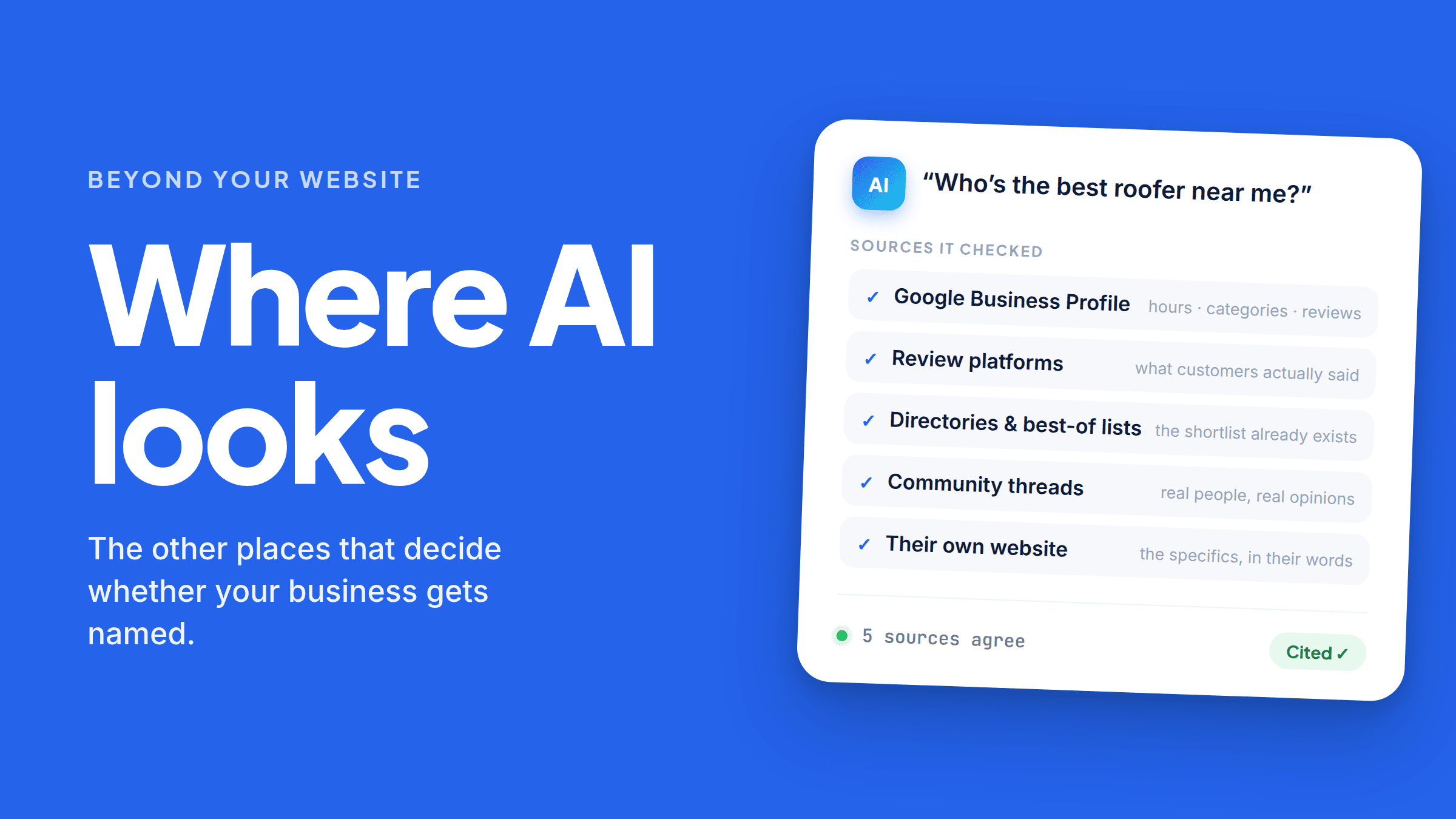
That’s because an answer engine doesn’t just read your site and repeat it. It gathers information about you from several places, sees whether those places agree, and then decides how confident it feels naming you to a stranger. Your website is one voice in that room. It’s the one with the most obvious reason to say nice things about you, so it rarely gets the final word on its own.
Here’s what else is in the room.
Why AI looks past your website at all
Put yourself in the AI’s position for a second.
Someone asks it for a good roofer in your town. It has to name one or two businesses to a person it’s never met, and it will get blamed if the answer is wrong. So it does what a careful person does: it checks whether more than one source says the same thing.
Your website says you do emergency roof repair and you’re open Saturdays. Fine — but every roofing website says something like that. When your Google Business Profile also says Saturday hours, and forty reviews mention someone showing up on a weekend, and a local directory lists you under roofing in the right town, the AI stops guessing. Now it has agreement, and agreement is what confidence is made of.
This is why a business with a plain website and a strong everything-else often gets named ahead of a business with a gorgeous website and nothing around it. A competitor doesn’t have to be better than you. They just have to be easier to verify than you.
Read that the right way round, though. It isn’t an argument that your website doesn’t matter — it’s an argument about what your website is for. The AI is checking sources against each other, and your site is one of the sources being checked. A site that looks expensive but never states your hours, your service area or your prices in words a crawler can read isn’t a weak source. It’s an absent one. There’s nothing on it to agree with, so you’ve handed the AI one fewer confirmation at the exact moment it was looking for one.
And it’s the only source in the room that speaks in your own words about the specifics. Your Google listing can confirm you’re open Saturdays. It isn’t going to explain what your warranty covers, why you don’t do flat roofs, or what you charge to come out. Design isn’t what gets checked. Answers are.
The big one: your Google Business Profile
If you only do one thing after reading this, do this one.
Your Google Business Profile is the free listing that shows up on the right side of Google and on Google Maps — your name, hours, phone, categories, service area, photos, and reviews. It’s the most complete, most current, most structured description of your business that exists anywhere, and it wasn’t written by your marketing.
That makes it the first place AI systems look for local answers. Google’s own AI features read that data directly, because Google owns it — when Google or Gemini answers a “best X near me” question, your profile is the backbone of what it has to work with. An empty profile means there’s not much to recommend.
The part people miss is that it also reaches the AI tools that have nothing to do with Google. Your profile data spreads. It flows into map apps, aggregators, directory listings, and pages all over the web that pull business details from it — and those pages are crawlable by everybody. ChatGPT doesn’t read Google’s results directly, but the sites it can read are full of information that came from your profile, so a strong profile reaches it the long way round.
What “complete” actually means, in plain terms:
- The right primary category. This is the biggest single lever on the profile. “Plumber” and “septic system service” are different businesses to a machine.
- Every service listed. If it isn’t listed, you don’t do it as far as the AI is concerned.
- Hours that are true, including holidays. Wrong hours are worse than no hours — they teach the systems that your data is unreliable, and they end up quoted back to your customers.
- Service area set correctly if you travel to customers.
- Recent photos. Recency reads as “this business is still operating.”
- Reviews that get replies. More on that next.
A large share of local businesses have never claimed or filled this profile out at all — which is either depressing or an opportunity, depending on which side of it you’re on.
Reviews: they do two separate jobs
Everyone knows reviews matter. Most people only know half of why.
Job one is confidence. A steady stream of recent, genuine reviews tells the AI you’re a real, active business that people keep hiring. A profile with six reviews from 2021 reads as dormant.
Job two is language, and this is the part nobody talks about. When an AI recommends you, it doesn’t just list your name — it says why. “They’re known for showing up same day and not pushing upsells.” Where did that sentence come from? Your reviews. The AI read them, spotted the themes, and turned them into its description of you.
That means your reviews are effectively writing your sales pitch. If forty customers mention that you explain things clearly, “explains things clearly” becomes what the AI tells strangers about you. If your reviews are all four-word “great job” reviews, the AI has nothing specific to say, and it will describe a competitor instead — because that competitor’s reviews gave it something to work with.
You can’t script reviews. You can ask for them at the right moment, and you can reply to them, which adds more text and shows the profile is tended. There’s more on what AI does and doesn’t take from them in does AI use my Google reviews.
The other sites AI actually pulls from
Here’s the uncomfortable pattern in the citation research: when AI engines answer “who’s the best X near me,” the sources they name are frequently not business websites at all. They’re third-party sites — review platforms, directories, ranking posts, and forums.
Take the specific numbers in that research with a grain of salt. A lot of it is published by companies selling AI visibility services, the figures move around between studies, and no single site dominates — even the most-quoted domain on any engine accounts for a small slice of all citations. But the shape holds up across independent studies, and it matches how the answers actually read. So here’s what’s in the room, and what each one is doing there.
Review platforms — Yelp, Google reviews, Trustpilot, the Better Business Bureau, Angi. Why AI trusts them: independent, structured, hard to fake at scale, full of first-hand customer language. ChatGPT in particular blends in outside providers like Yelp and TripAdvisor rather than relying on what a business says about itself. These are the closest thing an AI has to asking around.
Directories and “best of” lists — local roundups, city guides, “top 10 plumbers in [city]” posts, chamber of commerce listings. Why AI trusts them: somebody already did the ranking. An AI asked for a shortlist loves finding a shortlist. This is why those thin-looking “best HVAC companies in Tampa” blog posts punch far above their weight — they’re built in exactly the shape the question is asked in.
Reddit and community threads. Why AI trusts them: it’s real people arguing about who’s good and who ripped them off, which is very close to what the person asking actually wants. Study after study through 2026 has put Reddit at or near the top of the most-cited domains across the major engines. You can’t manufacture this, and you shouldn’t try — astroturfing a local subreddit is a good way to become the cautionary tale in the thread. But a customer saying your name in a “who should I call” thread is worth more than most things you could buy. We went deeper on that in Reddit beats your website in AI answers.
Industry-specific directories. Healthgrades and Zocdoc for medical, Avvo and Justia for law, Houzz and Angi for contractors, TripAdvisor and OpenTable for restaurants, Psychology Today for therapists. Why AI trusts them: they’re specialists. For a question about dentists, a dentist directory carries more weight than a general one. These are the most under-used listings in small business, and they’re usually free.
Bing. Why it matters: Bing’s index was the original engine behind ChatGPT’s live search and it still feeds into it, along with OpenAI’s own crawler and a handful of other providers. So Bing isn’t the whole story it was a year ago — but a page that appears nowhere in Bing has one fewer route in, and Copilot leans on the same index. Claiming a free Bing Places listing takes about fifteen minutes, and almost nobody bothers.
Social profiles and YouTube — Facebook, Instagram, LinkedIn, a YouTube channel. Why AI uses them: mostly as confirmation that you exist, are active, and are who you say you are. LinkedIn does heavy lifting for B2B specifically. YouTube is cited heavily by Google’s AI answers, which matters if you’re in a trade where people search “how to” before they search “who can.”
Local news, local blogs, and any press. Why AI trusts them: a third party with no stake wrote your name down. Sponsoring the little league team and getting a line in the local paper is an AEO tactic now, which is funny but true.
Wikipedia and Wikidata. Why it matters: mostly for larger brands. If you’re a five-person plumbing company, you don’t need a Wikipedia page and you’re not getting one. Skip it.
The invisible one: consistency
This is the least exciting item on the list and one of the most decisive.
Your business name, address, and phone number need to match everywhere they appear. Same name — not “Smith Plumbing” in one place and “Smith Plumbing & Heating LLC” in another. Same phone. Same address, formatted the same way. Old listings from a previous address or a disconnected number are actively working against you.
Here’s why a machine cares so much about something so boring. An AI is trying to decide whether all these mentions refer to one business. Every mismatch is a reason to think they might be two businesses, or one business with unreliable data. Neither makes it more likely to say your name out loud.
There’s no clever version of this. It’s an afternoon with a spreadsheet, searching your own business name and fixing what’s wrong.
What you can and can’t control
Being straight about this, because plenty of people will sell you the opposite.
Fully in your control: your website content, whether it’s crawlable, your Google Business Profile, your listings on directories and Bing, your name/address/phone consistency, and asking happy customers for reviews.
Partly in your control: what your reviews say — you influence it by doing good work and asking at the right time — whether local press mentions you, and whether you show up on best-of lists.
Not in your control: Reddit threads, what any individual AI decides to do on any given day, and how these systems weight their sources, which changes without warning and differs between engines. Citation patterns vary enough from platform to platform that no single checklist guarantees visibility everywhere.
Anyone promising you guaranteed AI mentions is selling something they can’t deliver. What you can actually do is make yourself the easiest business in your market to verify, and let that do the work.
The order to do it in
If you’ve got a few hours total, spend them like this.
- Claim and complete your Google Business Profile. Biggest return, costs nothing.
- Fix your name, address, and phone everywhere. Kill the dead listings.
- Get your recent review count up and reply to the ones you have.
- Claim Bing Places and the two or three directories that matter in your trade.
- Make sure your own site actually answers the questions people ask — in plain, crawlable HTML that doesn’t need JavaScript to appear.
That last one is the one that fails silently, so here’s how to check it.
The 20-second check: open your FAQ page, right-click, choose View Page Source, then press Ctrl+F (or Cmd+F) and search for a sentence from one of your answers. If it’s there, AI crawlers can read it. If it isn’t, your answers are being drawn in by JavaScript after the page loads — which means visitors see them and AI crawlers don’t.
Where FaqFlo comes in
Most of what’s on this page is off-site work: listings, reviews, directories, consistency. Nobody can do that for you, and you don’t need software for it. Go do it.
FaqFlo handles the part that’s on your own site — and it’s the part that quietly fails most often. We find the questions people are actually asking AI about businesses like yours, write answers built to be quoted, and give you clean, crawlable HTML you paste onto your own website, so the answers are readable from the first byte and the credit comes to you. Then we check whether ChatGPT, Perplexity and Gemini are starting to name you, so you can tell whether any of this is working.
Everything else in the room matters. This is the piece you own outright.
Frequently asked questions
Does my Google Business Profile affect whether AI mentions my business?
Yes, more than any other single thing for a local business. Google’s AI answers read your profile data directly, and the details from your profile also spread to other sites that AI tools can crawl. A complete, accurate, active profile is the highest-return step available to most small businesses.
Do I need to be on Reddit to get mentioned by AI?
You don’t need to post there, and you shouldn’t post fake recommendations about yourself. Reddit is one of the most-cited sources across the major AI engines because it’s real people discussing who’s good, so a genuine customer mentioning you carries real weight. Treat it as a reason to do work worth talking about, not a channel to manage.
Do reviews really change what AI says about me?
They change both whether you’re named and how you’re described. AI systems use review volume and recency to judge whether you’re a real, active business, then borrow the specific themes in your reviews to explain why they’re recommending you. Vague reviews give the AI nothing to say about you, so it describes a competitor instead.
Does Bing still matter if all my customers use Google?
It is worth the fifteen minutes. Bing’s index was the original source behind ChatGPT’s live search and still feeds into it alongside OpenAI’s own crawler and other providers, and Microsoft Copilot uses it too. It is no longer the single gateway some articles claim, but a free Bing Places listing is one more route in.
If I fix all my listings, do I still need to fix my website?
Yes, and the two do different jobs. Listings and reviews are how an AI decides it can trust you; your own site is where it gets the specifics — your prices, your service area, your policies — in your own words. That only works if those answers are real, crawlable HTML rather than content drawn in by JavaScript, which AI crawlers generally don’t run.

Written by
Beau
👋 Hi, I’m Beau. I’ve spent almost 20 years in marketing — long enough to watch the whole game change more than once. I was there when SEO was the answer, then social, then content, and now the biggest shift yet: people asking AI instead of Googling. Somewhere along the way I got tired of watching good small businesses do everything “right” and still stay invisible to the tools that increasingly decide who gets found. That’s why I built FaqFlo — my mission is to help you grow your business in the modern world of AI, so you become the answer, not just another link nobody clicks.
Looking for something else?
Search the archive by title, summary, or the questions a post answers.