 Beau
BeauHow Dentists Can Win With AI
Patients are asking ChatGPT for a dentist instead of scrolling Google. Here’s exactly how to be the practice it names.
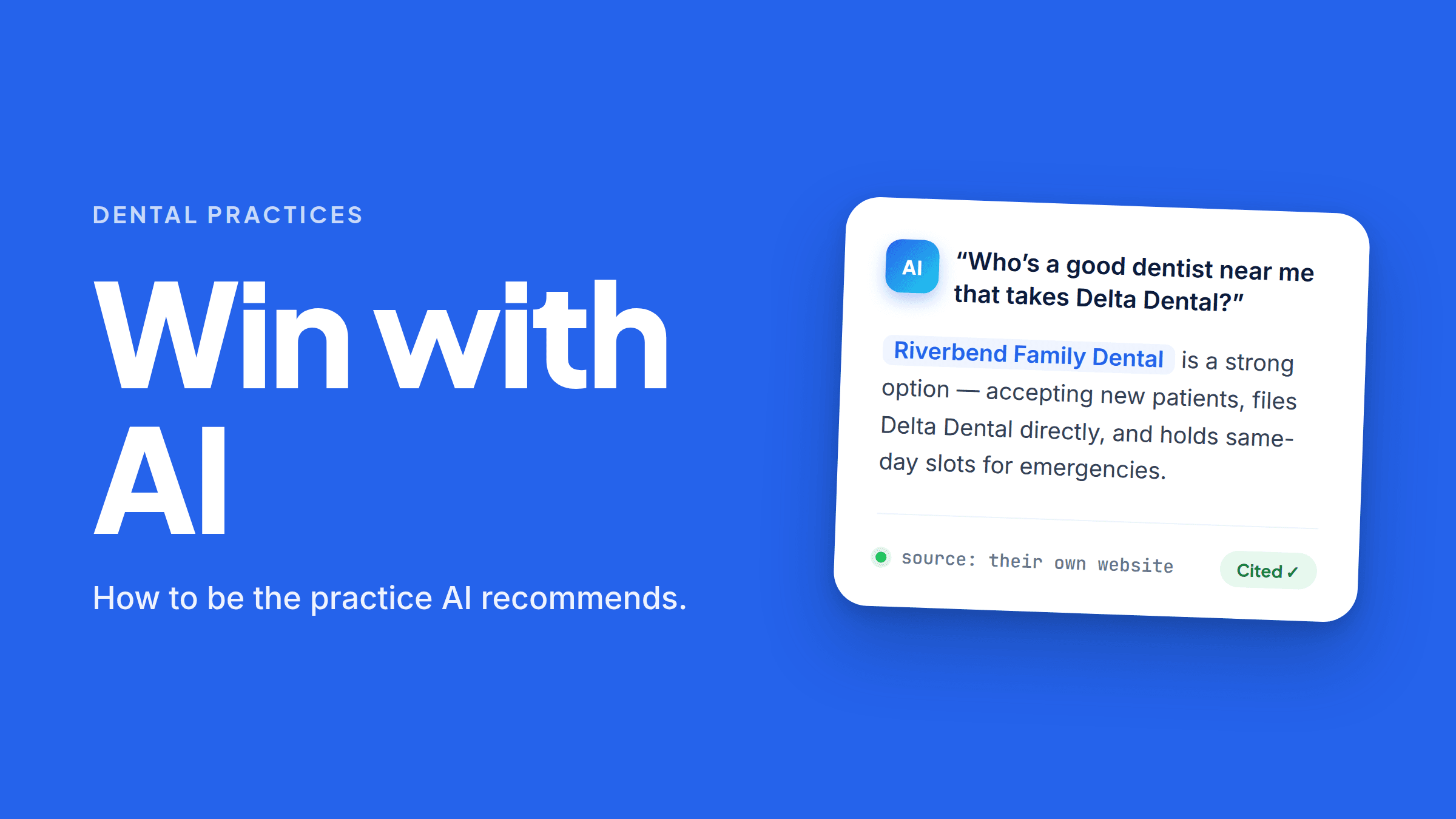
A woman wakes up on a Saturday with a cracked molar. She doesn’t open Google and scroll through ten listings. She opens ChatGPT and types: “Who can see me today for a cracked tooth in Concord? I have Delta Dental.”
She gets three names, a sentence about each, and picks one. She calls that office before she’s read a single website.
That’s the moment that decides who gets the patient now. Not page one of Google — the short list inside the AI answer. And most dental practices aren’t on it.
Why AI skips most dental practices
It isn’t because your practice isn’t good. It’s because the AI couldn’t find anything useful to say about you.
Answer engines like ChatGPT, Perplexity and Google’s AI Overviews build their answers out of text they can read on the open web. When a practice’s website is mostly photos, a slideshow and a paragraph about “compassionate care”, there’s nothing to quote. The AI doesn’t say “I’m not sure.” It confidently names the practice down the road that did spell things out.
There’s a second problem, and it’s the one that quietly sinks most dental sites: JavaScript.
Most dental website templates and FAQ plugins load their answers after the page opens, using JavaScript. A human sees a nice accordion that expands when tapped. An AI crawler grabs the raw page code and moves on — it generally doesn’t run JavaScript at all. So your answers are there for patients and completely invisible to the engines you want recommending you.
Your FAQ page can look perfect and get you cited exactly zero times.
SEO still matters. This is the floor above it.
None of this replaces search engine optimization. A fast, well-organized website with a solid Google Business Profile is still the foundation, and it always will be.
AEO — answer engine optimization — is what sits on top. SEO gets your page ranked in a list. AEO gets your practice named inside the answer, where no list is shown at all. You need both, and they feed each other.
What dentists need to do, exactly
Five steps. None of them require a marketing degree.
1. Answer the questions patients actually ask
Not “Why choose our practice.” The real ones, in the words people use:
- Do you take my insurance? Name the plans. Delta Dental, MetLife, Cigna, Aetna — write them out.
- Are you accepting new patients?
- Do you see emergencies same-day? What about weekends?
- What does a crown / cleaning / root canal / implant cost here?
- Do you offer payment plans or in-house membership for patients without insurance?
- Do you see kids? From what age?
- Do you offer sedation for anxious patients?
- Where do I park, and where exactly are you?
- What are your hours?
These are the questions that get typed into AI. If your website answers them in plain sentences, you’re quotable. If it doesn’t, you’re not in the conversation.
2. Be specific enough to quote
“We’re committed to gentle, patient-centered care” is unquotable. There’s nothing in it.
Names, plans, prices, ages, hours, neighborhoods. Specifics get quoted. Adjectives get skipped. Here is the same information, written the two ways:
What most sites say | What gets quoted |
|---|---|
| “We accept most major insurance plans.” | “We file Delta Dental, Cigna, MetLife and Aetna directly. If you’re out of network we’ll quote the full fee before we start.” |
| “Emergency appointments available.” | “We hold two same-day emergency slots every weekday. Call before 3pm and we’ll see you that day.” |
| “Family-friendly practice for all ages.” | “We see children from age one, and we have a paediatric hygienist on Tuesdays.” |
| “Affordable treatment options.” | “A standard cleaning is $120 without insurance. We offer a $30/month in-house membership that covers two cleanings a year.” |
Every sentence in the right-hand column is one an AI can lift whole into an answer. Every sentence on the left could describe any practice in your state — which is exactly why none of them get used.
3. Put the answer in the first sentence
Answer engines grab the cleanest, most direct answer they can find. So lead with it.
Bad: “At our practice, we understand dental emergencies are stressful, which is why…”
Good: “Yes — we hold same-day emergency appointments Monday through Friday. Call before 3pm and we’ll see you that day.”
Say the answer, then add the detail. Every time.
4. Make sure a machine can actually read it
This is the step that separates practices that get cited from practices that don’t.
Your answers need to exist as real, readable text in your web page itself — not loaded in later by a plugin or widget. Plain and boring is the goal. It looks like this:
<section class="faqflo-faqs" aria-labelledby="faq-heading">
  <h2 id="faq-heading">Frequently asked questions</h2>

  <div class="faqflo-item">
    <h3 class="faqflo-question">Do you take Delta Dental?</h3>
    <p class="faqflo-answer">Yes. We file Delta Dental directly, along with Cigna,
      MetLife and Aetna. We'll check your remaining benefit before your visit.</p>
  </div>

  <div class="faqflo-item">
    <h3 class="faqflo-question">Do you see emergencies the same day?</h3>
    <p class="faqflo-answer">Yes. We hold two same-day slots every weekday. Call
      before 3pm and we'll see you that day.</p>
  </div>
</section>
No accordion, no widget, no script. The question is in a heading, the answer is in a paragraph underneath it, and both are sitting in the page before anything loads.
The 20-second check: open your FAQ page, right-click, choose View Page Source, then press Ctrl+F (or Cmd+F) and search for a sentence from one of your answers. If it’s there, AI crawlers can read it. If it isn’t, your answers are being drawn in by JavaScript after the page loads — visitors see them and crawlers don’t. Then check that crawlers are allowed in at all, because a surprising number of sites block them without the owner ever deciding to.
It also matters that the content lives on your own website, not on a third-party directory or a page hosted by a vendor. When the AI cites the answer, the credit and the patient should come to you. Here’s how to paste it in on WordPress, Squarespace, Webflow or Wix.
5. Keep your basics consistent, and check on it
Two small habits do a lot of work here.
Make sure your practice name, address, phone number and hours match everywhere they appear — your website, Google Business Profile, insurance directories, health plan finders, local listings. Answer engines get nervous when the facts don’t agree, and a nervous engine recommends someone else. Wrong hours are worse than no hours, because they get quoted back to your patients.
Then check whether it’s working. Open ChatGPT, Perplexity and Google and ask a few questions a real patient would ask about your town. See whose names come back. If it’s the practice three miles away every time, you now know exactly what you’re fixing.
What this looks like when it works
An AI answer that names your practice isn’t traffic. It’s a referral.
The patient asked for a recommendation, got a short list from a source they trust, and called. They’re not price-shopping you against four other offices. They mostly want to know when you can see them. That’s the best kind of new patient call there is — and it happens at 2am, on a Sunday, to someone who’s never heard of you.
The practices winning this right now aren’t the ones with the biggest ad budget. They’re the ones whose websites plainly say what they do, who they take, and when they’re open — in text a machine can read.
Where FaqFlo comes in
FaqFlo does this whole loop for dental practices.
It checks whether AI can read your site at all, finds the questions people actually put to AI about dentists in your area, writes answer-first responses built to be quoted, and gives you a clean block of readable HTML you paste onto your own website — no plugin, no developer. Then it tracks whether you’re starting to show up in ChatGPT, Perplexity and Gemini, so you can see it working instead of hoping.
Twenty minutes once, then it keeps an eye on it for you.
Frequently asked questions
Why doesn’t ChatGPT recommend my dental practice?
Usually because it can’t find clear, readable information about you. Answer engines build recommendations from text they can crawl, so a site that’s mostly images, slideshows or JavaScript-loaded content gives them nothing to quote. The practice that spells out its insurance plans, hours and services in plain text gets named instead.
Is AEO different from the SEO my dental marketing company already does?
Yes, though they work together. SEO is about ranking your pages in a list of search results, while AEO is about being the practice an AI names inside its answer. Keep doing SEO — AEO is the layer on top for the growing number of patients who never see a results page.
Does my FAQ page already handle this?
Only if an AI can read it. Most dental FAQ plugins and accordion widgets load their answers with JavaScript, and AI crawlers generally don’t run JavaScript, so those answers are invisible to the engines you want recommending you. The content has to exist as plain, crawlable HTML on your own domain.
What questions should a dental practice answer first?
Start with insurance accepted, whether you’re taking new patients, same-day emergency availability, and typical costs for common treatments. Those are the ones patients ask out loud, and they are the ones that turn into phone calls. Add payment options, pediatric age range and sedation next.
Can I pay to be recommended by AI?
Not the way you’d buy an ad. AI recommendations come from what the engines can find and trust about your practice, not from a bid, which is part of why a mention feels like a referral rather than an advertisement. The work is making your practice findable and quotable, not buying placement.

Written by
Beau
👋 Hi, I’m Beau. I’ve spent almost 20 years in marketing — long enough to watch the whole game change more than once. I was there when SEO was the answer, then social, then content, and now the biggest shift yet: people asking AI instead of Googling. Somewhere along the way I got tired of watching good small businesses do everything “right” and still stay invisible to the tools that increasingly decide who gets found. That’s why I built FaqFlo — my mission is to help you grow your business in the modern world of AI, so you become the answer, not just another link nobody clicks.
Looking for something else?
Search the archive by title, summary, or the questions a post answers.