 Beau
BeauWhat Does Marketing Look Like in 2027 and Beyond?
An honest look at what still works, what’s a treadmill, and the three things to do if marketing just isn’t your thing.
Here’s the honest version: most marketing advice you’ll read this year is written by people who sell marketing. So it’s going to tell you to do everything. Post daily. Run ads. Start a podcast. Learn the new AI tool. Be on the new app.
You can’t do all of that. You have a business to run. So let’s sort marketing into what actually moves the needle in 2027 and beyond, what’s fine but optional, and what’s a treadmill you can step off.
The big shift: people get answers, not links
For twenty years, marketing meant getting the click. You showed up in a search result, someone clicked, they landed on your page, and you sold them from there.
That path is thinning out. SparkToro’s 2026 analysis found about 68% of Google searches now end without a click — up from roughly 60% two years earlier, and higher still on a phone. Someone asks an AI assistant or sees a Google AI answer, and gets what they need right there. They ask for “a good electrician near me who does same-day work” and they get two names and a sentence about each.
This doesn’t mean websites are dead. It means the job of your website changed. It used to be a storefront. Now it’s also the source material that AI reads before it decides whether to recommend you. If it can’t read you, it recommends someone else.
Two more things changed at the same time:
Attention is split into smaller pieces. People are on more platforms, for shorter stretches. No single channel reaches everyone anymore.
Generic content is worthless. AI can write a passable blog post in ten seconds, and everyone knows it. So the internet is flooding with average content. What stands out now is specific content: your real prices, your real service area, your real answers, your real customers saying real things.
Keep those three shifts in mind and the rest of this gets simple.
Two kinds of marketing: what you rent, and what you own
The most useful way to think about marketing in 2027 is not by channel. It’s by whether the work keeps paying you after you stop.
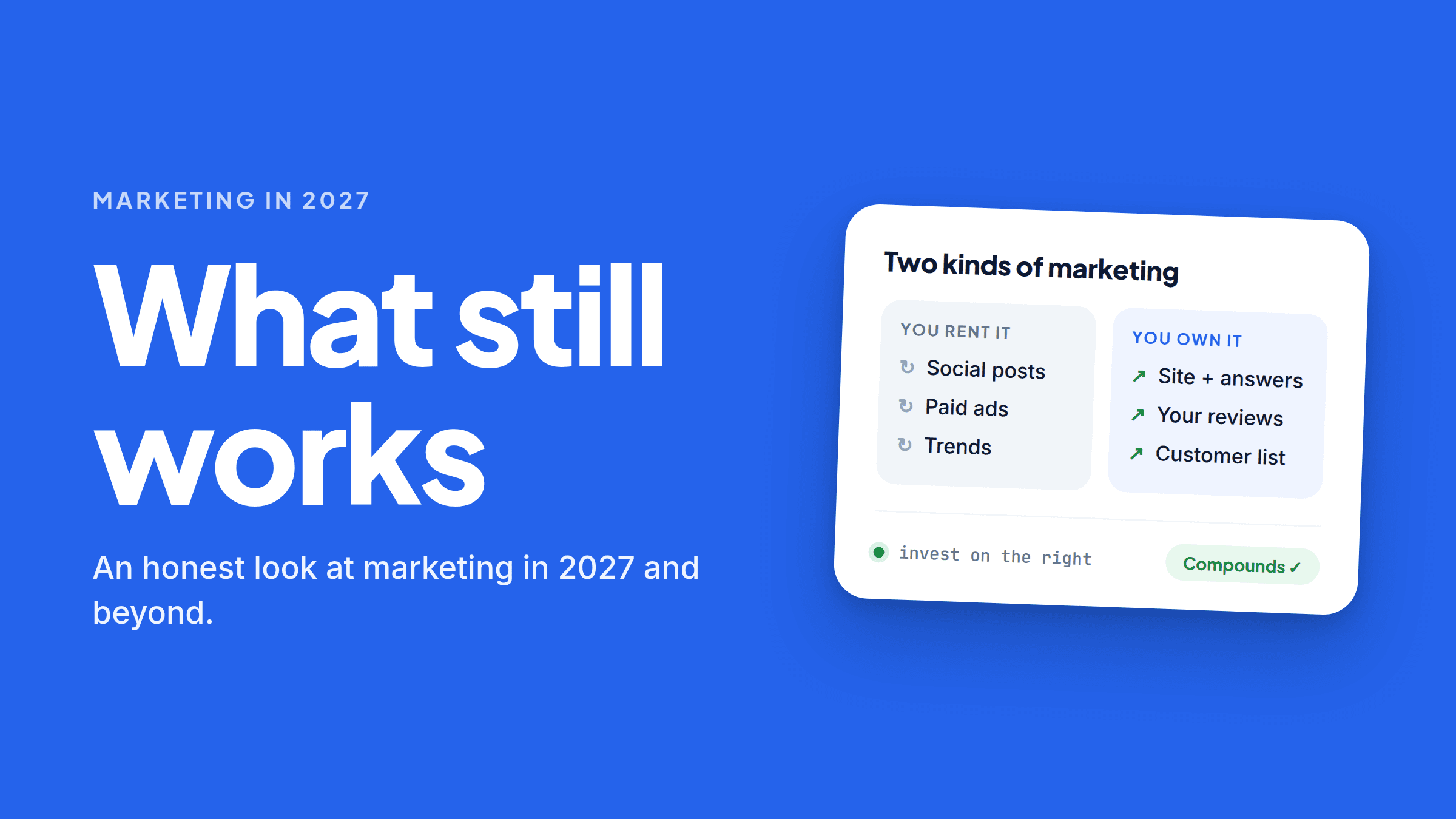
Things you rent. These work while you feed them and stop the moment you don’t. Social media posts. Paid ads. Chasing trends. They can be very effective. They just never build up. Miss a month and you’re back to zero.
Things you own. These compound. A good website with clear answers keeps getting found. A review from 2024 is still working for you today. A customer list you’ve built for five years is worth more every year. This is marketing equity — work that builds on itself.
Most small businesses spend their time on the rented stuff, because it’s what everyone talks about and it gives you a quick hit of likes. Then they wonder why they have to keep running just to stay in place.
Flip the ratio. Spend most of your limited time on what you own. Do the rented stuff when you can, without guilt when you can’t.
An honest scorecard, channel by channel
Your website and SEO — still the foundation. Don’t let anyone tell you SEO is over. It’s the ground floor. A fast, clear site with real information about what you do and where you do it is what everything else sits on. What’s changed: fewer clicks arrive from search, so your site has to work even when nobody clicks. That means the answers have to be on the page in plain text, not buried in a design.
AEO (answer engine optimization) — the next floor up. This is the new one, and it’s real. AEO means writing your content so AI tools can read it, trust it, and quote you by name when someone asks. It’s not a replacement for SEO. It’s what you build on top of it. The good news is that it’s mostly about plain, specific, question-and-answer content on your own site — which you probably should have had anyway.
Reviews — the highest return of anything on this list. Reviews are the closest thing to a cheat code. They drive local search and maps. They’re what AI reads to decide if you’re trustworthy. They’re what a customer checks after AI hands them your name. And they compound forever. One habit — asking every happy customer — beats almost any campaign.
Email and text — the list is equity, the sending is a treadmill. Your list of past customers is one of the most valuable things you own. Nobody can take it away, change an algorithm on it, or charge you rent to reach it. It is also the most reliable hedge there is against a search result that never sends a click. The honest catch: a list only works if you use it. A useful note every month or two keeps you in mind when they need you again.
Social media — keep up, but don’t depend on it. Here’s the part people don’t like to hear. Organic reach on most platforms is small now. A post reaches a fraction of your own followers. Viral rarely turns into revenue. Social is still worth it for two reasons: it’s the first place many people check to see if you’re real and active, and it’s where word of mouth happens in public. So keep it alive. Post when you have something to show. Just don’t build your business on it, and don’t let it eat your week.
Paid ads — they work, and they cost more every year. Ads are the fastest way to get customers and the least durable. Costs rise as more businesses pile in. Ads are great for filling a slow month or launching something new. They are a bad place to put your only money, because the leads stop the day the budget does.
Short-form video — powerful, expensive to keep up. Video reaches people who never read. But it demands constant new material. If you like doing it, do it. If you don’t, don’t guilt yourself into it. There’s no evidence a plumber who hates being on camera needs to be.
Word of mouth, referrals, and local partnerships — old, boring, undefeated. The best lead you’ll get this year will come from someone saying your name to someone else. That’s not a tactic. It’s a result. It comes from doing good work, asking for reviews, and staying in touch. Everything above feeds into this one.
What doesn’t change
Underneath every shift, the same things win: be easy to find, be easy to understand, be easy to trust, and be easy to contact.
AI didn’t change that. It just changed who’s asking. Now it’s often a machine asking on someone’s behalf. It wants the same things a person wants: clear answers, real specifics, and proof from other people that you’re good.
If marketing isn’t your thing: the only three that matter
If you read nothing else, do these three. They’re all things you own, and all three keep working while you’re busy running the business.
- Make your business readable. One real website with the answers to the questions people actually ask — what you do, where, what it costs, how fast, what makes you different. Written in plain text an AI can read, not hidden in a widget or a PDF. This one step covers SEO, AEO, and most of what an AI needs to recommend you. Do it once, update it a few times a year.
- Ask every happy customer for a review. Make it a habit, not a campaign. A text with a link, sent the day the job is done. That’s it. Nothing else on this list has a higher return for the effort.
- Keep your own list, and use it. Collect emails or phone numbers from every customer. Send something useful every month or two — a tip, a seasonal reminder, a heads-up about availability. You’re not selling. You’re staying in mind.
That’s the whole plan. Social, ads, and video go on top of this if you have the time or the taste for them. They don’t replace it.
Where FaqFlo comes in
The first of those three is the one most businesses get wrong without knowing it. Their answers exist, but they’re trapped in a design that AI can’t read, or spread across pages that don’t say anything specific.
FaqFlo finds the questions people actually ask AI about businesses like yours, drafts answers built to be quoted, gives you clean, crawlable content to put on your own site, and then tracks whether ChatGPT, Perplexity and Gemini start naming you. It’s the “make your business readable” step, done in an afternoon instead of a quarter.
Marketing in 2027 rewards the businesses that are clear, specific, and trusted. That’s not a trend. It’s just harder to fake now.
Frequently asked questions
Is SEO dead in 2027?
No. SEO is still the foundation: a fast, clear website with real information about what you do and where. What’s changed is that fewer people click through from search — about 68% of Google searches now end without a click — so your content also needs to work when it’s read by an AI instead of a person. That’s where AEO builds on top of it.
Do I still need to post on social media?
You should keep your profiles alive, because people check them to see if you’re real and active. But organic reach is small, and social rarely drives revenue on its own for a small business. Post when you have something worth showing and don’t let it take over your week.
What’s the single highest-return marketing activity for a small business?
Asking every happy customer for a review. Reviews drive local search and maps, they’re what AI reads to decide if you’re trustworthy, and they keep working for years. One consistent habit beats almost any campaign.
Are paid ads worth it anymore?
Yes, for specific jobs: filling a slow stretch, launching a new service, or reaching a new area fast. They’re the least durable channel, though, and they cost more each year. Use them on top of the things you own, not instead of them.
What is marketing equity?
It’s marketing work that keeps paying you after you stop doing it. Your website, your answers to real questions, your reviews, and your customer list all compound over time. Social posts and ads don’t; they work while you feed them and stop when you don’t.

Written by
Beau
👋 Hi, I’m Beau. I’ve spent almost 20 years in marketing — long enough to watch the whole game change more than once. I was there when SEO was the answer, then social, then content, and now the biggest shift yet: people asking AI instead of Googling. Somewhere along the way I got tired of watching good small businesses do everything “right” and still stay invisible to the tools that increasingly decide who gets found. That’s why I built FaqFlo — my mission is to help you grow your business in the modern world of AI, so you become the answer, not just another link nobody clicks.
Looking for something else?
Search the archive by title, summary, or the questions a post answers.