 Beau
BeauDoes a Website Matter Anymore in 2026?
Fewer people visit it. More AI reads it. That’s a new job, not a smaller one.
Yes, a website still matters in 2026. But it matters for a different reason than it used to.
It used to be the place customers landed. Now it’s more often the place AI goes to learn about you before it answers a customer’s question. Fewer people may visit your site. More software is reading it on their behalf.
If you’ve been wondering whether to let your website go stale, that’s the part worth knowing before you do.
Why people are asking this question
The doubt makes sense. Here’s what a lot of business owners are seeing:
Traffic is flat or dropping. More customers call after “asking ChatGPT” or reading a Google AI answer. Plenty of new jobs come in through a Facebook message or a Google Business Profile, and nobody seems to click the website link at all.
So it’s fair to ask: if people get their answer without visiting, why pay for a website?
The answer is that the visit was never the whole point. The website’s real job was always to tell the world what you do, where you do it, and why you’re a good choice. That job didn’t go away. The reader changed.
Your website’s new job: be the source
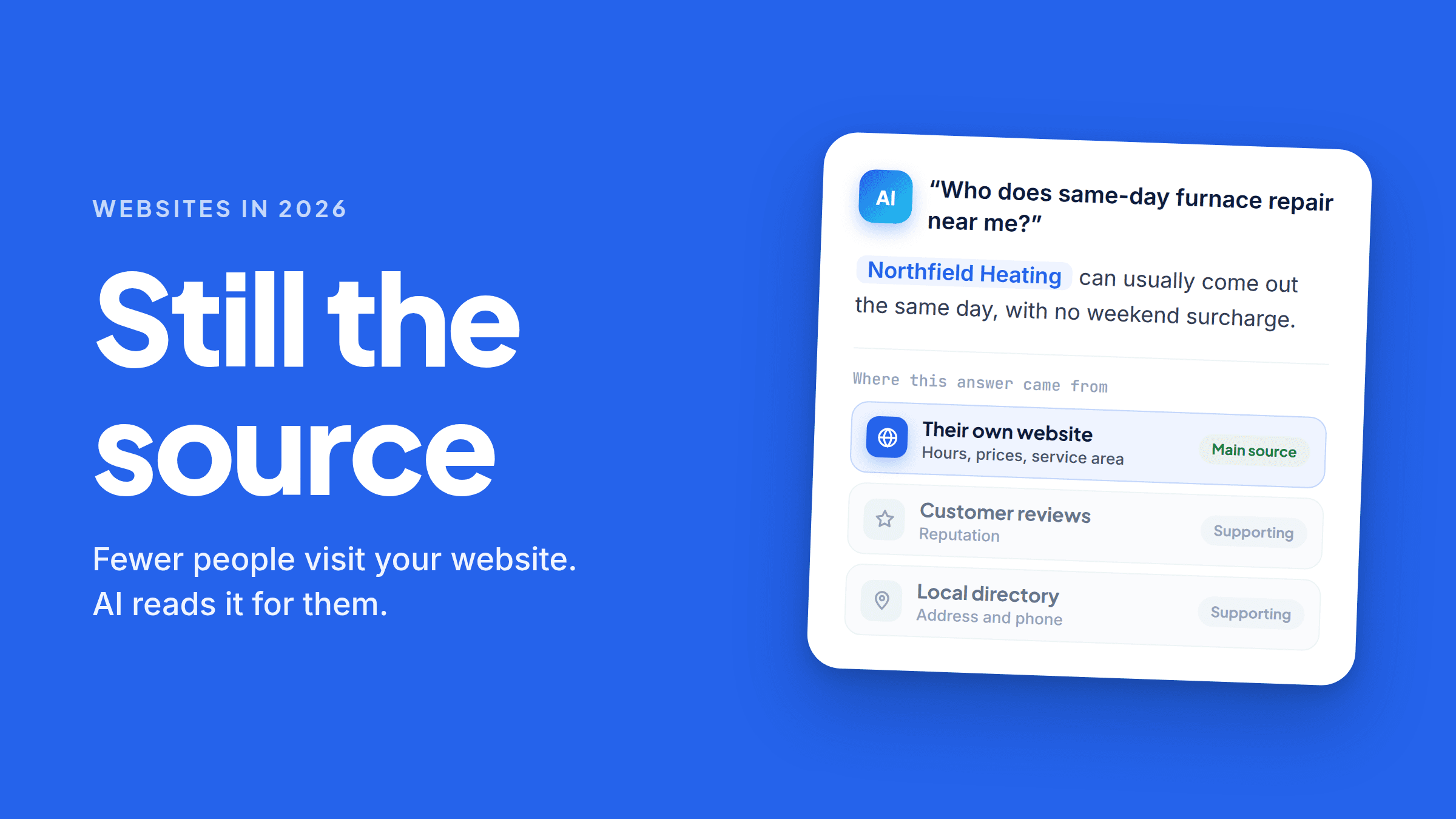
When someone asks an AI “who does same-day furnace repair near me,” the AI doesn’t make up an answer. It builds one from what it can find and read about local businesses.
That’s where your website comes in.
Your website is the one place on the internet where you decide what it says. Your services. Your service area. Your hours. Your prices. What makes you different. Written in your words, as detailed as you want.
An AI that can read all of that has something solid to work with. It can say “they come out the same day and don’t charge extra on weekends,” because you told it so.
An AI that can’t find that has to guess, or skip you. And when it skips you, the customer doesn’t go without an answer. They get your competitor’s name instead.
“Can’t I just use Facebook and Google?”
Keep them. They help. Reviews, your Google Business Profile, and directory listings all feed into what AI knows about you.
But they have limits your website doesn’t:
You don’t own them. The platform sets the rules, the layout, and what shows up. That can change any time.
They hold less. A profile has a few fixed boxes. It usually can’t hold a clear answer to “do you work on older oil furnaces?” or “what does a service call cost?”
Some of it is hard for AI to read. A lot of social media content sits behind a login or loads in ways crawlers can’t see. What’s easy for a person to scroll isn’t always easy for a machine to read.
Think of it this way. Your profiles are what other places say about you. Your website is your own statement. AI uses both, but only one of them is fully up to you.
It’s also where customers double-check you
Even when AI names you, many people take one more step before they call. They look you up.
If they find a clear, current website, that confirms the recommendation. If they find nothing, a broken page, or hours from 2019, they go back and try the next name on the list.
So your website now has two readers. The AI, which decides whether to mention you. And the customer, who decides whether to trust that mention. Both need to find the same clear story.
What a website needs to do now
The good news: this doesn’t mean you need a bigger or fancier site. In most cases, you need a clearer one.
Answer the questions people actually ask. “Do you do same-day?” “What does it cost?” “Do you cover my town?” Put a direct answer to each one on your site. Answers get picked up by AI. Slogans don’t.
Be specific. “Quality service you can trust” tells AI nothing. “Licensed techs, same-day furnace repair, no weekend surcharge” is a sentence it can repeat.
Make sure AI can read it. This is the one most people miss. Some FAQ widgets and page builders load text using JavaScript, and AI crawlers generally don’t run JavaScript. The page looks fine to you and shows up blank to them. Your key answers need to be plain text in the page itself.
Let AI crawlers in. Your site has a small file called robots.txt that tells bots what they can visit. Some sites block AI crawlers by accident. If they’re blocked, nothing else on this list matters.
Keep it current. Old hours and old prices hurt twice. AI may repeat them, and customers who notice will trust you less.
What about SEO?
SEO still matters. It’s the foundation. A site that loads fast, is easy to use, and ranks in regular search is still worth having, and it helps with everything above.
Getting cited by AI, often called AEO — answer engine optimization — is the next floor up. It builds on a good site. It just adds a new question to ask: when an AI answers a question about my kind of business, can it find me, and does it say my name?
Where FaqFlo comes in
FaqFlo helps your website do its new job.
It checks whether AI can actually read your site. It finds the questions people ask AI about businesses like yours. It helps you write clear, specific answers, and gives you clean HTML you paste onto your own website, so the credit goes to you. Then it tracks whether you start showing up in AI answers over time.
Your website isn’t dead. It just has a new reader. FaqFlo makes sure that reader finds something worth repeating.
Want to know whether AI can read your site right now? Start with FaqFlo’s free check.
Frequently asked questions
Do small businesses still need a website in 2026?
Yes. Even if fewer people visit it, AI tools read websites to decide which businesses to recommend. Your website is the one place you fully control what they learn about you.
Can a Google Business Profile replace my website?
Not fully. Your profile is important and you should keep it up to date, but it only holds a few fixed details. Your website can answer the specific questions customers ask, which gives AI much more to work with.
Why would AI recommend my competitor instead of me?
Usually because it found clear, readable information about them and not about you. AI builds answers from what it can read. If your services, area, and prices aren’t clearly written on your site, you’re harder to recommend.
How can I tell if AI can read my website?
Check whether your key text shows up without JavaScript and whether your robots.txt file lets AI crawlers in. FaqFlo’s free audit checks both for you. You can also ask ChatGPT or Google a question a customer would ask and see if your name comes up.
Do I need a brand-new website to show up in AI answers?
Usually not. Most sites just need clearer answers to real customer questions, written as plain text AI can read. Adding a well-written FAQ section to the site you already have is often the fastest fix.

Written by
Beau
👋 Hi, I’m Beau. I’ve spent almost 20 years in marketing — long enough to watch the whole game change more than once. I was there when SEO was the answer, then social, then content, and now the biggest shift yet: people asking AI instead of Googling. Somewhere along the way I got tired of watching good small businesses do everything “right” and still stay invisible to the tools that increasingly decide who gets found. That’s why I built FaqFlo — my mission is to help you grow your business in the modern world of AI, so you become the answer, not just another link nobody clicks.
Looking for something else?
Search the archive by title, summary, or the questions a post answers.