 Beau
BeauWhat Is llms.txt and Do You Actually Need One?
A small file with a lot of hype around it. Here’s the honest answer.
If you’ve been anywhere near a marketing newsletter lately, someone has told you your site needs an llms.txt file. Usually with some urgency. Sometimes with a link to buy a generator.
So let’s do this plainly. What it is, what it does, and whether you should care — including the part most articles about it leave out.
What it is
llms.txt is a plain text file you put at the root of your website, like yoursite.com/llms.txt.
Inside, you write a short, human-readable map of your site: what your business is, and links to the
pages that matter most, with a line describing each.
That’s it. It’s a text file. You can write one in a notepad app.
The idea is straightforward. AI assistants have a limited window of attention. Your website is full of navigation, cookie banners, footers, and menus that mean nothing to a machine. llms.txt is a way of saying: here’s the signal, skip the noise.
If you’ve ever seen a robots.txt file, it’s a cousin of that. But robots.txt tells crawlers what they can’t touch. llms.txt suggests what they should pay attention to.
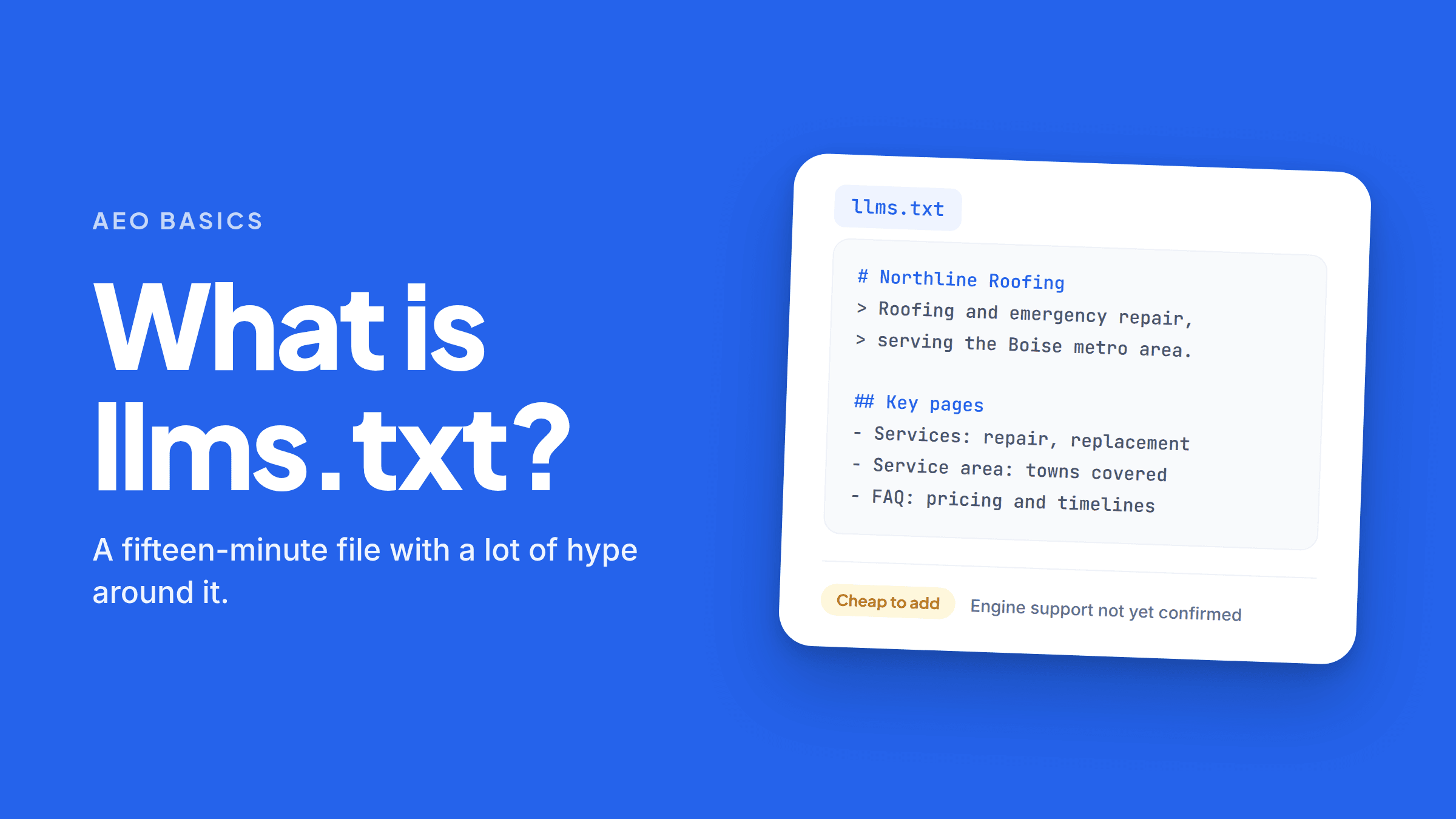
A simple one looks roughly like this:
# Northline Roofing

> Residential roofing and emergency repair serving the Boise metro area.

## Key pages
- [Services](https://example.com/services): Roof repair, replacement, and same-day tarping.
- [Service area](https://example.com/areas): Towns and neighborhoods we cover.
- [FAQ](https://example.com/faq): Pricing, timelines, insurance, and warranty questions.
Clean, short, obvious.
The honest verdict: it probably isn’t doing much yet
Here’s the part the hype skips.
llms.txt is a proposal, not a standard. It was suggested by a developer in 2024 and picked up quickly among people who build with AI. What it does not have is confirmed, widespread support from the big answer engines. Google has publicly been lukewarm at best. The major assistants have not committed to reading it. There’s no verified case of a small business getting cited because of an llms.txt file.
So when someone tells you this file is why you’re invisible to AI, they’re overselling it.
But — and this matters — it costs you about fifteen minutes and it can’t hurt. It’s a text file. It doesn’t slow your site down, it doesn’t break anything, and if support does firm up, you’re already done. That’s a reasonable bet at that price.
Just don’t confuse it with the thing that actually matters.
What actually matters more
If you only have an hour to spend on being found by AI, do these first, in this order.
-
Make sure your content is readable without JavaScript. This is the big one and it sinks more small businesses than anything else. Most FAQ plugins and accordion widgets build their answers with JavaScript after the page loads. AI crawlers generally don’t run JavaScript — they grab the raw HTML and move on. So your best content looks perfect to visitors and simply doesn’t exist to the engines. An llms.txt pointing at a page the crawler can’t read is a map to an empty room.
-
Make sure crawlers are allowed in. Check your robots.txt. A surprising number of sites block GPTBot, ClaudeBot, PerplexityBot, or Google-Extended without the owner ever deciding to — it came with the theme, or a developer added it years ago as a blanket rule.
-
Actually answer the questions. Prices, service area, hours, timelines, what you don’t do. In plain sentences, on your own domain. This is the raw material an AI builds a recommendation out of. No file format substitutes for having something to say.
-
Then, sure, write an llms.txt. Fifteen minutes. Cheap insurance.
Notice that the first three are just good website hygiene. That’s the theme here. Traditional SEO built the foundation — a healthy, crawlable, well-organized site. Answer Engine Optimization is the next floor up, and it’s built out of the same materials. There isn’t a magic file that skips the construction.
How to write one, if you want to
Keep it short and specific.
- Start with your business name as a heading, then one line saying what you do and where.
- List 5–10 links to your genuinely most important pages, each with a short plain-English description.
- Use your real service area and real specialties in the wording — not marketing language.
- Save it as
llms.txtand upload it to the root of your site, so it loads atyoursite.com/llms.txt. - Check it loads in a browser. If you get a 404, it’s in the wrong folder.
Don’t stuff it with keywords, don’t list every page you have, and don’t describe pages as more important than they are. The value of the file is that it’s honest and short.
Where FaqFlo comes in
FaqFlo generates your llms.txt automatically — but it treats it as the last step, not the first, because that’s the order that actually gets results.
Before that, it checks whether AI crawlers can read your site at all, whether they’re allowed in, and which questions people are asking about businesses like yours that you don’t currently answer. Then it gives you those answers as crawlable HTML for your own domain and tracks whether the engines start naming you.
The file is easy. Having something worth pointing the file at is the work.
Frequently asked questions
What is an llms.txt file?
It’s a plain text file at the root of your website that gives AI systems a short, readable summary of your business and links to your most important pages. Think of it as a suggested table of contents written for machines rather than visitors.
Do ChatGPT and Google actually read llms.txt?
There’s no confirmed, broad support from the major answer engines today, and Google has been publicly unenthusiastic about it. It’s a community proposal that may or may not become standard, so treat it as a cheap bet rather than a requirement.
Is llms.txt the same as robots.txt?
No. robots.txt tells crawlers which parts of your site they’re not allowed to access, and it is widely respected. llms.txt is a newer, optional suggestion about which content is most useful, and support for it is far from universal.
Will an llms.txt file get my business cited by AI?
On its own, almost certainly not. Citations come from having clear, factual, crawlable content that answers real customer questions — the file just points at that content, so it’s worthless if the content isn’t there.
Where do I put the llms.txt file?
At the top level of your domain, so it opens at yoursite.com/llms.txt. Most website builders have a way to upload a file to the root or add a custom route; if it returns a “page not found,” it isn’t in the right place.

Written by
Beau
👋 Hi, I’m Beau. I’ve spent almost 20 years in marketing — long enough to watch the whole game change more than once. I was there when SEO was the answer, then social, then content, and now the biggest shift yet: people asking AI instead of Googling. Somewhere along the way I got tired of watching good small businesses do everything “right” and still stay invisible to the tools that increasingly decide who gets found. That’s why I built FaqFlo — my mission is to help you grow your business in the modern world of AI, so you become the answer, not just another link nobody clicks.
Looking for something else?
Search the archive by title, summary, or the questions a post answers.