 Beau
BeauThe 7 Pages Every Service Business Website Needs
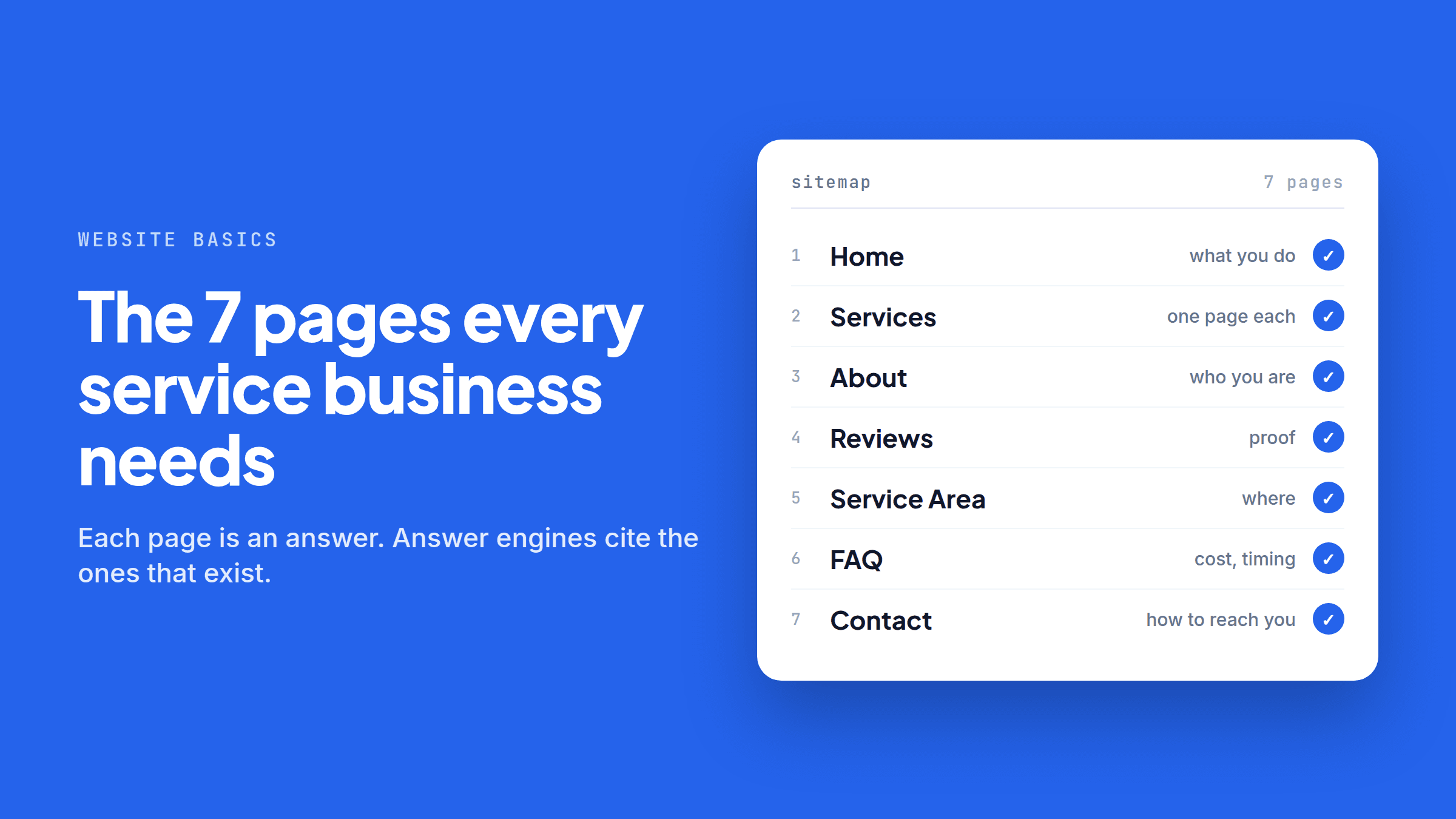
Every service business website needs seven pages: Home, one page per service, About, Reviews, Service Area, FAQ, and Contact. Most sites are missing at least two of them.
A missing page is a missing answer. Customers can’t find it. Google can’t rank it. AI answer engines like ChatGPT, Perplexity and Google’s AI can’t cite it.
Here’s what each page does, and how the same seven pages set you up to get cited by AI.
Why pages matter
Your website is a set of answers. Each page is where one answer lives.
Someone asks, “Who replaces water heaters in Dover, NH?” That needs a service page and a service area page. “Are they any good?” That’s your reviews page. “What does it cost?” That’s your FAQ.
No page, no answer. The customer, and the AI, move on to a site that has one.
1. Home
Your home page says what you do, where you do it, and how to get in touch. All three, in the first screen.
Skip the slideshow. Skip “Welcome to our website.” Write the headline like a plain sentence: “Residential plumbing repair in the Seacoast, NH.” Then your phone number and a button.
2. One page per service
This is the page most businesses skip. They list every service on one page and call it done.
Every service you want to be found for needs its own page. Water heater replacement gets a page. Drain cleaning gets a page. Furnace repair gets a page.
Each service page should cover:
- What the service is, in plain words
- Who it’s for and when you need it
- What the process looks like
- A price range, or what changes the price
- How to book it
One service per page means one clear answer per page. Search engines and answer engines both want that.
3. About
People hire people. Your About page shows who’s behind the business.
Keep it real. How long you’ve been doing this. Who’s on the team. Your licenses and insurance. Why you started. Real photos of real people beat stock photos every time.
4. Reviews
Put your best reviews on your own site, on their own page. Don’t just link to Google.
This is your proof page. When someone asks, “Can I trust this company?” this is the answer. It works best alongside a steady flow of new Google reviews — the page on your site is the version an AI can read directly.
5. Service Area
List the towns you serve by name. Not “the greater metro area.” The actual towns.
If you serve a lot of towns, group them by region. If a few towns are your bread and butter, give each one a short page of its own. That’s how you show up for “plumber in Portsmouth” and “plumber in Exeter” instead of neither.
6. FAQ
Your FAQ page answers the questions you get on the phone all day. How much does it cost? Do you offer emergency service? Are you licensed and insured? How fast can you come out?
Write the question the way a customer says it. Answer it in two or three sentences. Don’t dodge pricing. “Most water heater replacements run $1,800 to $3,200 depending on size and fuel type” is an answer. “Call for a quote” is not. (Use your own numbers — a price borrowed from an example is a promise you didn’t make, and an AI will repeat it exactly.)
7. Contact
Phone, email, address, hours, and a short form. Keep your phone number in the header of every page, but still have a Contact page. It’s where people go once they’ve decided. It’s also a good place for a short FAQ — the four or five questions people ask right before they reach out.
How these pages set up AEO
SEO is the foundation. These seven pages, with clear headings and plain text, are what get you ranked in regular search. That hasn’t changed.
AEO (answer engine optimization) is the next floor up. Answer engines don’t show a list of links. They give one answer and cite a few sources. To be a source, your site has to hold the answer in a form the engine can read and trust.
Each page does one part of that job.
Service pages answer “what.” Someone asks an AI, “What’s involved in replacing a sump pump?” The engine looks for a page that explains it plainly. A bulleted list on a generic Services page gives it nothing to cite. A real sump pump page does.
Service Area pages answer “where.” Answer engines get asked local questions all day: “Who does furnace repair near Hampton, NH?” If the town name isn’t on your site in plain text, you’re not in the running.
About and Reviews answer “who” and “can I trust them.” Licenses, years in business, named team members, and real reviews on your own domain all help an engine decide you’re safe to recommend.
The FAQ page answers everything else. This is the most citable page on any service website. It’s questions and answers, the same format the engine uses. Ask an assistant “How much does drain cleaning cost?” and it pulls from pages that state a number.
Contact answers “how do I reach them.” Your name, address, and phone should match across every page and your Google Business Profile. That tells engines you’re one real business.
Two rules that make it work
Rule 1: The text has to be in real HTML. Many website builders load FAQ accordions, review widgets, and service lists with JavaScript after the page opens. AI crawlers don’t run JavaScript. If your answers only show up after a script runs, the engine sees a blank page. Your answers need to be in the page’s static HTML.
Rule 2: Answer first, explain second. Put the direct answer in the first sentence under each heading. Add detail after. Engines grab the first clear statement they find. Bury it in paragraph four and they grab it from someone else.
What to do this week
- Count your services. Count your service pages. If the numbers don’t match, that’s your first job.
- Write down the ten questions you answer on the phone most. That’s your FAQ page.
- Search your site for your town names. If nothing comes up, build the Service Area page.
- Check your Reviews page. If it’s just a link to Google, bring the reviews onto your site.
You don’t need a redesign. You need the right pages with plain answers on them.
Frequently asked questions
Do I really need a separate page for every service?
Yes, for every service you want to be found for. One page per service gives search engines and answer engines one clear topic to rank or cite. A single page that lists everything ranks for nothing in particular.
How long should each service page be?
Long enough to answer what it is, who it’s for, what happens, and what it costs. That’s usually 400 to 800 words. Clear beats long.
Should I put prices on my website?
Put ranges. Customers and answer engines both want a number. A range with a short note on what changes the price beats “call for a quote” every time.
What’s the difference between SEO and AEO?
SEO gets your pages ranked in a list of search results. AEO gets your pages cited inside the single answer an AI engine gives. You need SEO first. AEO builds on top of it using the same pages.
My FAQ is on my site but AI tools never mention it. Why?
The most common cause is that the FAQ loads with JavaScript, so AI crawlers can’t see it. View your page source. If the questions and answers aren’t in the raw HTML, the engines are looking at an empty page.

Written by
Beau
👋 Hi, I’m Beau. I’ve spent almost 20 years in marketing — long enough to watch the whole game change more than once. I was there when SEO was the answer, then social, then content, and now the biggest shift yet: people asking AI instead of Googling. Somewhere along the way I got tired of watching good small businesses do everything “right” and still stay invisible to the tools that increasingly decide who gets found. That’s why I built FaqFlo — my mission is to help you grow your business in the modern world of AI, so you become the answer, not just another link nobody clicks.
Looking for something else?
Search the archive by title, summary, or the questions a post answers.