 Beau
BeauHow to Get More Google Reviews (and Why It Matters More Than Ever)
Reviews used to win you the click. Now they help decide whether an AI says your name at all.
Ask a business owner what their reviews are for and most will say the same thing: “So people trust us.” True. But that’s only half the job now.
When someone asks ChatGPT or Google’s AI “who’s a good roofer near me,” the answer doesn’t come from a ranking. It comes from whatever the AI can read about you and believe. Your Google reviews are one of the biggest piles of that evidence, and they’re written by people who aren’t you, which is exactly why an AI takes them seriously.
So let’s cover two things. First, how to actually get more reviews without being weird about it. Second, why those reviews are quietly doing AEO work for you, whether you planned it or not.
First, get your Google Business Profile ready
Before you ask a single customer, make sure the profile they’re about to review is worth reviewing.
Claim and verify it. If you haven’t, go to your Google Business Profile and complete verification. You can’t reply to reviews on a profile you don’t own.
Fill in every field. Hours, service area, categories, phone, website, photos. A half-empty profile makes a reviewer hesitate and makes an AI unsure what you do.
Grab your review link. Google gives you a short link that drops the customer straight into the review box — look for the option to ask for reviews in your profile dashboard. Save it somewhere you can copy it in two seconds. This link is the whole game.
How to ask for reviews (the part that actually works)
Most businesses have plenty of satisfied customers and very few reviews. The gap isn’t satisfaction. It’s that nobody asked, or they asked at the wrong time, or they made it a chore.
Ask at the peak moment. For a service business, that’s when the job is done and the customer is standing there saying thanks. For a store, it’s after the product arrives and they’ve had a few days with it. For a professional service, it’s when the problem is solved, not when the invoice goes out. Timing is about catching people when the work is fresh — not about picking who to ask. More on that distinction below, because Google cares about it.
Ask in person, then follow up by text. “Would you mind leaving us a Google review? I’ll text you the link right now.” Then actually text it while you’re still in the driveway. A verbal ask plus an instant link converts far better than either one alone.
Make it one tap. Send the direct review link. Not “search for us on Google.” Not “go to our website and find the button.” One link, one tap, review box open.
Keep the message short and human. Something like: “Hi Dana, thanks again for having us out today. If you have 60 seconds, a Google review really helps a small business like ours: [link]. Thank you!” No pitch, no pressure — and note that it doesn’t ask how they felt about the job first.
Put the link everywhere a customer already is. Email signatures. The bottom of invoices and receipts. A QR code on the counter, the truck, the takeout bag, the thank-you card in the box. The point is to lower the effort to almost zero.
Give a nudge on what to say. People freeze at a blank box. “If you mention what we did and which town you’re in, it helps other folks find us” produces a much better review than “leave us a review.” (This matters for AEO too, and we’ll get there.)
Follow up once. If they said yes and didn’t do it, one friendly reminder a few days later is fine. Two is nagging.
Make it a habit, not a campaign. A burst of 30 reviews in one week followed by silence looks odd to Google and to customers. A steady trickle, a few every week, looks like a real business with real customers.
What not to do
A few things that feel like shortcuts and end up costing you.
Don’t pay for reviews or offer discounts for them. It’s against Google’s policies and the reviews tend to get filtered anyway.
Don’t review-gate — and the bar is lower than you think. Review gating means screening customers by how happy you expect them to be, then only sending the review link to the ones you like the look of. Google updated its Maps review policy in April 2026 and now actively enforces this: gated reviews can be removed and the profile itself penalised. The bar is lower than most people realise — even “if you enjoyed your experience, please leave us a review” can read as gating, because it quietly excludes everyone who didn’t. Ask everyone, and ask the same way.
Don’t write them yourself, or have your cousin do it. Fake reviews get caught, and a profile full of five-star reviews with no detail reads as fake to humans and machines alike.
Don’t ignore the bad ones. A calm, specific reply to a negative review is often more persuasive than ten positive reviews, because it shows how you handle a problem.
Reply to every review
This is the step most businesses skip, and it’s the cheapest one.
Reply to every review, good or bad, within a day or two. Thank people by name. Mention the specific job or product. Keep it short.
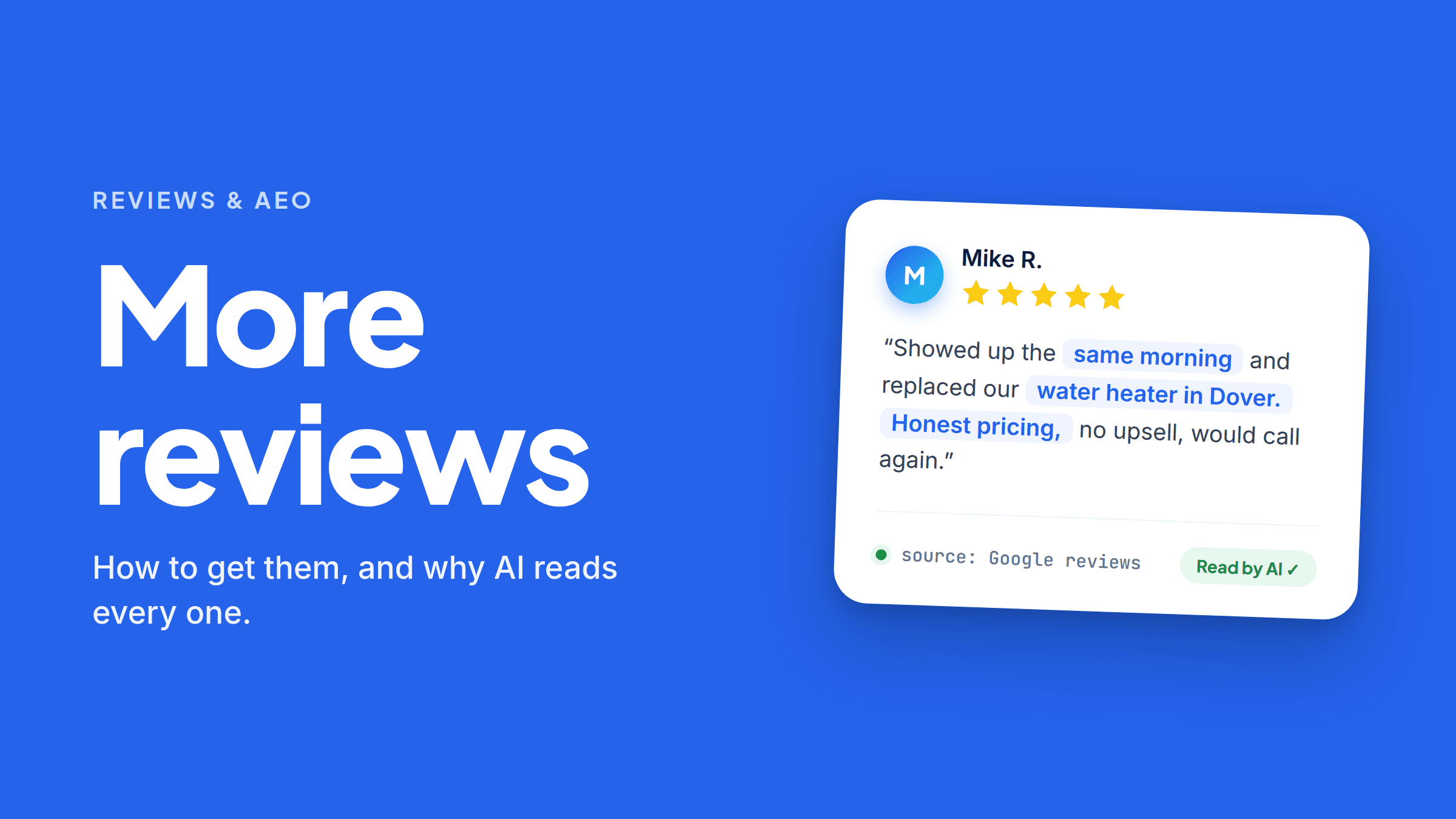
Replying does three things. It tells the next customer you pay attention. It tells Google the profile is active. And it gives you a chance to add the specific, factual details an AI can read: “Thanks, Mike. Glad the same-day water heater replacement in Dover worked out.” Now that reply says what you do and where you do it, in plain words, on a page everyone trusts.
Why reviews matter for local SEO
Reviews have been a core local ranking signal for years. Google documents three factors behind local results — relevance, distance and prominence — and says review count and review score feed directly into prominence. Freshness isn’t something Google spells out the same way, but every local practitioner will tell you a steady flow beats a stale pile.
That’s the foundation, and it still matters. But there’s a floor above it now.
Why reviews matter for AEO
AEO, or answer engine optimization, is about being the business an AI names when someone asks a question you could answer. Here’s where reviews fit.
An AI needs evidence, and reviews are evidence it didn’t have to take your word for. Your website says you’re reliable. Two hundred strangers saying “showed up on time, fixed it, didn’t upsell” is a different kind of proof. Answer engines lean on outside sources when deciding who to recommend, and your Google profile is one of the most consistently readable ones.
Themes beat individual reviews. This is the part worth being precise about, because it changes what you ask for. Assistants generally don’t read all two hundred of your reviews — they work from summaries, star ratings, and whatever snippets happen to be visible on pages they can crawl. So no single glowing review is going to carry you. What surfaces is the pattern: if forty people independently mention same-day service in Portsmouth, that becomes something an AI can say about you. That’s why nudging customers to name the job and the town works — not because one sentence gets lifted, but because forty of them build a theme.
Recency signals you’re still in business. AI answers favour businesses that look current. A steady flow of new reviews says you’re open, active, and worth recommending this month, not three years ago.
Your replies are content too. Every reply you write is text on a trusted page, in your voice, with your details. Treat it that way.
Reviews and your own answers work together. Here’s the thing reviews can’t do alone: they’re scattered, they’re written in customers’ words, and they don’t answer the questions people actually type. “Do you offer financing?” “How fast can you get here?” “Do you cover my town?” Those need clear answers on your own website, in plain HTML an AI can read. Reviews mostly help an AI choose between businesses it already knows about — they rarely get you into the conversation in the first place. Your own answers are what do that.
That’s the loop. Reviews prove you’re real. Your answers tell the AI exactly what you do. Together, they make you the easy name to say.
Where FaqFlo comes in
Reviews are your job. Nobody can ask your customers for you. But the other half — the clear answers on your site that an AI can quote — is the part FaqFlo handles. We find the questions people are actually asking AI about businesses like yours, write answer-first responses built to be quoted, give you crawlable HTML to paste on your own domain, and track whether ChatGPT, Perplexity and Gemini start naming you.
Get the reviews rolling this week. Then make sure the AI reading them can find your answers too.
Frequently asked questions
How many Google reviews do I need?
There’s no magic number, but more recent reviews beats a big old pile. A business with 40 reviews and a new one every week usually outperforms one with 200 reviews that stopped two years ago. Aim for a steady trickle rather than a one-time push.
Is it okay to ask customers for Google reviews?
Yes. Google allows you to ask, and even gives you a direct link for it. What you can’t do is pay for reviews, offer discounts in exchange, or only ask the customers you expect to be happy — that last one is review gating, and Google has actively enforced against it since its April 2026 policy update.
Should I reply to negative reviews?
Always, and calmly. A short, specific reply that acknowledges the issue and says what you did about it shows future customers and AI engines how you handle problems. Never argue in the reply; take the details offline.
Do Google reviews help me show up in ChatGPT and other AI answers?
They help, mostly by giving an AI reason to pick you over a similar business. Assistants tend to work from review summaries, ratings and visible snippets rather than reading every review, so a consistent theme across many recent reviews matters more than any single one. They work best alongside clear, crawlable answers on your own website, which is where the AI learns exactly what you offer.
What’s the best way to get customers to actually leave the review?
Ask right after the work is done, then text the direct review link straight away. Keep the message short, suggest they mention the service and their town, and send one reminder if needed. Most of the gap between satisfied customers and actual reviews is just friction.

Written by
Beau
👋 Hi, I’m Beau. I’ve spent almost 20 years in marketing — long enough to watch the whole game change more than once. I was there when SEO was the answer, then social, then content, and now the biggest shift yet: people asking AI instead of Googling. Somewhere along the way I got tired of watching good small businesses do everything “right” and still stay invisible to the tools that increasingly decide who gets found. That’s why I built FaqFlo — my mission is to help you grow your business in the modern world of AI, so you become the answer, not just another link nobody clicks.
Looking for something else?
Search the archive by title, summary, or the questions a post answers.