 Beau
BeauRanking the Best AI Platforms for Your Business
Not which one you should use. Which ones are already recommending your competitor.
Most “best AI platform” lists answer a question you didn’t ask: which chatbot should you type into.
That’s a fine question if you’re picking a writing assistant. It’s the wrong one if you run a business. The version that actually costs you money is this: when a customer asks an AI which company to call, which platforms are giving the answer — and are you in it?
That’s a ranking you can build from real numbers. So here it is, ordered by how much of your customer’s decision passes through each one, with the data behind every placement.
First, an honest note about the data
Two respected trackers can’t agree on the basics. StatCounter had ChatGPT at roughly 77% of worldwide AI chatbot web visits in June 2026, with Gemini and Perplexity around 8% each. Similarweb data for May 2026 put ChatGPT at about 54% and Gemini at nearly 28%.
Both are correct. They’re measuring different things — different domains, different devices, different definitions of “an AI chatbot.” App usage adds anywhere from 15% to 60% on top of web visits depending on the assistant, and Google’s AI shows up inside a search results page where nobody counts it as a “chatbot visit” at all.
So treat the order below as directional, not decimal-precise. The gaps that matter here are big enough to survive the disagreement.
1. ChatGPT
The one your customers mean when they say “I asked AI.”
OpenAI last officially confirmed 900 million weekly active users in February 2026, and the app crossed a billion monthly users in June 2026 — the fastest app in history to get there, per Sensor Tower data reported by Reuters. By late July, The Information reported weekly actives approaching a billion too.
But scale isn’t the reason it’s first. Referrals are. Conductor put ChatGPT at 87.4% of average AI referral traffic across industries. eMarketer’s coverage of Grips Intelligence data went higher still, at 92.2%. Whatever the exact figure, when someone clicks through to a business from an AI answer, it’s usually ChatGPT that sent them.
The catch: ChatGPT is stingy with citations. It averages fewer sources per answer than its rivals — roughly 7, versus around 12 for Google AI Overviews — and it leans hard on encyclopedic and editorial sources. In one analysis of 680 million citations, Wikipedia alone accounted for 47.9% of its top-10 source share. Fewer slots means each one is worth more, and harder to win.
2. Google’s AI surfaces — AI Overviews, AI Mode, and Gemini
Bigger reach than anything else. Just harder to see.
At Google I/O in May 2026, Sundar Pichai put AI Overviews above 2.5 billion monthly users and AI Mode past 1 billion. The standalone Gemini app reported over 950 million monthly actives at Alphabet’s Q2 2026 earnings, up from 750 million at the end of 2025.
For a local business, this may genuinely be number one. Whitespark found AI Overviews appearing on about 68% of local business queries in 2026 — versus 39% for the traditional local pack. And Ahrefs’ analysis of 300,000 keywords found that when an AI Overview appears, clicks to the #1 organic result drop by 58%.
Read that twice. Ranking first is worth substantially less than it was, on the exact queries where local businesses live.
The catch: Google’s AI reach is enormous but the traffic is nearly invisible in your analytics, because it’s folded into ordinary Search reporting. Big influence, faint footprint.
3. Perplexity
Small audience. Loud citations.
Perplexity is nowhere near the top on users — figures range from around 45 million monthly actives on the core product to 100 million-plus across everything it now sells. On web visit share it sits in the low single digits.
It punches far above that for one reason: it cites more than anyone. Depending on the dataset, Perplexity shows somewhere between 16 and 22 sources per answer, roughly triple ChatGPT. In one 34,000-response study, Perplexity mentioned brands 13.05% of the time while ChatGPT managed 0.59%.
The catch: its source diet is unusual. Reddit alone made up 46.7% of Perplexity’s top-10 citation share in Profound’s data. Winning here has as much to do with being discussed by real people as with what’s on your own site.
4. Microsoft Copilot
Low consumer share, serious workplace distribution.
Copilot barely registers on public chatbot rankings — around 1–4% depending on the tracker. But it reaches roughly 420 million monthly users through Microsoft 365, with about 20 million paid seats as of Q3 FY2026. That’s a lot of people asking questions from inside Word and Outlook, on the clock.
There’s an eye-catching data point here: Microsoft Clarity studied 1,277 domains and found Copilot referrals converting at 17 times the rate of direct traffic. Tiny volume, unusually serious intent.
Priority: high if you sell to businesses. Low if you’re a bakery.
5. Claude
The one moving fastest in B2B referrals.
Claude sits in the low-to-mid single digits on most consumer trackers, but it’s the only line trending decisively upward in business referral data. One tracking wave measured its share of B2B AI referrals rising from 11.8% to 18.5% between waves, with a single-month reading of 27.2% in April 2026.
It’s also unusually generous to brands’ own websites. Slate HQ tracked 300,000+ citations across six B2B brands and found Claude gave the highest share of citations to a brand’s own content, at 9.1% — ahead of Perplexity at 6.8%, with ChatGPT consistently the least brand-friendly.
Priority: worth watching if you sell software, services, or anything with a professional buyer.
6. Grok and Meta AI — not yet
Meta AI reported 1.2 billion monthly users across Meta’s apps in Q1 2026, which sounds like it belongs at the top. It doesn’t, for your purposes: those are largely people bumping into an assistant inside Instagram and WhatsApp, not asking for a contractor recommendation and clicking out to a website. Grok sits around 2.4% of web share and is heavily bundled with X Premium.
Neither is a meaningful referral source for a small business today. Revisit in a year.
The finding that should change your plan
Here’s the part that surprises people, and it matters more than the order above.
These platforms barely overlap. A study of 161,286 prompts in May–June 2026 found the major engines shared only about 17% of their cited sources for the same question — and just 3.8% of sources were cited by all of them. Separate analysis of 680 million citations found only 11% domain overlap between ChatGPT and Perplexity.
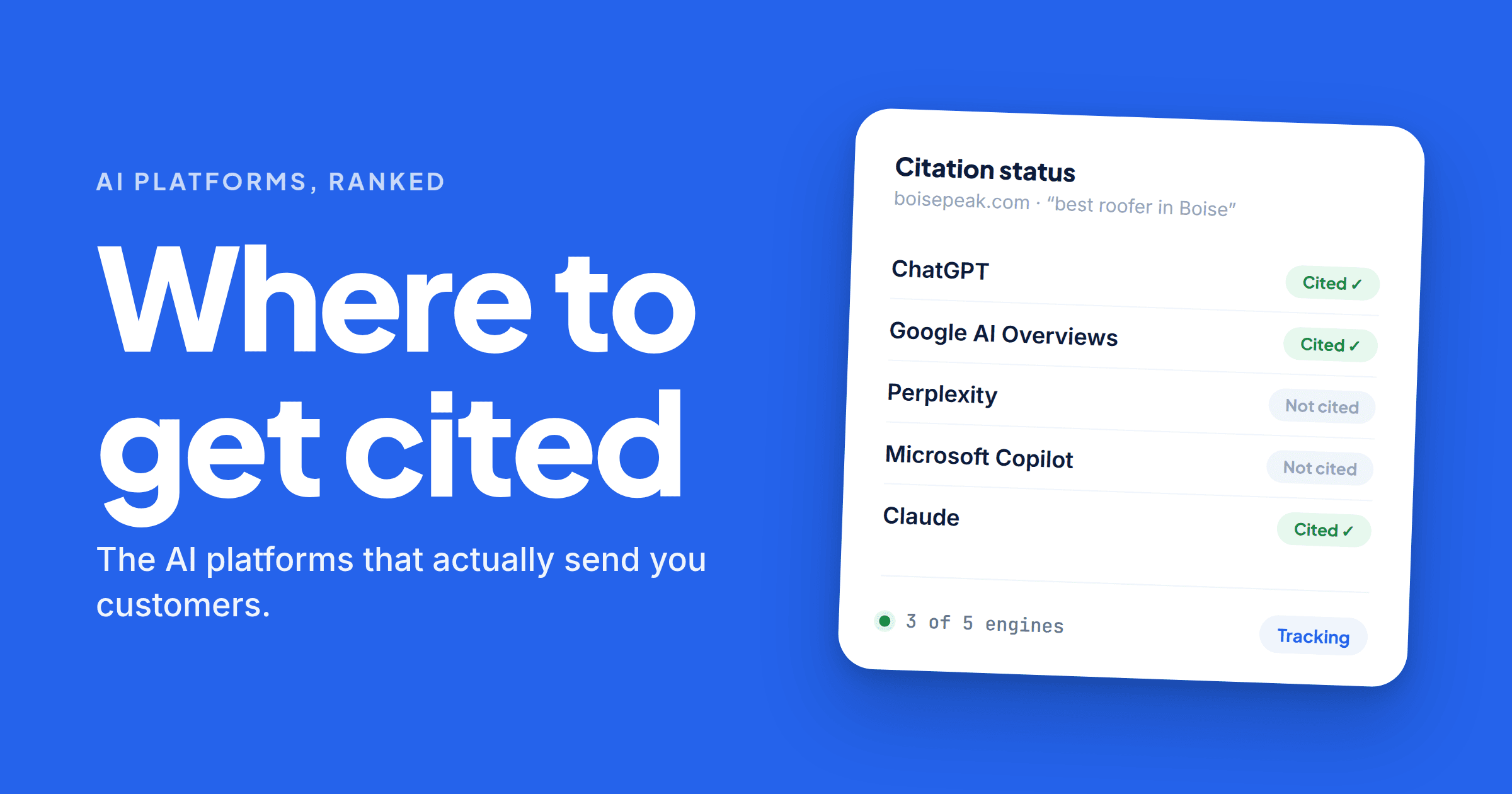
So “am I visible in AI?” isn’t one question with one answer. You can be the top recommendation in Perplexity and completely absent from ChatGPT, for the same query, on the same day. Checking one engine and assuming the rest look similar is like checking your Google ranking and assuming it tells you about Bing.
What works on every one of them
The platforms diverge. The fundamentals don’t.
People are already doing this. BrightLocal’s 2026 survey of 1,002 US adults found 45% had used an AI tool to find a local business in the past year — up from 6% the year before. That makes AI the third most-used local discovery channel, behind only Google and Facebook, ahead of Yelp and Tripadvisor. In the same window, Google’s share of review discovery fell from 83% to 71%.
And the traffic is good traffic. Adobe Digital Insights found AI-referred visitors to US retail sites converting 42% better than non-AI traffic in March 2026 — a channel that had converted 38% worse twelve months earlier. Those visitors also spent 48% more time on site and generated 37% more revenue per visit.
But almost nobody is set up for it. One estimate puts 88% of local businesses with no active strategy for appearing in AI results. In one measurement, ChatGPT surfaced just 1.2% of all local business locations.
Four things move the needle regardless of platform:
Answer the questions people actually ask. In plain language, the way a customer would type it, with a direct answer in the first sentence. Answers get quoted. Slogans don’t.
Be specific. “Committed to quality” is unquotable. “Licensed techs, same-day AC repair in Tampa, no after-hours surcharge” is a sentence an AI can lift straight into an answer.
Make it crawlable. This is the one that quietly sinks businesses. If your FAQ is rendered by a JavaScript widget, AI crawlers generally don’t run JavaScript — so it looks perfect to visitors and doesn’t exist to the engines. It has to be real HTML on your own domain, present the moment the page loads.
Mind the off-page half. One analysis of 23,000+ citations found roughly 77% of the sources cited in AI answers about a brand were off-page — directories, reviews, forums, video. Your reviews and your listings aren’t separate from AI visibility; they’re a large part of it.
One honest caveat while we’re here: Ahrefs tracked 1,885 pages adding schema in 2026 and found JSON-LD schema produced no measurable change in AI citations across AI Overviews, AI Mode and ChatGPT — its own summary is that “adding schema produced no major uplift in citations on any platform.” Schema is worth having for machine-readability and for search generally — but the plain, crawlable text is what does the actual work. Don’t let anyone sell you schema as the magic.
And remember the last step: Yext’s 2026 survey found that although about three-quarters of AI users rate their trust in AI local recommendations at 4 or 5 out of 5, only 5% go straight from AI answer to purchase. Most verify first — 53% search Google, 49% go to the business’s website. The AI hands them your name. Your site still has to close it.
Where FaqFlo comes in
You can’t chase six platforms by hand, and you shouldn’t have to.
FaqFlo finds the questions people are actually asking AI about businesses like yours, writes answers built to be quoted, publishes them as real crawlable HTML on your own domain — so the credit and the click come to you — and then tracks whether you’re starting to show up across ChatGPT, Perplexity, and Google’s AI answers over time.
That last part is the whole point of this article. Given how little the engines overlap, the only way to know whether AEO is working is to watch more than one of them.
The ranking above tells you where the attention is. Tracking tells you whether you’re in it.
Frequently asked questions
Which AI platform should my business focus on first?
ChatGPT, if you have to pick one — it sends the large majority of measurable AI referral traffic, with Conductor putting it at 87.4% across industries. But if you’re a local business, Google’s AI surfaces are at least a tie for first, since AI Overviews appear on roughly 68% of local business queries and reach over 2.5 billion monthly users.
Is ChatGPT bigger than Google’s AI?
It depends what you count. ChatGPT is the biggest standalone assistant, with 900 million weekly users officially confirmed in February 2026 and over a billion monthly app users by June. Google’s AI reaches more people overall — AI Overviews alone were reported above 2.5 billion monthly users — but that reach is spread across Search rather than a single chatbot.
Why do market share numbers vary so much between sources?
Because they measure different things. StatCounter tracks web referrals and had ChatGPT near 77% of AI chatbot visits in mid-2026; Similarweb-based figures for a similar period put it closer to 54%. Different domains, devices, and definitions produce very different answers. Use the numbers for direction, not precision.
If I’m visible in ChatGPT, am I visible everywhere?
No, and this is the most useful thing to know. A study of 161,286 prompts found the major engines shared only about 17% of their cited sources, with just 3.8% cited by all of them. Being the answer on one platform tells you almost nothing about the others.
Does AI traffic actually turn into customers?
Increasingly, yes. Adobe Digital Insights found AI-referred visitors to US retail sites converted 42% better than non-AI traffic in March 2026, having converted 38% worse a year earlier. They also spent more time on site and generated more revenue per visit. Volume is still small; quality is high.
Do I need to be on every platform?
You don’t optimize per platform so much as make yourself easy to quote everywhere. Clear questions, direct factual answers, real crawlable HTML on your own domain, and a healthy off-page presence do work across all of them. Then track which engines are actually citing you and put extra effort where the gap is.
How do I find out where I stand right now?
Ask each engine a few questions a real customer would ask and see whose names come back — that’s the rough version. The better version is tracking it across engines and questions over time, since answers shift as content and competitors change. That’s what FaqFlo does.

Written by
Beau
👋 Hi, I’m Beau. I’ve spent almost 20 years in marketing — long enough to watch the whole game change more than once. I was there when SEO was the answer, then social, then content, and now the biggest shift yet: people asking AI instead of Googling. Somewhere along the way I got tired of watching good small businesses do everything “right” and still stay invisible to the tools that increasingly decide who gets found. That’s why I built FaqFlo — my mission is to help you grow your business in the modern world of AI, so you become the answer, not just another link nobody clicks.
Looking for something else?
Search the archive by title, summary, or the questions a post answers.