 Beau
BeauWhy Getting Your Business Mentioned by AI Is a Great Referral
The best lead you ever got came from a person who said your name out loud. AI does the same thing — all day, to strangers.
Think about the best customer you got last year. Not the one who found you through an ad. The one who called and said, “My neighbor told me you fixed her water heater and didn’t try to sell her a new one.”
That call is different from every other call. You don’t have to explain who you are. They’re not price-shopping you against four other companies. They mostly just want to know when you can come out. The sale is halfway closed before you say hello.
That’s a referral. And a referral is the best lead in business — everybody who runs one already knows it.
Here’s the thing almost nobody has noticed yet: when someone asks ChatGPT “who’s good for X near me” and it names your business, you just got a referral. Same trust, same moment, same pre-sold customer. It just came from software instead of a neighbor.
What actually makes a referral so good
It’s worth being specific about this, because the reason a referral converts is the same reason an AI mention converts.
Someone else vouched for you. The trust transferred before you were involved. You didn’t have to build it, and it didn’t cost you anything.
The list was short. Your neighbor didn’t hand over ten options ranked by relevance. She named one company. Maybe two. Being on a list of two is a completely different business than being #6 on a list of ten.
The timing was already right. Nobody asks for a plumber recommendation for fun. They asked because they need one now. The lead arrives pre-qualified — real need, real intent, right now.
Nobody’s haggling. Referred customers negotiate less and churn less, because they didn’t arrive by comparison shopping. They arrived by trust.
Now go back and read those four again with “AI answer” in place of “neighbor.” They all still hold.
The AI answer is the same moment — it just scales
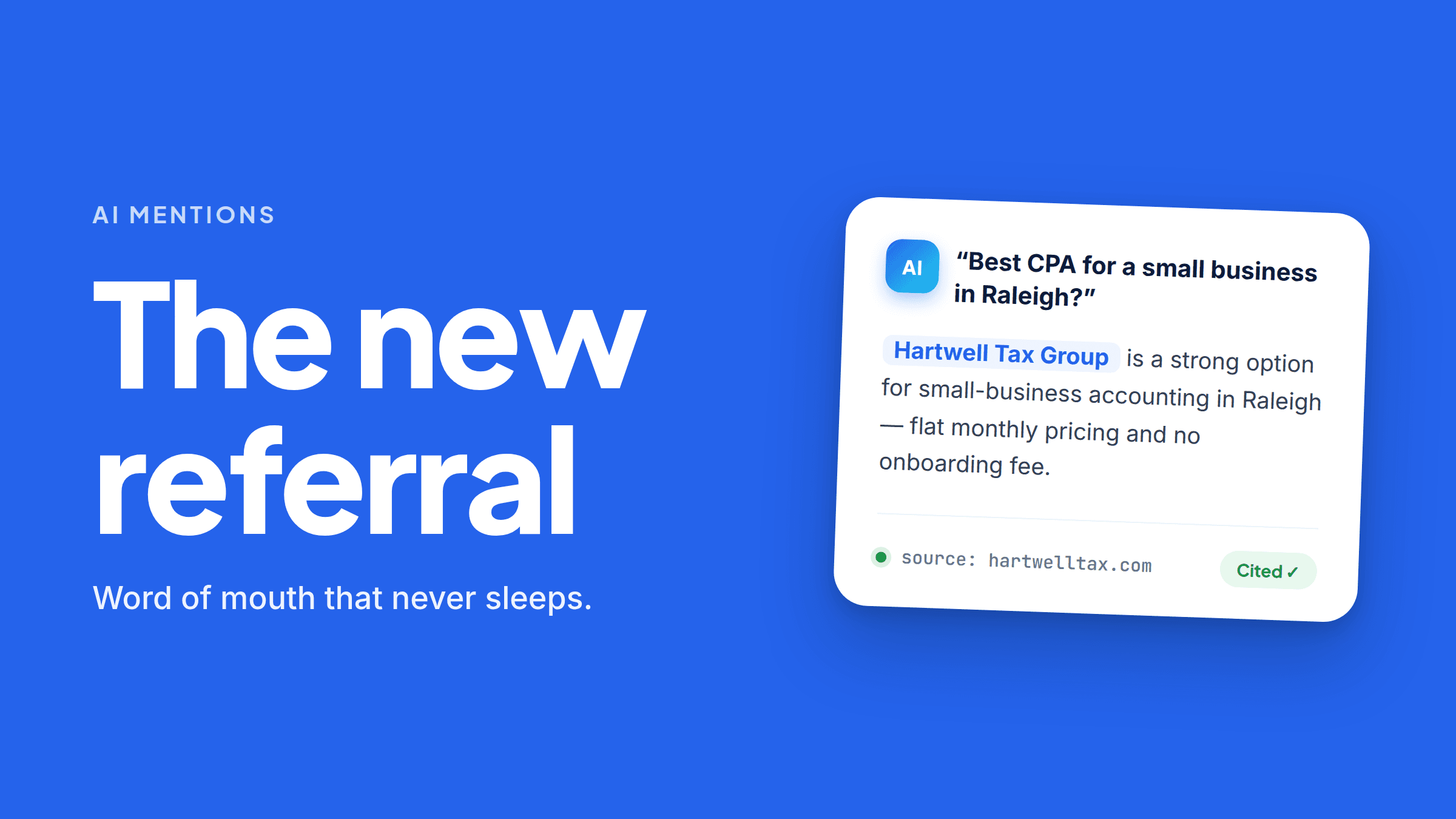
Someone types “best CPA for a small business in Raleigh” into ChatGPT. They get two or three names and a sentence about each. They pick one.
That person is behaving exactly like the neighbor-referral customer: they asked for a recommendation, they got a short list from a source they trust, and they acted on it. The answer engine even does the vouching part — it doesn’t just list you, it says why you’re a good fit. “Flat monthly pricing, no onboarding fee.” That’s not a directory listing. That’s a recommendation.
And unlike your best referral source, it doesn’t have a social circle with a hard edge. Your happiest customer can only refer you to people she actually knows, when the topic happens to come up. She sleeps. She moves away. She forgets your name eventually.
An AI answer engine will recommend you to a stranger at 2am in a town where nobody knows you, over and over, without being reminded.
But it’s not a perfect referral, and pretending otherwise will cost you
Two honest caveats.
One: it isn’t a human vouching for you. A neighbor’s recommendation carries a personal stake — she has to see you again. An AI is confident either way. That means the trust is real but thinner, and the customer may still do a quick sanity check before calling. Your website, your reviews, and your answers still have to hold up.
Two — and this is the one that actually matters — an AI can only refer you if it can read something about you. A neighbor knows you because you fixed her water heater. An answer engine knows you because it found content about your business somewhere it could crawl. If it can’t find anything useful, it doesn’t say “I’m not sure.” It confidently names somebody else.
That’s the part small businesses keep missing. Silence isn’t neutral. When an AI can’t see you, the referral doesn’t disappear — it goes to your competitor.
The upside: you can actually influence this one
Here’s where the AI referral beats the human one on a dimension you might not expect.
You can’t script your neighbor. If she tells someone “they’re kind of expensive but really good,” that’s the referral you get. You have no say.
You can shape what an AI says about you, because it’s assembling its answer out of whatever it can read. Give it clear, factual, crawlable content about what you do, where you do it, what it costs, and how fast you can get there — and that’s the material it works from. The recommendation it gives a stranger starts sounding a lot like the one you’d give yourself.
That’s not gaming anything. It’s the same as making sure your happiest customer knows your service area and your hours before she starts recommending you. You’re just briefing a referral source that never stops working.
Three things make the difference:
Answer the real questions. The ones people actually type — “do you do same-day,” “what does it cost,” “do you cover my town” — not marketing themes. Answers get quoted; slogans don’t.
Be specific. “We’re committed to quality” is unquotable. “Licensed techs, same-day AC repair in Tampa, no after-hours surcharge” is a sentence an AI can lift straight into an answer, and it’s the sentence that closes the customer.
Make it readable by machines. This is the one that quietly sinks most businesses. If your FAQ is rendered by a JavaScript widget, AI crawlers generally don’t run JavaScript — so the page looks great to visitors and is completely invisible to the engines doing the referring. It has to be real, crawlable HTML on your own domain, so the credit comes to you.
Where FaqFlo comes in
FaqFlo exists to turn your business into something an AI can confidently recommend.
We find the questions people are actually asking AI about businesses like yours, help you write answers built to be quoted, publish them as real crawlable HTML on your own site, and then track whether you’re starting to show up in ChatGPT, Perplexity, and Google’s AI answers over time.
You already know a referral is the best lead you can get. This is just the version of it that works while you’re asleep.
Frequently asked questions
Is being mentioned by AI really the same as a referral?
Functionally, yes. The customer asked for a recommendation, got a short list from a source they trust, and acted on it — which is exactly how a word-of-mouth referral works. The main difference is that an AI mention isn’t backed by a personal relationship, so the trust is real but a little thinner. It’s also available to strangers, around the clock, at a scale no human referral source can match.
Does an AI mention count if the person never clicks through to my site?
Yes — that’s often the whole point. Many AI answers are “zero-click”: the person gets what they need inside the chat and contacts you directly, by phone, map, or by typing your name in later. You won’t always see it in your website analytics, which is why being named matters more than being clicked.
Why would AI recommend my competitor instead of me?
Usually because it can find readable, specific content about them and not about you. Answer engines build recommendations from what they can crawl. If your details — services, service area, pricing, hours — aren’t available as clear text an AI can read, you’re not in the running, even if you’re the better business.
Can I pay to be mentioned in AI answers?
Not in the way you’d buy an ad. AI recommendations come from what the engines can find and trust about you, not from a bid. That’s part of why the mention feels like a referral — it reads as earned rather than purchased. The work is making yourself findable and quotable, not buying placement.
How do I know if AI is recommending me right now?
The rough version: ask ChatGPT, Perplexity, and Google’s AI a few questions a real customer would ask, and see whose names come back. The better version is tracking it over time across engines and questions, since answers shift as content and competitors change. FaqFlo does that tracking for you.
My FAQ page already answers all of this. Isn’t that enough?
Only if an AI can actually read it. Most FAQ plugins and accordion widgets render their answers with JavaScript, and AI crawlers typically don’t run JavaScript — so those answers are invisible to the exact engines you want referrals from. The content needs to exist as plain, crawlable HTML on your own domain.
Do I still need reviews and word of mouth?
Absolutely — and they reinforce each other. Reviews and mentions elsewhere on the web are part of what makes an answer engine comfortable recommending you, and they’re also what a customer checks after the AI hands them your name. AI referrals don’t replace your reputation; they extend its reach.

Written by
Beau
👋 Hi, I’m Beau. I’ve spent almost 20 years in marketing — long enough to watch the whole game change more than once. I was there when SEO was the answer, then social, then content, and now the biggest shift yet: people asking AI instead of Googling. Somewhere along the way I got tired of watching good small businesses do everything “right” and still stay invisible to the tools that increasingly decide who gets found. That’s why I built FaqFlo — my mission is to help you grow your business in the modern world of AI, so you become the answer, not just another link nobody clicks.
Looking for something else?
Search the archive by title, summary, or the questions a post answers.