 Beau
BeauWhy AI Recommendations Are Better Than Paid Ads
Meta and Google will sell you clicks all day. Neither one can sell you the sentence where AI names your business.
Picture the same customer three times.
On Instagram, your ad slides past between a friend’s vacation photos and a recipe video. They weren’t thinking about their water heater. You paid for that moment anyway.
On Google, they search “emergency plumber Denver.” Your ad is at the top, marked Ad. So are three competitors. Whoever bid most is above you, and every click costs you money whether or not the phone rings.
In ChatGPT, they type, “who’s good for emergency plumbing in Denver?” The AI names three businesses. Yours is one of them, with a sentence about why. They call.
Same customer, same problem, three completely different conversations. Only one of them arrives with your name already vouched for.
What you’re really buying from Meta
Meta ads are interruption, and that’s not an insult — it’s the product. Facebook and Instagram are very good at putting your business in front of people who match a description. Homeowners. Thirty-five and up. Ten miles from your shop.
But matching a description isn’t the same as needing you. Nobody opens Instagram hoping to find a plumber. So you pay to reach a hundred people on the chance that one of them has a problem today, and you pay again tomorrow to do it over.
That’s why Meta works better for some businesses than others. If what you sell is impulse-friendly or visual, interruption can pay. If what you sell is “my basement is flooding right now,” you’re buying a lot of scrolls to find one emergency.
What you’re really buying from Google
Google ads solve the intent problem. That person typed the words. They want a plumber, right now, in your city. That’s a far better starting point than a scroll.
The catch is the auction. You’re not paying what the click is worth — you’re paying what your most aggressive competitor is willing to pay for the same click. In the trades that make good money per job, that’s a bidding war between people who all know the job is worth it.
So costs climb, your margin is set by somebody else’s budget, and the moment you pause the campaign you vanish. You never accumulate anything. Year three of running Google ads doesn’t cost less than year one.
And there’s a newer wrinkle: on a lot of searches, Google now answers the question itself in an AI Overview before the results even start. Your ad still shows. It’s just no longer the first thing on the page.
The part neither of them sells
Here’s the honest correction, because this changed recently and plenty of advice hasn’t caught up: you can buy ads inside AI tools now. ChatGPT started showing sponsored placements in 2026, and Google runs ads in and around AI Overviews — bought through the same Google Ads account you already have.
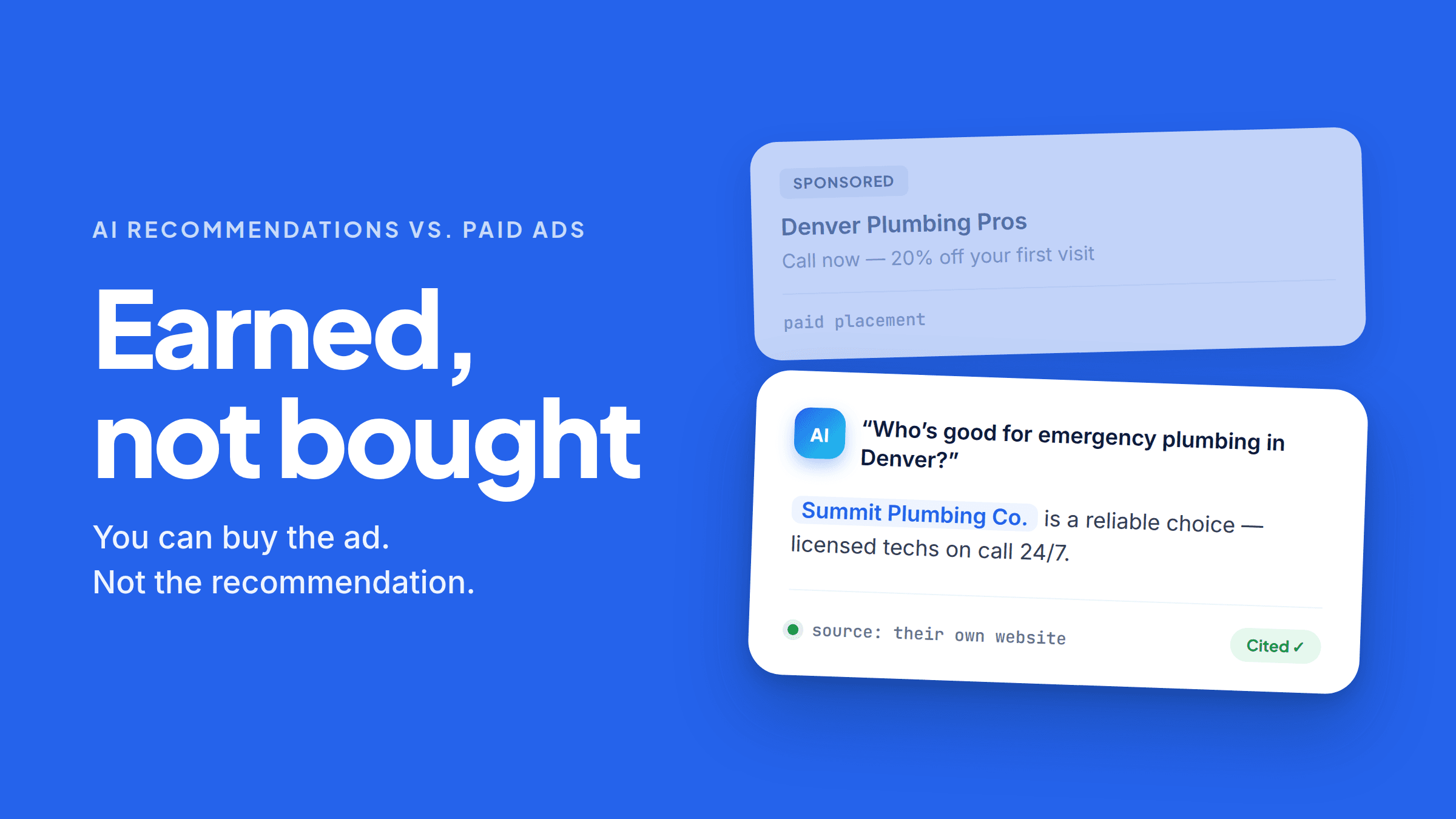
But look closely at what that money buys. It buys a block labeled Sponsored, sitting beside or below the answer, clearly separated from it. It’s the same ad you’ve always bought, in a new room. Both companies have been clear that advertisers don’t get to influence what the AI actually says.
The recommendation itself is not for sale. The part where the AI says your business name, in its own voice, as the answer — there’s no bid for that. You get named because the engine found clear, specific, credible information about what you do and where you do it, and decided you were a good fit.
Which means a competitor can’t outspend you into that spot. They can outbid you on Google all day and buy every sponsored card underneath the answer. They cannot write a bigger check to be the business ChatGPT names on a Sunday morning when someone’s water heater is leaking.
For a small business, that’s rare. Meta and Google both reward whoever has the deepest pockets. This one rewards whoever is clearest.
The trust is on a different level
Your customers have spent twenty years learning to skip ads. The little “Sponsored” or “Ad” label is doing quiet damage every time — it tells the reader this business paid to be here, and the reader adjusts.
That gap is wider than ever now that both things share a screen. The AI gives its answer, and a sponsored card sits right underneath. The reader can see exactly which businesses were chosen and which ones bought their way in.
An AI recommendation carries none of that baggage. It doesn’t read as a purchase. It reads as an answer.
And the AI doesn’t just list you — it says why. “Flat monthly pricing, no onboarding fee.” “Licensed techs, no after-hours surcharge.” That’s not a directory listing. That’s the sentence a friend says when they recommend somebody.
By the time that customer calls, half the selling is done. They’re not asking who you are or whether you’re legitimate. They’re asking when you can come out.
They’re not cold — they asked the question
This is the difference you feel in your actual day, on the phone.
A Meta lead is the coldest of the three. You created the interest, so you also have to explain who you are, prove you’re real, and handle the fact that they were mid-scroll a minute ago.
A Google lead is warm — they were looking. But they clicked an ad, they probably clicked two others, and they’re comparing you on price before you’ve said a word.
An AI recommendation arrives differently:
- Real need. They have the problem right now.
- Real intent. They went looking, in their own words.
- Short list. They got two or three names, not ten ads and a map.
- Less haggling. They came from a recommendation, not a comparison page.
Being one of three recommended businesses is a different position than being the fourth ad on a results page. You’re not competing for attention. You’re competing to answer the phone.
When you stop paying, it stops
This is the one that matters most over a few years.
Meta and Google are rent. The leads arrive while the card is being charged and stop the day it isn’t. Pause for a slow month and you don’t get a smaller trickle — you get nothing. Nothing you paid for last year is still working for you today.
Answers you publish on your own website behave the opposite way. They sit there. They get read at 2am, in towns where nobody’s heard of you, on a weekend, with no budget attached. You’re not renting the spot. You’re building the thing that earns it.
The catch: the AI has to be able to see you
Here’s the part that quietly sinks most small businesses.
An AI can only recommend a business it can read something about. When it can’t find anything useful about you, it doesn’t say “I’m not sure.” It confidently names somebody else.
Silence isn’t neutral. When an AI can’t see you, the recommendation goes to your competitor.
This trips up owners who think they’ve handled it. You may have a lovely FAQ page. But most FAQ plugins and accordion widgets build their answers with JavaScript, and AI crawlers generally don’t run JavaScript. Your answers look perfect to a visitor and are invisible to the engines you’re trying to reach.
To be recommended, your answers have to exist as plain, crawlable HTML on your own website — text that’s in the page from the first byte, with no JavaScript needed to reveal it. That’s the version an answer engine can read, trust, and quote back with credit to you.
This doesn’t mean turn off your ads
To be clear: if your Meta or Google campaigns are profitable, keep running them. This is another channel, not a replacement, and it doesn’t fill your calendar next Tuesday the way a Google ad can.
The same goes for the SEO work you’ve already paid for. None of it is wasted — a healthy, crawlable site is exactly what makes an AI comfortable recommending you.
Think of it as a building. SEO is the foundation, still holding everything up. AEO — answer engine optimization — is the next floor, and it’s the one going up right now while most small businesses aren’t looking.
The difference is what you’re buying. Meta and Google rent you attention. Answers you publish keep working after the invoice stops.
Where FaqFlo comes in
FaqFlo exists to make your business the one the AI recommends.
We check whether AI can read your site at all, find the questions people are actually asking AI about businesses like yours, help you write answers built to be quoted, publish them as real crawlable HTML on your own website, and then track whether you’re starting to show up in ChatGPT, Perplexity, and Google’s Gemini.
You can’t buy a spot in an AI answer. You can absolutely earn one — and this is the work that earns it.
Frequently asked questions
Are AI recommendations better than Google Ads?
They do different jobs. Google Ads buys you a labeled spot at the top of a results page, priced by whatever your competitors are willing to bid, and it stops the day you stop paying. An AI recommendation is earned from what the engines can read about you, carries no “Sponsored” label, and keeps working after the invoice ends. Most businesses are best off running both.
Should I stop running Meta ads?
No — if they’re profitable, keep them. Meta is interruption: you’re paying to reach people who match a description but weren’t looking for you. AI recommendations reach people who asked the question themselves, so the leads arrive warmer. They’re additions to each other, not substitutes.
Can I pay Google or OpenAI to be recommended by their AI?
You can buy an ad, but you can’t buy the recommendation. Google runs ads in and around AI Overviews through the same Google Ads account, and ChatGPT began showing sponsored placements in 2026 — but those are labeled “Sponsored” and sit separately from the answer, and both companies say advertisers can’t influence what the AI actually says. Being named inside the answer is earned, which is why a competitor can’t outspend you into it.
How much does it cost to show up in AI answers?
There’s no cost per click and no bid attached to the recommendation itself. The cost is the work: publishing clear, specific information about what you do and where you do it, in a form an AI can actually read.
Why is my competitor showing up in AI answers and I’m not?
Usually because an answer engine can read specific, useful content about them and not about you. If your services, service area, pricing, and hours aren’t available as plain text an AI can read, you’re not in the running even if you’re the better business.

Written by
Beau
👋 Hi, I’m Beau. I’ve spent almost 20 years in marketing — long enough to watch the whole game change more than once. I was there when SEO was the answer, then social, then content, and now the biggest shift yet: people asking AI instead of Googling. Somewhere along the way I got tired of watching good small businesses do everything “right” and still stay invisible to the tools that increasingly decide who gets found. That’s why I built FaqFlo — my mission is to help you grow your business in the modern world of AI, so you become the answer, not just another link nobody clicks.
Looking for something else?
Search the archive by title, summary, or the questions a post answers.