 Beau
BeauWhat It Means to Be Cited Versus Named in AI
Two different wins. Most businesses only measure one of them — and it’s usually the wrong one.
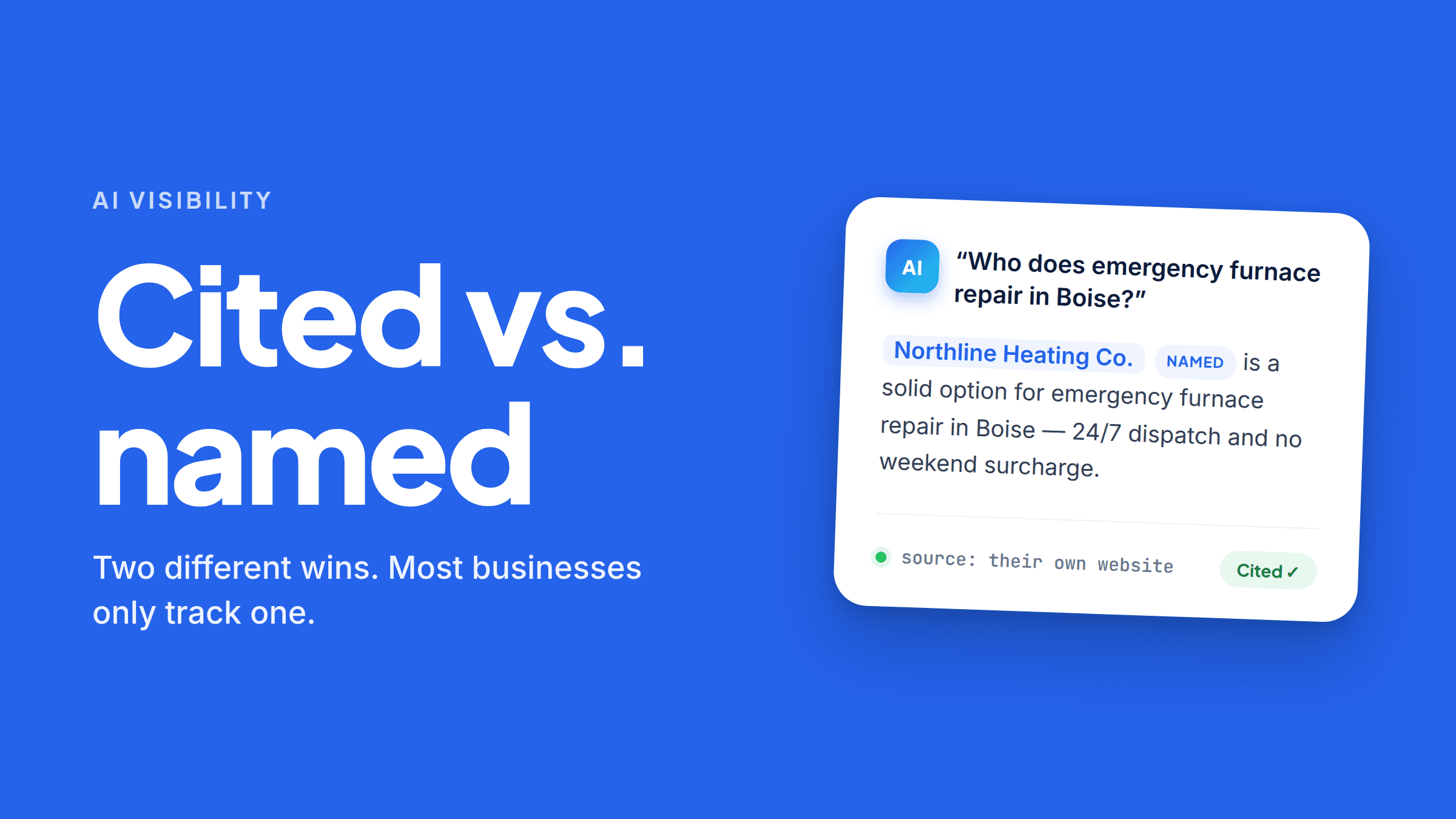
Someone asks ChatGPT, “Who does emergency furnace repair near me?”
The answer comes back with three business names and a sentence about each. Underneath, or off to the side, there are a few little source links.
Those are two separate things. The names in the answer are mentions. The links underneath are citations. They don’t always point at the same businesses, and that gap is where most small businesses are quietly losing.
Being named is the recommendation
When an AI says your business name in an answer, you got the referral. The customer now knows you exist, and they know why you were suggested — “open on weekends”, “flat pricing”, “licensed and insured”.
That’s the moment that turns into a phone call. They may never click anything. They’ll type your name into Google Maps, or tap the number, or just remember you.
If you only get to win one of these two, win this one. Being named is the sale.
Being cited is the credit
When an AI cites you, it’s showing its work. It’s saying: here’s where this came from, and it came from your website.
A citation does three things a mention doesn’t.
It can send you a click. Some people do tap the source link. That’s real traffic that never shows up if you’re only mentioned.
It’s proof the engine can read your site. A citation means a crawler reached your page, understood it, and trusted it enough to point at it. That’s a health check you can’t fake.
It makes the mention stickier. When the engine has your own page to pull from, the details it repeats are your details — your hours, your service area, your prices. Not a guess, and not a five-year-old directory listing.
The four places you can be standing
Here’s the useful part. Every business is in one of four spots, and each one means something different.
| Cited (linked) | Not cited | |
|---|---|---|
| Named | The goal. It recommends you and takes its facts from your site. | Winning the customer, losing the record. The facts it repeats come from a page you don’t own and can’t edit. |
| Not named | Doing the work, losing the job. Your page explains the topic; a competitor’s name is in the answer. | Invisible. Usually because there’s nothing on your site a crawler can read. |
The bottom-right box is the honest starting point for most small businesses, and it’s almost always the same cause: there’s nothing about the business the crawlers can actually read.
Why the two don’t move together
Naming and citing come from different places, which is why fixing one doesn’t automatically fix the other.
Naming draws on everything the AI knows about you. Its training data, review sites, directories, local listings, news, forums, and whatever it pulled up in the moment. Your website is one input among many. You influence it, but you don’t own it.
Citing is live. The engine went and fetched pages while answering, then linked what it used. That’s a decision made in seconds, based on what’s sitting in your page’s HTML right now.
That difference is why citation is the lever worth pulling first. You can’t rewrite what the internet already says about you this afternoon. You can change what’s on your own site, and that’s exactly what the citing half of the system reads.
The mistake almost nobody catches
Most businesses that check on this at all check one thing: “Did it say my name?”
So they ask ChatGPT a question, see their name, and decide they’re fine.
Then they miss the second half. If every source link under that answer points to a directory, the AI is describing your business using somebody else’s summary of it. When your prices change, or you add a service, or you expand your service area, the answer doesn’t update — because the page it’s reading isn’t yours and nobody’s updating it for you.
You’re being recommended from a snapshot. That’s fine right up until the snapshot is wrong, and by then you have no way to correct it.
The reverse mistake is just as common: watching only for traffic from AI tools. Most AI answers are zero-click. If clicks are your only measure, you’ll conclude AI isn’t sending you anything while it quietly recommends you all week.
What to do about each gap
If you’re named but not cited: you need crawlable content on your own domain that answers the same questions the directories are answering for you. Real HTML, present the moment the page loads. Most FAQ plugins render answers with JavaScript, and AI crawlers generally don’t run JavaScript — so those answers might as well not exist.
If you’re cited but not named: your content is readable but generic. Add the specifics that make you a recommendable business rather than a helpful article. Names, towns, response times, prices, credentials. “Same-day service in Concord and Manchester, licensed and insured, no after-hours surcharge” is a sentence an AI can lift straight into a recommendation. “We’re committed to quality” is not.
If you’re neither: start with whether AI can read your site at all. That check takes about ten seconds, and for a lot of small businesses it’s the entire problem.
Where FaqFlo comes in
FaqFlo watches both halves.
We find the questions people actually put to AI about businesses like yours, write answers built to be quoted, and publish them as real crawlable HTML on your own domain — so the engine has your page to read and your page to link.
Then we put those questions to ChatGPT, Perplexity and Gemini every week and record what came back, one of three ways:
- Linked — your domain was one of the sources the answer used.
- Named only — the AI said your name but sent the click somewhere else. It also records which domain took it.
- Not named — you weren’t in the answer, and again, who was.
Those are three different problems with three different fixes, which is the whole reason they’re counted separately rather than rolled into one “visibility” number.
Frequently asked questions
What’s the difference between being cited and being named by AI?
Being named means the AI says your business name inside its answer, which is the recommendation the customer acts on. Being cited means the AI links your page as a source it used, which is the credit and the click. They’re separate outcomes, and you can get one without the other.
Which one matters more for a small business?
Being named is what wins the customer, because that’s the name they call. But being cited is what you can control, since it depends on what’s readable on your own website. The businesses that do well get named because they’re citable.
Can I be mentioned by AI without ever being cited?
Yes, and it’s very common. The AI may know about you from directories, review sites or local listings and recommend you without linking your website at all. It works until those third-party pages go stale, because then the AI is repeating outdated facts about you that you can’t edit.
Why would an AI cite my page but recommend a competitor?
Usually because your content explains a topic well but doesn’t clearly identify you as the business to hire. Answer engines need specifics — service area, hours, pricing, credentials — to move from "this page is informative" to "this company is the answer". Add those details and citations start turning into mentions.
How do I check whether I’m named or cited right now?
Ask ChatGPT, Perplexity and Gemini a few questions a real customer would ask, then look at two things separately: whether your name appears in the answer text, and whether your domain appears in the source links. Doing it once gives you a snapshot; doing it every week across a set of questions shows whether you’re gaining or losing ground.

Written by
Beau
👋 Hi, I’m Beau. I’ve spent almost 20 years in marketing — long enough to watch the whole game change more than once. I was there when SEO was the answer, then social, then content, and now the biggest shift yet: people asking AI instead of Googling. Somewhere along the way I got tired of watching good small businesses do everything “right” and still stay invisible to the tools that increasingly decide who gets found. That’s why I built FaqFlo — my mission is to help you grow your business in the modern world of AI, so you become the answer, not just another link nobody clicks.
Looking for something else?
Search the archive by title, summary, or the questions a post answers.