 Beau
BeauKids Are Asking AI Now. Adapt Now, or Miss Them Later.
The people who will hire you in 2036 are asking ChatGPT questions today — by voice, in plain words, and in a hurry. Answer the way they ask now, and you’re the name they’ll already know later.
Watch a 19-year-old find a mechanic
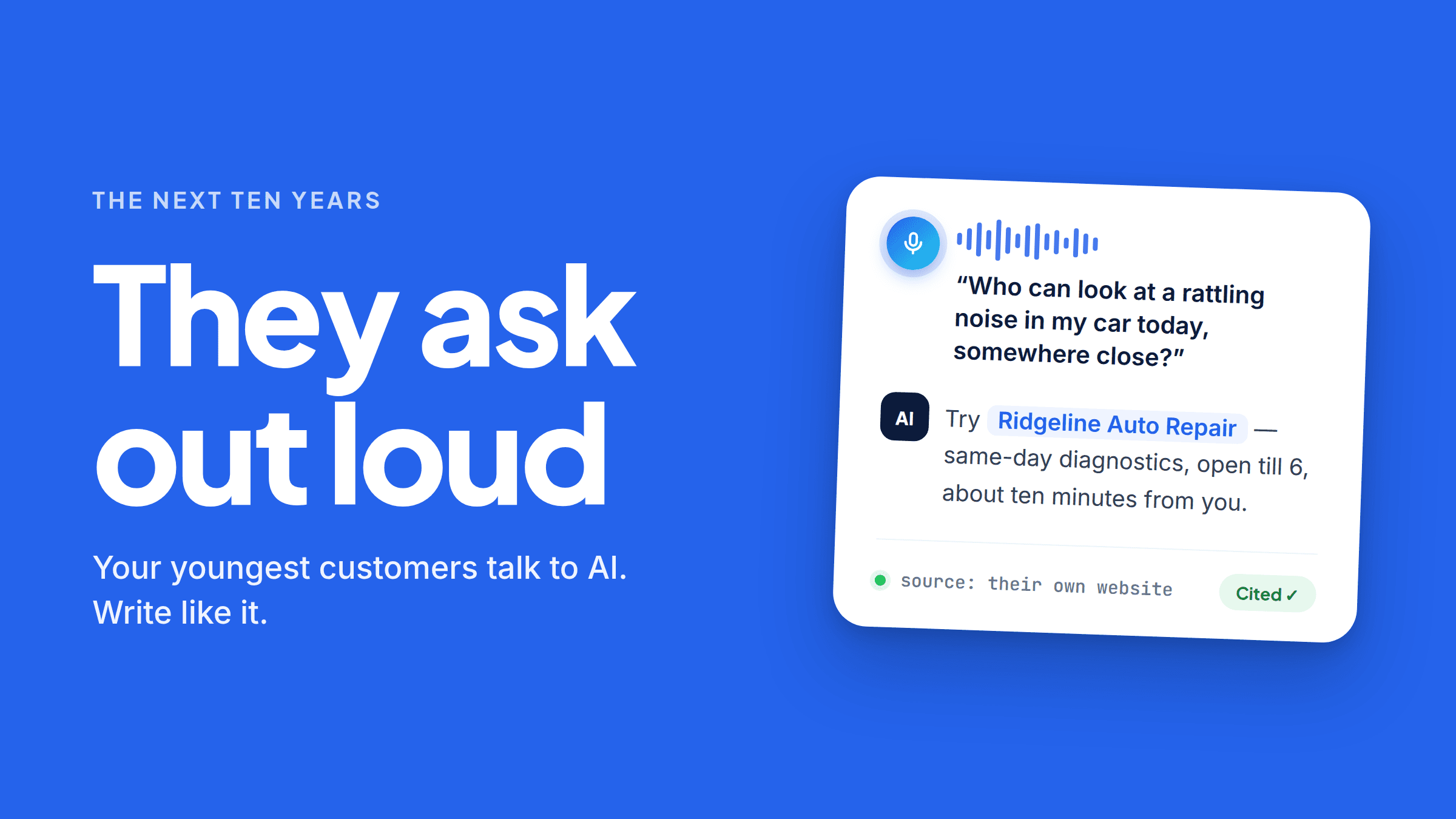
Picture someone in their late teens or early twenties. Their car is making a noise. They don’t open a search engine and type “auto repair near me.” They tap the little microphone in ChatGPT and say, “Who can look at a rattling noise in my car today, somewhere close?”
They get an answer in a few seconds. Two or three names, a sentence about each. They pick one.
No results page. No scrolling. No landing on your homepage. Just a question, spoken out loud, and an answer.
That’s not a fringe habit. It’s how a growing share of younger people look for everything — a dentist, a taco place, a tutor, a plumber. And the ones doing it now are the ones who will be buying homes, running households, and hiring services for the next ten years.
Young people didn’t switch to AI. They started there.
If you’ve been in business a while, you learned to be found in a certain order. First the phone book, then the search engine, then reviews, then social. Each one was a layer you added.
Your youngest customers skipped most of that. Many of them opened an AI assistant before they ever got in the habit of “Googling it.” Pew’s 2026 survey of Americans and AI found 18-to-29-year-olds are the heaviest chatbot users of any age group, at around two-thirds, and a January 2026 Search Engine Land study put the share of consumers who now start a search with AI rather than Google at 37%.
It isn’t a clean sweep — some trackers have Gen X adopting chatbots faster than younger adults on certain measures — but the direction among the youngest adults is not in much doubt.
That matters for one simple reason. Habits formed at 18 don’t reset at 30. The way someone finds a business in their first years of adulthood is the way they’ll find one for decades. You’re not just competing for this year’s customer. You’re competing for the default in that person’s head.
Voice changes what a “question” looks like
Here’s the part that should change how you write.
Typing makes people terse. You’d type “emergency dentist Boston.” Speaking makes people normal. You’d say, “Is there a dentist near me that can see me today for a broken tooth?”
The difference is measurable: a spoken query runs about seven words against three for a typed one, and 73.4% of voice queries now start with a question word — how, what, where. People are not reciting keywords at their phones. They are asking.
Voice questions have a shape:
- They’re full sentences. Not keywords. Actual questions with “who,” “can,” “how much,” “is there.”
- They’re simple. One thing at a time. Nobody dictates a paragraph.
- They’re specific. A town, a day, a problem, a price. “Today.” “Near me.” “How much.”
- They expect a spoken-style answer back. Short. Direct. Sounds like a person.
When an AI answers a voice question, it’s often reading its answer out loud, or showing something short enough to glance at. It can’t quote three paragraphs of “we pride ourselves on excellence.” It needs a clean, quotable sentence that answers the exact thing that was asked.
If your site doesn’t have that sentence, the AI finds a business that does.
This is a ten-year decision, not a Tuesday one
It’s tempting to treat AI search as a trend to check on later. Wait and see. Fix it when it’s bigger.
The problem is that the customers driving it aren’t waiting. Every year, another group of people finishes school, starts earning, and starts asking AI where to spend that money. Every year, the share of your market that “just asks” gets larger, and the share that “just Googles” gets smaller. That isn’t a wave that passes. It’s a floor that keeps rising.
SEO isn’t going away. A solid website that ranks well is still the foundation, and it’s still what an AI reads to learn about you. AEO — Answer Engine Optimization — is the next floor up. It’s making sure that when someone asks a question you can answer, the AI has a clear, readable, quotable answer from you to hand back.
Building that floor now, while most of your competitors haven’t, is the cheapest it will ever be.
How to write for the customer who talks
You don’t have to rebuild your website. You have to change how a few key answers are written.
Answer the spoken question, not the keyword. Write the question the way someone would say it out loud. “Do you do same-day repairs?” beats “Same-Day Repair Services.” Then answer it in the first sentence.
Keep the answer short enough to say. Read your answer out loud. If you’d be embarrassed reading it to a customer on the phone, an AI won’t quote it either. Aim for one or two plain sentences, then details if needed.
Put the specifics in the sentence. Where, when, how much, how fast. “Yes — we do same-day repairs in Portsmouth and Dover, Monday through Saturday, usually within four hours.” That sentence answers five voice questions at once.
Use the words people say, not the words you use. Customers say “broken tooth,” not “dental trauma.” They say “won’t turn on,” not “power fault.” Match their language and the AI can match you to their question.
Cover the boring questions too. Hours, parking, whether you take cards, whether you come to them. Younger customers ask these by voice constantly, and a clear answer wins the referral before anyone compares prices.
Make sure AI can actually read it. This is the one that quietly sinks businesses. Most FAQ plugins and accordion widgets load their answers with JavaScript, and AI crawlers generally don’t run JavaScript. Your answers can look perfect to a visitor and be completely invisible to the engine doing the referring. They need to exist as plain, crawlable HTML on your own website.
Where FaqFlo comes in
Everything above is exactly what FaqFlo was built to do.
It finds the questions people actually ask AI about businesses like yours — including the plain, spoken kind — writes short, answer-first responses built to be quoted, publishes them as real crawlable HTML on your own domain, and then tracks whether you’re starting to show up in ChatGPT, Perplexity and Gemini over time.
The customers who talk to AI are the ones who are going to keep showing up for the next decade. FaqFlo makes sure that when they ask, the answer is you.
Frequently asked questions
Are younger people really using AI instead of search engines?
Increasingly, yes. Pew’s 2026 survey found 18-to-29-year-olds are the heaviest chatbot users of any age group, at around two-thirds, and a January 2026 study put the share of consumers starting a search with AI rather than Google at 37%. Search engines aren’t gone, but for many younger adults AI is the first stop.
Why does voice matter for how I write my content?
Because spoken questions are full, simple sentences with specific details — a voice query averages about seven words against three for a typed one, and roughly three-quarters now begin with a question word like how, what or where. Content written as short, direct answers to those exact questions is what an AI can quote back. Keyword-style headings and long marketing copy don’t fit that shape.
Do I need to make my website “voice-enabled”?
No. You don’t need any special voice technology on your site. The AI handles the listening and speaking; your job is to have clear, plain-language answers on your own website that it can read and repeat. Good written answers are what make voice answers possible.
Does focusing on AI mean I should stop doing SEO?
No. SEO is still the foundation, and a well-built website that ranks well is also what AI engines read to learn about you. AEO is the next floor up: making sure the answers on that site are short, specific, and readable by AI, so you get named when someone asks a question.
How long does it take for this to pay off?
Some of it works fast — once your answers are live as crawlable HTML, engines usually find them within hours to a couple of weeks, and the first AI answers quoting you tend to land two to eight weeks after you publish. But the real payoff is long-term. The people forming the habit of asking AI today will keep asking for years, and the businesses with clear answers in place now are the ones they’ll keep hearing about.

Written by
Beau
👋 Hi, I’m Beau. I’ve spent almost 20 years in marketing — long enough to watch the whole game change more than once. I was there when SEO was the answer, then social, then content, and now the biggest shift yet: people asking AI instead of Googling. Somewhere along the way I got tired of watching good small businesses do everything “right” and still stay invisible to the tools that increasingly decide who gets found. That’s why I built FaqFlo — my mission is to help you grow your business in the modern world of AI, so you become the answer, not just another link nobody clicks.
Looking for something else?
Search the archive by title, summary, or the questions a post answers.