 Beau
BeauHow Long Does It Take for AI Search to Pick Up Your Content?
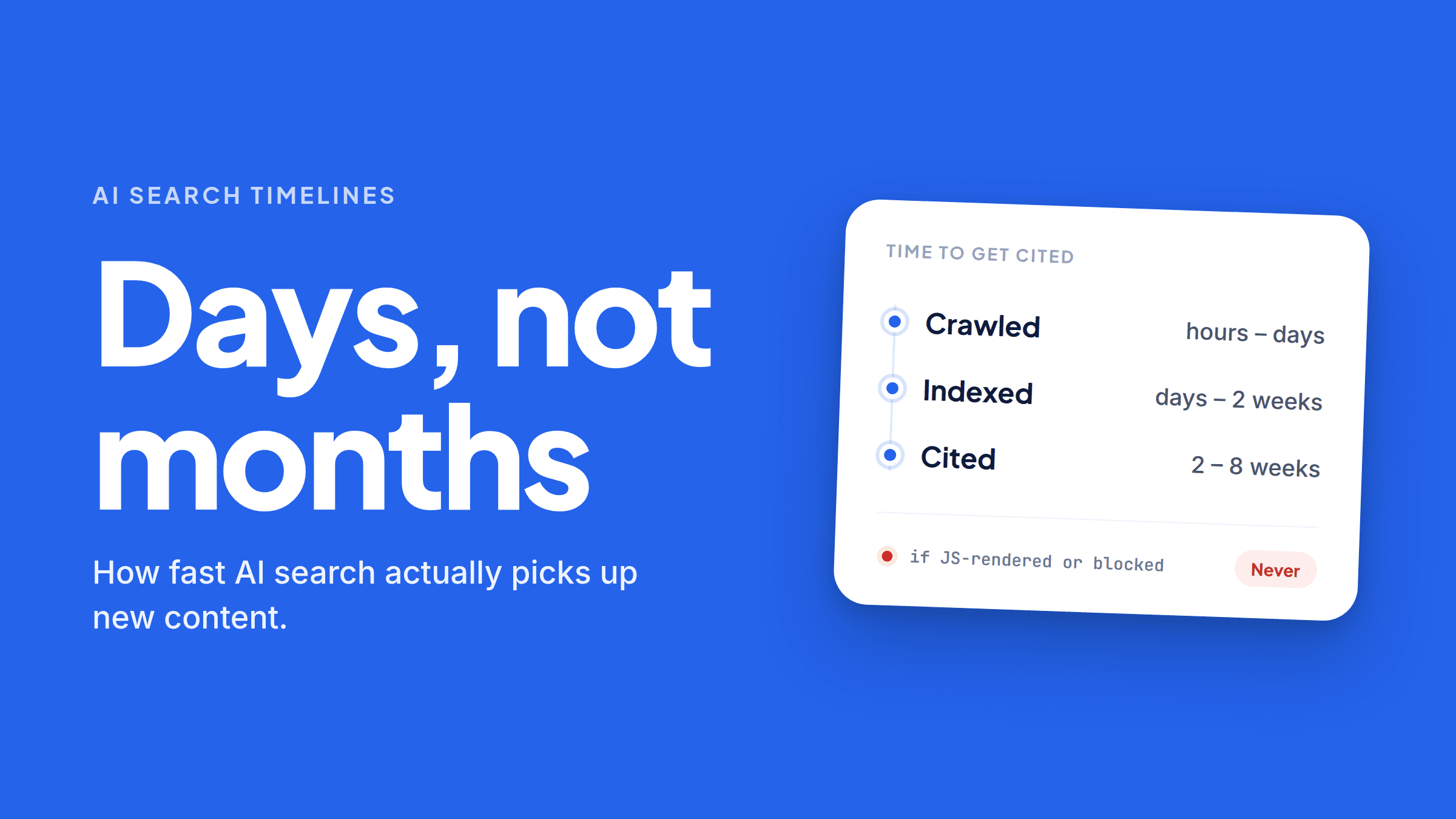
Days, not months — assuming the crawler can read your page at all.
There are three clocks, not one
“How long until AI picks up my content” is really three questions, and they run on very different schedules.
Crawled. A bot fetched your page. This is the fast one — often the same day you publish.
Indexed. Your page is now in the pool the engine can pull from when someone asks a question. Days to a couple of weeks.
Cited. An AI actually names you in an answer. Weeks — and it isn’t automatic just because the first two happened.
Most of the confusion comes from mixing up the second and third. Being findable and being chosen are different things.
Engine by engine
Perplexity is the fastest. It runs a background index and a live web search on every query, so freshly published content can turn up in its answers almost immediately.
ChatGPT is fast — when it searches at all. OpenAI’s OAI-SearchBot builds ChatGPT’s search
index, and it visits most sites every few days or weeks rather than several times a day. There’s a
bigger catch: a 2026 analysis found ChatGPT only runs a live web search on about a third of
prompts — the rest are answered from what the model already knows. So a brand-new page can only win
the searched share.
Google AI Overviews runs on Google’s clock. If Google has indexed the page, AI Overviews can cite it — which means the timeline is simply your normal Google indexing timeline. For an established site that’s days. For a brand-new small-business site, it can be weeks, and sometimes it just doesn’t happen.
Copilot, Grok and Claude mostly ride the same rails. Bing’s index feeds several of them, which is why getting into Bing matters more than most small businesses realise.
One published test makes the speed difference concrete: a new page was crawled by ChatGPT and Perplexity on the day it went live, while Bing and Google didn’t come by until one to two days later. AI crawlers are not the slow part.
What actually decides your timeline
Six dependencies, roughly in order of how much they matter.
- Can the crawler read the page. This is the gate everything else sits behind. OpenAI’s search crawler reads raw HTML only — if your content loads through JavaScript, it frequently sees a blank page. A FAQ accordion that looks perfect to a visitor can be completely absent from the version a bot reads. No amount of waiting fixes this.
- Your robots.txt. Blocking the AI crawlers sets your
timeline to infinity. Worth noting that OpenAI’s systems take roughly a day to pick up changes
after you edit
robots.txt, so unblocking isn’t instant either. - How often you already get crawled. Sites that already appear in AI answers get crawled more often — it compounds once you’re in. A site with existing traffic and links gets picked up in days. A six-month-old site with three backlinks waits longer.
- Server speed. AI crawlers are less patient than Googlebot. A slow page that Googlebot would
retry may simply be skipped, or only partly fetched, by
PerplexityBot. - How the answer is written. This is the difference between indexed and cited. Cited pages tend to lead with a direct answer in the first 50 words, and Q&A formatting is associated with roughly three times the citation rate. A page that buries the answer under three paragraphs of context gets passed over for one that doesn’t.
- Whether anyone is asking. You can be perfectly crawlable and still never get cited, because nobody is asking a question your page answers. Citations only happen on real queries.
How to make it faster
- Publish as real HTML on your own domain. Not a JavaScript widget. This is the single biggest lever, and it’s binary.
- Allow the citation crawlers —
OAI-SearchBot,PerplexityBot,Claude-SearchBotandGoogle-Extended— in yourrobots.txt. - Get into Bing. Submitting your sitemap to Bing Webmaster Tools takes about ten minutes and is one of the highest-leverage things you can do, because ChatGPT Search leans on Bing’s index for live retrieval. IndexNow pushes new URLs to Bing instantly instead of waiting for a crawl cycle.
- Put the answer in the first sentence. Then the detail.
- Be specific. Prices, hours, service areas, timeframes. Vague marketing copy is unquotable.
- Get mentioned elsewhere. Being referenced on sites that are already indexed speeds up discovery of yours.
What to expect at each mark
Week 1. Check your server logs. You should see AI crawlers hitting the new page. If you see nothing at all, something is blocking them — that’s a technical problem, not a patience problem.
Weeks 2–4. Start asking the engines the questions a real customer would ask. You may see nothing yet. That’s normal.
Weeks 4–8. First citations usually show up here, if they’re going to. Even with everything done right, two to four weeks is a fair minimum before drawing conclusions — and if nothing has happened well past that, the issue is usually relevance or authority rather than discovery.
Day 90. Now you have a real signal. If you’re cited for some questions and not others, you have a gap list, which is exactly what you want.
Where FaqFlo comes in
Most of the “how long does it take” anxiety turns out to be a technical problem in disguise. Businesses wait three months for a page the crawlers were never able to read.
FaqFlo starts by checking that: whether AI can see your site at all, and whether the crawlers are blocked. Then it finds the questions people are actually asking AI about businesses like yours, writes answers built to be quoted, and gives you clean crawlable HTML to paste onto your own site — so the clock starts the day you publish. After that it tracks whether you’re actually showing up in ChatGPT, Perplexity and Google’s AI answers, so you’re not guessing about the timeline. You’re watching it.
Frequently asked questions
How long does it take for AI to find new content on my website?
Hours to two weeks for the crawl, and two to eight weeks before you’re actually quoted in an answer. AI crawlers often visit a new page the same day it’s published.
Why hasn’t AI picked up my page after a month?
Usually because the crawler can’t read it. If your content is rendered by JavaScript — most FAQ plugins are — AI crawlers see an empty page, and waiting won’t fix that. The other common cause is a robots.txt rule blocking the AI bots.
Which AI search engine picks up new content the fastest?
Perplexity, because it runs a live web search on every query. ChatGPT is close behind when it searches, and Google AI Overviews is slowest since it depends on standard Google indexing.
Does getting indexed mean I’ll get cited?
No. Indexing makes you eligible; citation depends on whether your answer is the clearest one available — and on whether anyone is asking the question.
How do I know if AI has picked up my content?
Check your server logs for AI crawler visits, then ask the engines the questions a real customer would ask and see whose names come back. FaqFlo tracks the second part for you over time.

Written by
Beau
👋 Hi, I’m Beau. I’ve spent almost 20 years in marketing — long enough to watch the whole game change more than once. I was there when SEO was the answer, then social, then content, and now the biggest shift yet: people asking AI instead of Googling. Somewhere along the way I got tired of watching good small businesses do everything “right” and still stay invisible to the tools that increasingly decide who gets found. That’s why I built FaqFlo — my mission is to help you grow your business in the modern world of AI, so you become the answer, not just another link nobody clicks.
Looking for something else?
Search the archive by title, summary, or the questions a post answers.