 Beau
BeauAEO for Roofers: How to Get More Work From AI
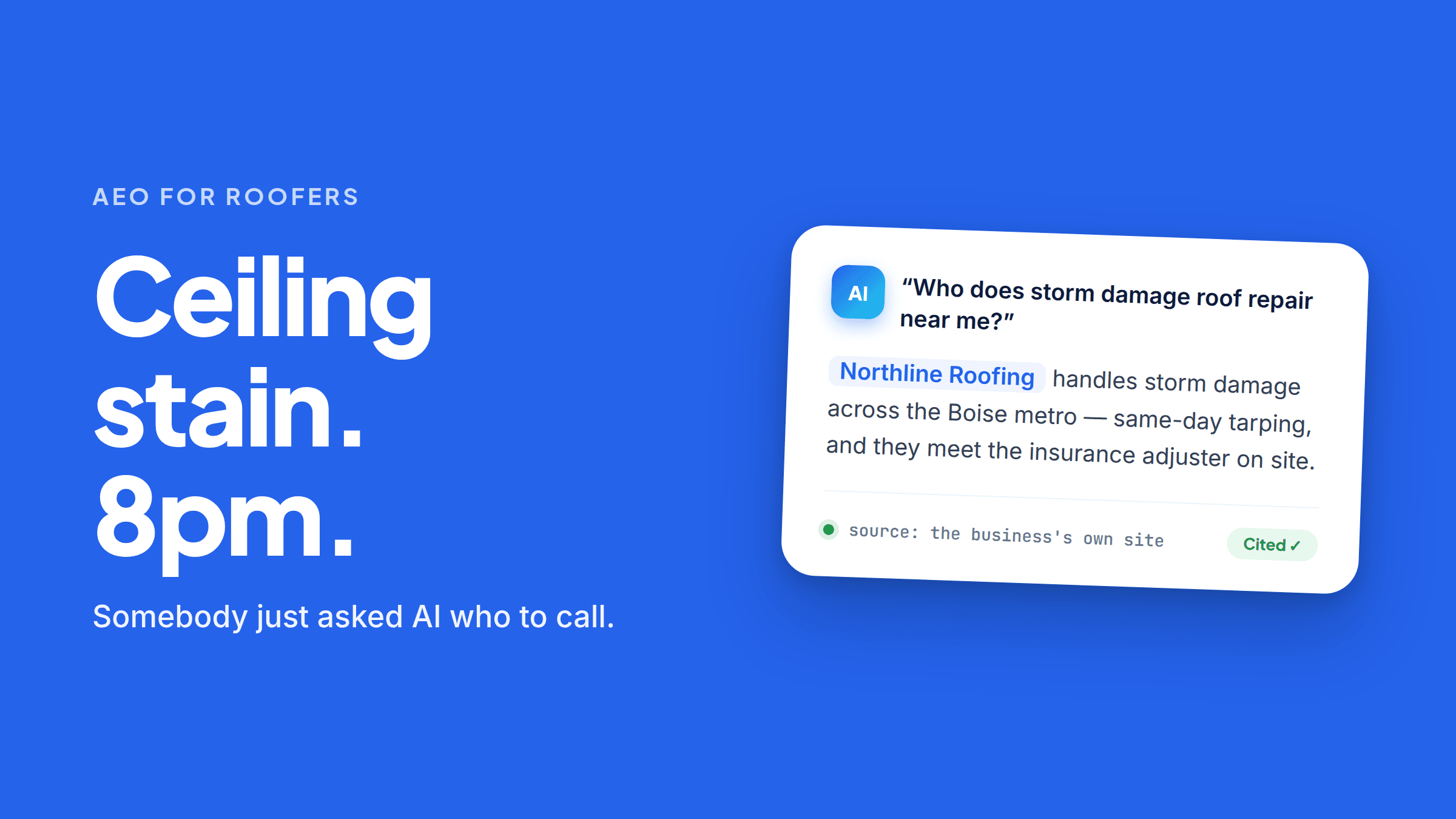
A roof leak is a same-day decision, and the customer is asking somebody for a name. Increasingly that somebody isn’t Google.
Roofing sits at an unusual intersection. The jobs are large, the decisions are urgent, and the customer usually knows nothing about the product they’re buying. That combination makes them ask for advice — and asking has quietly moved from “call my brother-in-law” to “ask ChatGPT.”
Three roofing situations, three different AI answers, all worth winning:
The leak. Water is coming through a ceiling. They need a name in the next ten minutes. Nobody’s comparing shingle warranties.
The storm. A hail or wind event goes through, and half the neighborhood is suddenly asking the same questions at the same time — is this claimable, who does insurance work, is that door-knocker legitimate. Every one of those is a question an AI will answer, and the answer names companies.
The replacement. A roof at end of life, researched over weeks. Costs, materials, financing, warranties, whether to go metal. The AI is functioning as a shortlist builder here, and the shortlist is short.
Getting named in those answers is what people mean by AEO — Answer Engine Optimization. Here’s the roofing version.
First: can AI read your site at all?
Before anything clever, check this. It’s the most common failure and it’s invisible from the outside.
Your content might be rendered by JavaScript. If your services, financing details, or FAQ appear after the page loads — which is how nearly every FAQ plugin and accordion widget works — AI crawlers generally don’t see it. They fetch the raw HTML and move on without running scripts.
Crawlers might be blocked. Check yoursite.com/robots.txt for Disallow: / under GPTBot,
OAI-SearchBot, ClaudeBot, PerplexityBot, or Google-Extended. This is almost always
accidental — inherited from a theme or an old developer rule.
Your details might be trapped in images. Service area in a map graphic, financing terms in a PDF, manufacturer certifications in a logo strip. A person reads all of that. A crawler reads none of it.
Twenty-second check: open your live site, right-click, choose View Page Source, press Ctrl+F, and search for a town you cover or a material you install. Not there? It isn’t in the page.
⚠️ Use View Page Source, not Inspect Element. Inspect shows the page after scripts have run, which is what a person sees rather than what a crawler gets.
The questions roofing customers actually ask AI
Roofing has a long, specific list, and most of it never appears on roofing websites:
- Who can come look at a roof leak today?
- How much does a new roof cost for a house my size?
- Will insurance cover this, and do you work with insurance companies?
- Do you do free inspections?
- How long does a roof replacement take?
- Do you offer financing?
- How long is the warranty, and what does it actually cover?
- Do you install metal, or just asphalt?
- Are you certified by a particular manufacturer?
- Do you cover my town?
- Are you licensed and insured, and do you carry workers’ comp?
- Can you tarp it today until you can do the repair?
- Do you subcontract the work or use your own crews?
You answer all of these on the phone, every week. Almost none of them are written down anywhere on your website.
That isn’t a marketing failure — it’s an inventory problem. You have the answers. They’re just not somewhere a machine can reach.
Four roofing specifics worth getting right
Insurance work. This is the biggest single opportunity in the list. After a storm, an enormous share of the questions are insurance questions, and most roofing websites say something vague like “we work with all insurance companies.” Say the useful version instead: do you do the inspection and documentation, do you meet the adjuster on site, do you handle supplements, do you require payment before the claim settles. Those are the things that decide who gets called, and they’re specific enough for an engine to quote.
Manufacturer certifications. If you’re a certified installer for a major manufacturer, say which one, by name, in text. Customers ask by brand — especially when a warranty is involved — and a named certification is exactly the kind of concrete, checkable fact an answer engine can use. Don’t leave it in a logo image.
Emergency response. “Can you tarp it today” is a real question with a yes or no answer. If the answer is yes, say so plainly with your actual response window. If it’s no, say that too.
Price ranges. You can’t quote a roof blind and nobody expects you to. But “most asphalt replacements on a typical single-family home in this area run $9,000–$18,000 depending on size, pitch, and layers” is far more useful — and far more quotable — than “contact us for a free quote.” The vague version gives an engine nothing, and gives the customer a reason to call the company that was upfront.
Write answers the way an engine can use them
Answer in the first sentence. Not “For over 25 years, our family-owned company has proudly protected homes…” Start with: “Yes — we do same-day emergency tarping across the county, usually within four hours of the call.”
Use real numbers, towns, and timeframes. “Fast, reliable service” cannot be lifted into an answer because it doesn’t say anything. “Most replacements are done in one to two days” can.
Name your towns individually. “The tri-state area” is vague. Listing actual towns means you’re in the running when somebody asks about one by name.
Say what you don’t do. “We don’t do flat commercial roofs” or “we don’t handle solar removal and reinstall” isn’t lost business. It stops you being recommended for jobs you’d turn down, and that kind of specificity makes an engine more confident about the jobs you do want.
Two to four sentences each. Engines extract chunks. A tight chunk gets used; a long paragraph gets skipped.
Get it onto your own site as plain text
The answers have to live as real, crawlable HTML on your own domain. Not in a plugin, not in an iframe, not only on a lead-generation directory.
Why your own domain matters here more than in most trades: roofing leads are expensive, and the directories know it. If your only readable details live on someone else’s marketplace page, you’re feeding their citation and paying for the lead twice.
Most builders have a native code block for this — WordPress has Custom HTML, Squarespace has Code, Webflow has Embed. Wix is the exception worth flagging, because its embed tool wraps content in an iframe that crawlers treat as a separate document; on Wix, use native text elements instead. We walked through all four step by step here.
Then run the View Page Source check again. If the answers show up in the raw source, it’s really done.
Don’t skip the foundations
None of this replaces the basics, and in roofing the basics carry real weight:
- Google Business Profile, claimed, accurate, with your true service area and the Q&A section on the profile filled in.
- Reviews — and reviews that mention the specific job and how fast you responded are worth several that say “great crew.”
- A site that works on a phone, because the leak search happens standing in a hallway looking at a ceiling stain.
Regular SEO built that foundation and it still is the foundation. AEO is the floor above it: making sure that when an engine assembles an answer about roofing in your area, it has something specific and true to say about your company.
Where FaqFlo comes in
FaqFlo was built for a contractor with twenty minutes between a job and payroll, not a marketing department.
It checks whether AI can read your site, finds the questions people are actually asking about roofers in your area, drafts answers written to be quoted, and hands you crawlable HTML to paste onto your own website. Then it tracks whether ChatGPT, Perplexity and Gemini start naming you — and flags when a competitor is getting named for a question you’re not.
You already know every answer on that list. This is putting them where the ceiling-stain phone call gets decided.
Frequently asked questions
How do I get my roofing company recommended by ChatGPT?
Make sure your content is readable as plain HTML without JavaScript, that AI crawlers aren’t blocked in your robots.txt, and that your site clearly states your service area, emergency response time, insurance process, certifications, and price ranges. An engine can only recommend what it can read and describe.
What should a roofing website FAQ cover?
The questions customers ask before they book: emergency and tarping availability, replacement cost ranges, how you handle insurance claims, warranty terms, financing, materials installed, manufacturer certifications, and which towns you cover. Two to four plain sentences each, with real numbers and real place names.
Does mentioning insurance claims help my AI visibility?
Yes, and it’s the most under-used opportunity in roofing. After a storm a large share of questions are insurance questions, so stating specifically how you handle inspections, adjuster meetings, and supplements gives an engine something concrete to quote about you.
Should I put roof replacement prices on my website?
A range with what it depends on, yes. You can’t quote a roof sight unseen, but “most replacements run $9,000–$18,000 depending on size, pitch, and layers” is quotable and builds trust, while “call for a free quote” gives an answer engine nothing to work with.
Do I need an agency to do AEO for my roofing business?
No. The work is checking whether crawlers can read your site, writing plain answers to questions you already know by heart, and getting them onto your own site as readable text — which a contractor can do in an afternoon or hand to whoever manages the website.

Written by
Beau
👋 Hi, I’m Beau. I’ve spent almost 20 years in marketing — long enough to watch the whole game change more than once. I was there when SEO was the answer, then social, then content, and now the biggest shift yet: people asking AI instead of Googling. Somewhere along the way I got tired of watching good small businesses do everything “right” and still stay invisible to the tools that increasingly decide who gets found. That’s why I built FaqFlo — my mission is to help you grow your business in the modern world of AI, so you become the answer, not just another link nobody clicks.
Looking for something else?
Search the archive by title, summary, or the questions a post answers.