 Beau
BeauWhy Business Owners Should Care About AI
Not the robot-takeover version. The version where a stranger asks AI who to call, and it says a name.
Here’s the short answer: your customers have started asking AI who to hire, and AI answers with a name. If it isn’t your name, it’s your competitor’s. That’s the whole reason to care.
Everything else you’ve heard about AI — writing emails faster, making logos, summarizing meetings — is optional. Nice, but optional. This part isn’t, because it’s already changing how people find and choose a business like yours, whether or not you ever open ChatGPT yourself.
Getting found: the list got a lot shorter
For twenty years, being found meant showing up on a page of results. Ten links, a map, some ads. If you were sixth on the list, you still got a few calls. Being found was a sliding scale.
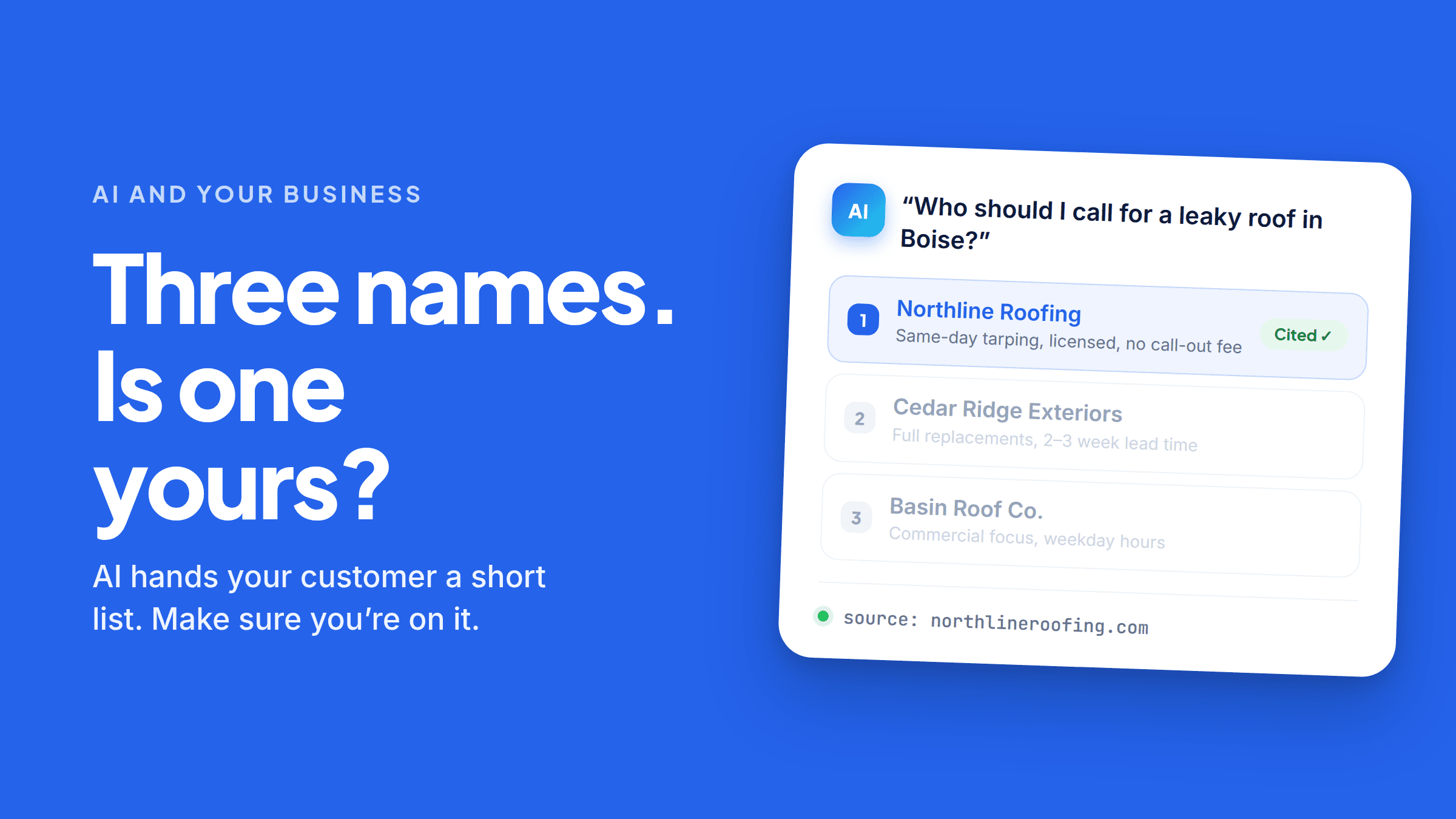
An AI answer doesn’t work like that. Someone types “who’s good for emergency plumbing in Dover” and gets two or three names and a sentence about each. There is no sixth place. There’s the short list, and there’s everyone else.
That’s the shift business owners need to understand: getting found stopped being a spectrum and turned into a yes or no. You’re either named in the answer or you’re invisible in it. And the person asking usually never scrolls, never compares ten options, and never sees your website at all before deciding who to call.
Building trust: AI doesn’t just list you, it vouches for you
Here’s the part that’s easy to miss. When an AI names your business, it doesn’t hand over a phone number and stop. It says why.
“Flat monthly pricing, no onboarding fee.” “Licensed techs, same-day service, no after-hours surcharge.” That’s not a directory listing. That’s a recommendation — the same thing your best customer does when she tells her neighbor about you.
So the trust arrives before you do. The caller isn’t price-shopping you against four other companies. They mostly want to know when you can come out. That’s a better lead than anything you can buy.
Two honest limits, though.
The trust is real but thinner than a human’s. A neighbor has a personal stake in the recommendation. An AI is confident either way. So most people do a quick sanity check after they get your name — they glance at your website, your reviews, your hours. Those still have to hold up.
And the AI can only vouch for what it can read. It builds that “why” sentence out of whatever it finds about your business. Vague marketing copy gives it nothing to work with. Clear facts — what you do, where, how fast, what it costs — give it a sentence worth repeating.
Growing: this one doesn’t stop when the budget does
Ads work while you pay for them. The day you turn them off, they stop.
Being the answer works differently. Once AI engines can read clear, factual content about your business, they’ll recommend you to a stranger at 2am in a town where nobody knows your name — over and over, without being reminded, without a monthly bid.
It also scales past your customers’ social circles. Your happiest customer can only refer you to people she actually knows, when the topic happens to come up. An answer engine has no social circle and never forgets you exist.
And the leads are pre-qualified. Nobody asks an AI for a roofer for fun. They asked because water is coming through the ceiling right now.
So why isn’t AI recommending you already?
Usually not because you’re the worse business. Almost always because there’s nothing readable about you.
Three things cause that, and all three are fixable.
Your answers are trapped in JavaScript. This is the big one. Most FAQ plugins and accordion widgets load their answers with JavaScript after the page opens. Humans see them fine. AI crawlers generally don’t run JavaScript, so they read your page and find nothing. Your best content is there for people and gone for machines.
You never wrote the answers down. Your website probably has a services page and an about page. It probably doesn’t have a plain sentence that says “we do same-day AC repair in Tampa and there’s no after-hours surcharge.” If nobody wrote it, nothing can quote it.
You’re blocking the crawlers. Some sites tell AI crawlers to stay out in their robots.txt file, often by accident. If GPTBot, ClaudeBot, or PerplexityBot aren’t allowed in, the answer is settled before it starts.
One thing worth saying plainly: this doesn’t replace SEO. A healthy, fast, well-organized website is still the foundation, and it still matters. Getting cited by AI is the next floor up — you build it on top of the SEO work, not instead of it.
What to do about it
You don’t need an agency and you don’t need a week. Start here:
- Write down the ten questions customers actually ask you on the phone. Real words, not keywords.
- Answer each one in two or three sentences. Lead with the answer. Be specific — towns, hours, prices, timelines.
- Put those answers on your own website as plain text that loads with the page, not inside a widget that loads after it.
- Make sure AI crawlers are allowed in your robots.txt.
- Check back. Ask ChatGPT, Perplexity, and Google’s AI a question a real customer would ask, and see whose names come back.
That last step is the one people skip, and it’s the one that tells you whether any of this worked.
Where FaqFlo comes in
FaqFlo does that loop for you. It checks whether AI can see your site at all, finds the questions people are actually asking AI about businesses like yours, writes answers built to be quoted, gives you clean crawlable HTML to paste onto your own website — so the credit and the click come to you, not us — and then tracks whether you start showing up in ChatGPT, Perplexity, and Google’s Gemini.
You already know a recommendation is the best lead you can get. This is the version of it that keeps working while you’re asleep.
Frequently asked questions
Why should a small business owner care about AI?
Because your customers are already using it to decide who to call. When someone asks an AI for a recommendation, it names two or three businesses — and if you’re not one of them, you never get the chance to compete for that job.
Do I need to use AI myself for this to matter?
No. This isn’t about adding AI tools to your business. It’s about being visible to the AI tools your customers are already using, which is a completely separate thing from whether you ever open ChatGPT.
Why is AI recommending my competitor instead of me?
Almost always because it can find clear, readable information about them and not about you. Answer engines build recommendations from what they can crawl, so a business with specific, plain-text answers on its site will beat a better business that never wrote anything down.
Does this replace my SEO?
No — SEO is still the foundation, and a healthy website helps both. Getting quoted by AI is the layer on top: SEO helps you rank on a results page, and AEO helps you get named inside the answer itself.
How do I know if AI can see my website?
The quick test is to view your page’s source or turn JavaScript off and check whether your answers are still there. If they disappear, AI crawlers can’t see them either — and that’s the first thing worth fixing. The easiest way to do all of this is through FaqFlo.

Written by
Beau
👋 Hi, I’m Beau. I’ve spent almost 20 years in marketing — long enough to watch the whole game change more than once. I was there when SEO was the answer, then social, then content, and now the biggest shift yet: people asking AI instead of Googling. Somewhere along the way I got tired of watching good small businesses do everything “right” and still stay invisible to the tools that increasingly decide who gets found. That’s why I built FaqFlo — my mission is to help you grow your business in the modern world of AI, so you become the answer, not just another link nobody clicks.
Looking for something else?
Search the archive by title, summary, or the questions a post answers.