 Beau
BeauWhy AEO Beats Keeping Up With Social Media
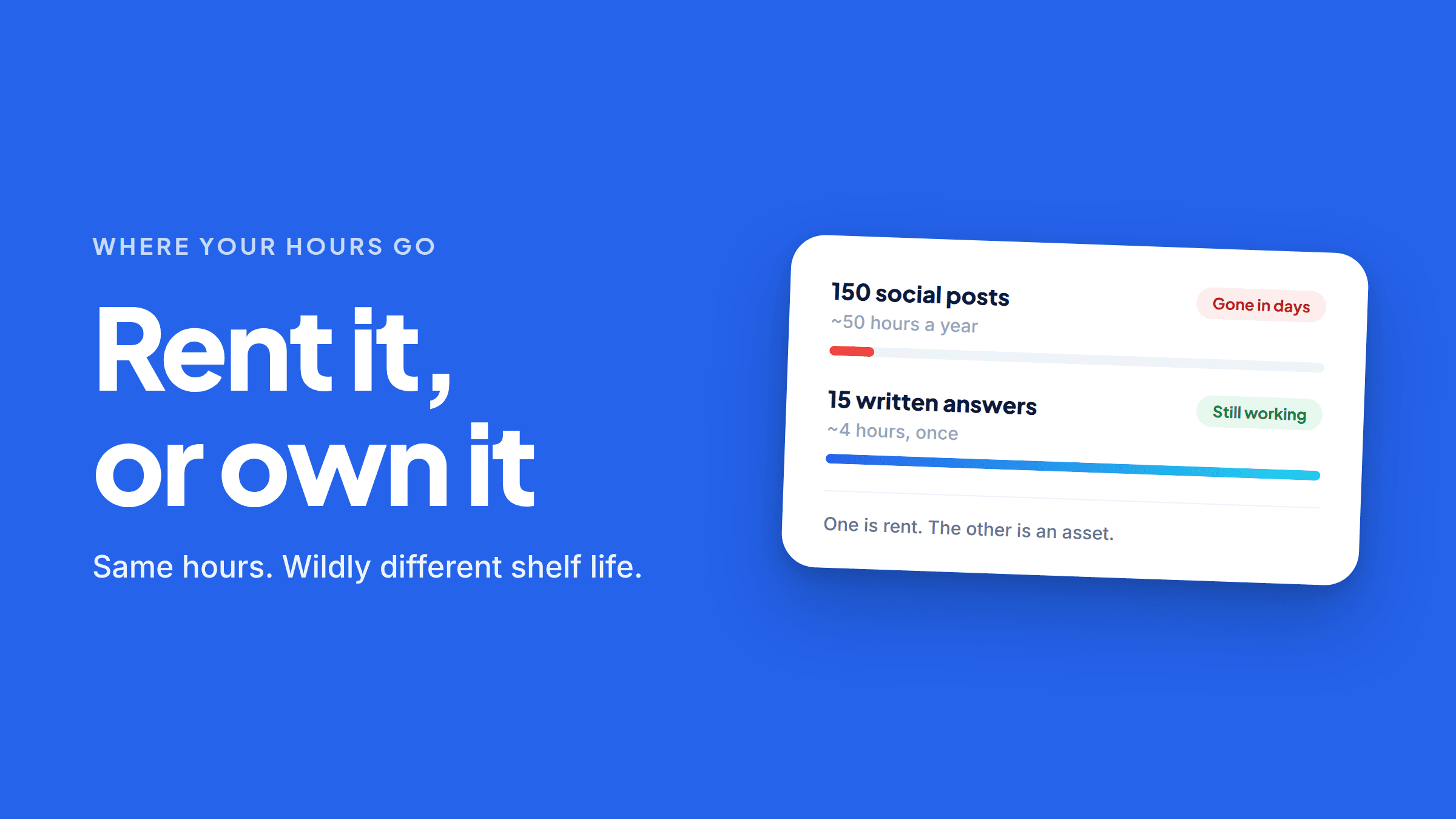
Same hours, wildly different shelf life. One is a treadmill, the other is a filing cabinet.
Nobody has ever told a small business owner to do less. The advice is always additive: post more, post consistently, get on the new platform, do video now, do short video now, three times a week, at the right time of day, with the right hook.
So let’s do the thing nobody does and talk about where your limited hours actually go furthest.
This isn’t an argument for abandoning social media. It’s an argument about shelf life — and once you see the difference, it’s hard to unsee.
The treadmill
Here’s the deal social media offers you.
You produce something. It’s shown to some fraction of the people who already follow you, for somewhere between a few hours and a few days. Then it’s gone — not deleted, just buried nineteen posts deep in a feed where nobody, including you, will ever find it again.
To keep the results, you have to keep producing. Stop for three weeks and the results stop with you. That’s not a flaw in how you’re doing it; it’s the actual design. The platform’s job is to keep a feed moving, not to keep your business findable.
Run the arithmetic on a realistic year:
- Three posts a week, fifty weeks — call it 150 posts
- Twenty minutes each, including the photo, the caption, and the deciding-what-to-post part
- Roughly 50 hours
At the end of that year, what’s still working for you? Essentially nothing from month one. Maybe a handful of posts that did unusually well. You’re renting attention, and rent is due weekly.
And here’s the part that stings: you almost certainly answered a customer’s pricing question in a comment thread in March, clearly and well. That answer is now unreachable. It exists, technically. It’s findable by no one.
The filing cabinet
Now the other option.
You write down the fifteen questions customers actually ask you before they book. What it costs, how fast you can come, which towns you cover, whether there’s a call-out fee, what’s included, how long the job takes, whether you’re licensed and insured.
Two to four plain sentences each. You already know every answer — you say them out loud ten times a day.
Then you put them on your own website as readable text.
- Roughly 3 to 5 hours, once
That page doesn’t decay. It gets crawled, and re-crawled. It’s still answering questions in eighteen months. When an answer engine builds a response about your trade in your town, that’s the material it works from — and when it cites you, the credit and the call come to you, because it’s your domain.
Fifty hours of renting attention against four hours of building an asset. That’s the actual comparison, and almost nobody frames it that way because nobody sells you the four-hour version.
What social genuinely does well
I want to be fair here, because the “quit social media” version of this argument is wrong and you’d be right to distrust it.
Social is good at things AEO can’t touch:
- Showing your work. Before-and-after photos are proof, and proof is persuasive.
- Staying present with people who already know you. Repeat customers, past clients, the local network.
- Community. A local group where you’re a known, helpful presence is real business.
- Personality. People hire people, and a feed carries that in a way an FAQ page never will.
None of that is nothing. Keep doing it.
But notice what’s not on that list: being discovered by someone who doesn’t know you exist. Social is fundamentally a retention and reputation channel dressed up as an acquisition channel. The stranger with a leaking roof at 8pm is not scrolling your feed. They’re asking somebody — and increasingly that somebody is an AI assistant.
Where the two collide
The awkward truth underneath all of this: most of what you post to social is invisible to answer engines anyway.
Those platforms render nearly everything with JavaScript, much of it sits behind a login, and crawlers generally don’t run JavaScript or hold accounts. And when something is readable, the source is the platform rather than your business — you didn’t earn the citation, you don’t own the address, and the customer’s path doesn’t lead back to you.
So the content isn’t just short-lived. For the purposes of getting recommended, a lot of it was never counted at all.
Which means the 50 hours and the 4 hours aren’t competing for the same outcome. They’re doing different jobs, and only one of them makes you findable by strangers.
The order to do it in
You don’t have to choose. You have to sequence.
-
Write the answers once, on your own site. Fifteen questions, plain sentences, real numbers, real town names. Answer in the first sentence — engines and skimming customers both reward it.
-
Make sure a machine can actually read them. Open your live page, right-click, choose View Page Source, press Ctrl+F, and search for one of your answers. If it isn’t there, it’s being built by JavaScript after the page loads and the engines will never see it.
-
Then post, with less pressure. Once the durable version exists, social goes back to being what it’s good at. You’re not trying to make a Tuesday post carry your pricing policy anymore.
-
Harvest your own comments. This is the highest-return hour in the whole plan. Go back through your replies from the last few months and pull out every question you answered well. That’s your FAQ page, already written, in your own voice, by the person who actually knows the answers.
-
Update it when reality changes, and otherwise leave it alone. That’s the entire maintenance burden. It’s about an hour a quarter.
⚠️ Use View Page Source, not Inspect Element. Inspect shows the page after scripts have run, which is what a person sees rather than what a crawler gets.
The reframe
Social media asks: what will you publish this week?
AEO asks: what do people ask you, and is the answer written down anywhere a machine can read?
The first question never stops. The second one has an end. You finish it, and then it keeps working — while you’re on a job, while you’re asleep, while you’re taking the week off, which is exactly when a feed goes quiet and stops producing anything at all.
And none of this is a departure from regular SEO. A clear, crawlable site that answers real questions has always been the foundation, and it still is. Answer Engine Optimization is the floor above it: writing those answers so they can be lifted cleanly into somebody else’s answer, and making sure they’re actually readable when the engine comes looking.
Where FaqFlo comes in
FaqFlo is the four hours, compressed.
It finds the questions people are actually asking AI about businesses like yours in your area, drafts answers in the direct, specific style engines quote, and gives you crawlable HTML to paste onto your own website — with a check afterward confirming the text really landed in the page. Then it tracks whether ChatGPT, Perplexity and Gemini start naming you, and flags new questions coming up that you don’t answer yet.
Keep posting if you enjoy it. Just stop letting it be the only place your answers exist.
Frequently asked questions
Is AEO better than social media marketing?
They do different jobs, so it’s less either/or than it looks. Social is strong for reputation and staying visible to people who already know you, while AEO is how strangers who’ve never heard of you end up with your name — and AEO content keeps working long after a post has scrolled away.
Should I stop posting on social media?
No. Change the order instead: publish your durable information — pricing, service area, hours, what you do and don’t handle — on your own website as readable text first, then post about it. The post reaches your followers, and the page stays findable and creditable.
How much time does AEO actually take?
The bulk of it is a few hours once: writing plain answers to the fifteen questions customers ask most and getting them onto your own site as readable text. After that it’s roughly an hour a quarter to keep prices, hours, and service areas current.
Why doesn’t my social media content help me get found by AI?
Those platforms render almost everything with JavaScript and gate a lot of it behind a login, and AI crawlers generally don’t run JavaScript or hold accounts. Even when a post is readable, the source credited is the platform rather than your business.
What’s the fastest AEO win for a small business?
Go back through your own comment replies and messages, pull out the questions you answer most, and publish those answers on your website as plain text. The hard part is already done — you’ve written those answers dozens of times, just never anywhere permanent.

Written by
Beau
👋 Hi, I’m Beau. I’ve spent almost 20 years in marketing — long enough to watch the whole game change more than once. I was there when SEO was the answer, then social, then content, and now the biggest shift yet: people asking AI instead of Googling. Somewhere along the way I got tired of watching good small businesses do everything “right” and still stay invisible to the tools that increasingly decide who gets found. That’s why I built FaqFlo — my mission is to help you grow your business in the modern world of AI, so you become the answer, not just another link nobody clicks.
Looking for something else?
Search the archive by title, summary, or the questions a post answers.