 Beau
BeauSimple AEO & GEO Guide For Business Owners
Two scary acronyms. One simple idea. Here’s the whole thing in plain English.
First, the two words
AEO stands for Answer Engine Optimization. GEO stands for Generative Engine Optimization. Two groups of people picked two names for the same job. If someone tries to sell you on the difference between them, they’re selling you something.
Both mean this: when a person types a question into ChatGPT, Perplexity, or Google’s AI, you want the AI to name you.
You already know its older cousin. It’s called SEO, and it’s about getting your website onto page one of Google. SEO is still the foundation — a healthy, findable website is what AEO is built on top of. AEO is the next floor up. Instead of only trying to be a link on a list, you’re also trying to be the answer.
An example, start to finish
Maria owns a dog grooming shop in Portland.
Someone who just moved to town picks up their phone and types this into ChatGPT:
Where can I get my dog groomed in Portland if he’s scared of clippers?
The AI writes back a short paragraph. It names two shops and says a little about each one. The person picks one, calls, and books.
Maria was not one of the two names. Not because her shop is worse — she’s been doing this for eleven years and she is genuinely great with nervous dogs. She wasn’t named because nothing on the internet told the AI so.
Her website says “Portland’s friendliest groomers. Book today!” That’s a slogan. An AI can’t do anything with a slogan. It needs facts.
Now here’s the same shop after one afternoon of work. Maria adds a section to her site that says, in plain words:
Do you groom dogs that are scared of clippers? Yes. We use quiet, low-vibration clippers and hand scissors for anxious dogs, and we book them into our quiet morning slots. No sedation. We’re in Portland, Oregon, and we’ve been doing this for 11 years.
Next time someone asks that question, the AI has something real to grab. And when it names her shop, it can explain why — because she told it why.
That’s AEO. That’s GEO. That’s the whole job.
Why most businesses get skipped
Three reasons. All fixable.
Their website doesn’t answer anything. Most small business sites have a home page, an about page, and a contact form. Lots of adjectives. Almost no answers. An AI can’t quote an adjective.
Their answers are too fuzzy. “Great service at fair prices” tells an AI nothing. “Oil change, $65, most cars, no appointment, open till 6” tells it everything it needs.
The AI can’t actually read the page. This is the sneaky one. Lots of websites use something called JavaScript to make answers pop open when you click them — those little plus signs on a FAQ page. Your visitors see the answers fine. But AI crawlers usually don’t click anything and don’t run JavaScript. They grab the plain text of the page and leave. If your answers only show up after a click, the AI reads a page with no answers on it.
That’s the part that stings. The page looks perfect. It’s just invisible to the exact robots you’re trying to reach. (There’s a whole post on why FAQ plugins cause this if you want the detail.)
The five steps
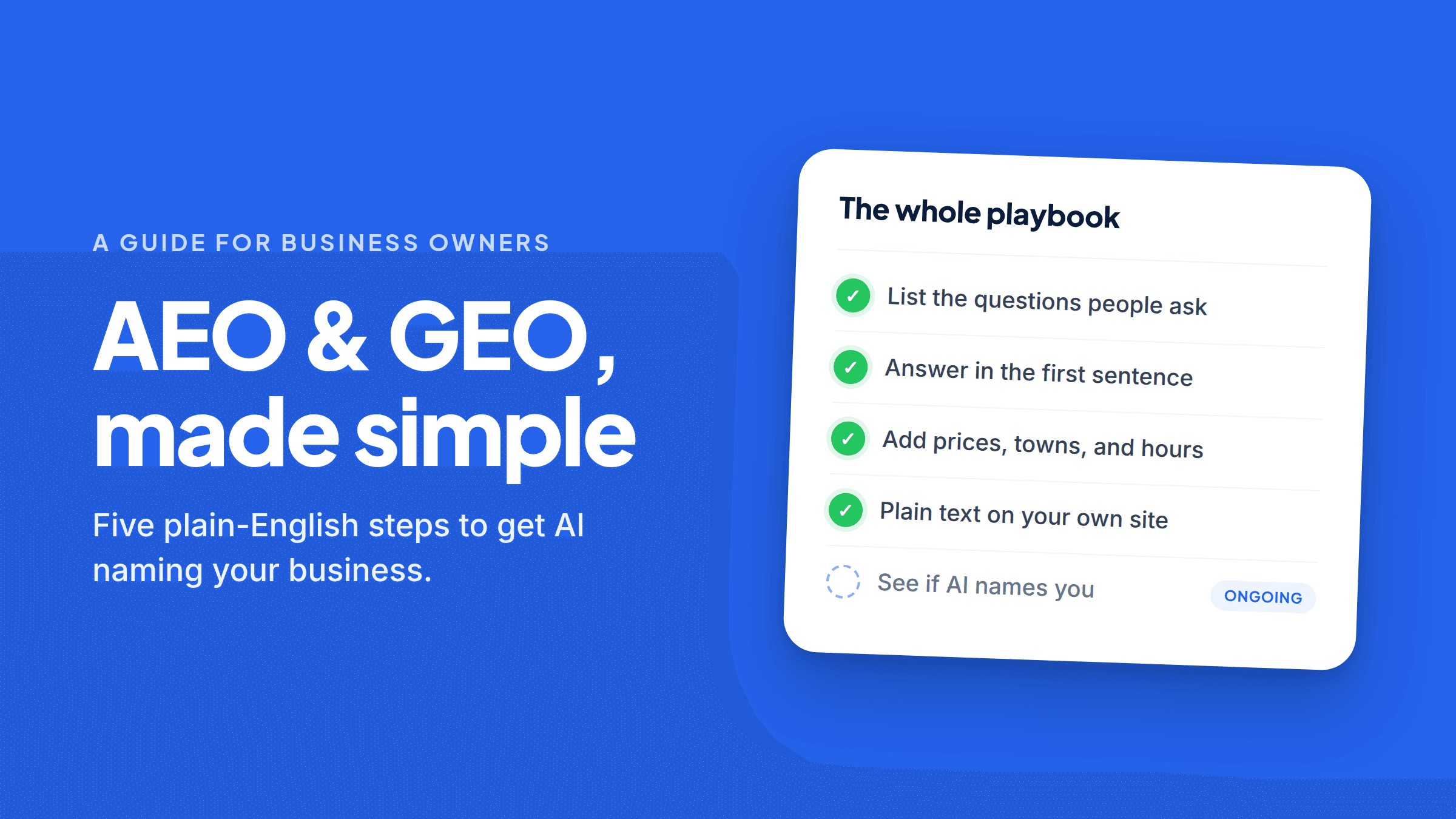
Here’s the whole playbook. You can do it yourself.
1. Write down the questions people actually ask you. Not marketing topics. Real questions, in the words a customer would use. “Do you come out on weekends?” “How much for a small dog?” “Do you take walk-ins?” You already answer these on the phone ten times a week.
2. Answer each one in the first sentence. Don’t warm up. Don’t tell the story of your company. Question, then answer, immediately. AI grabs the cleanest answer it can find, so make yours the easiest one to grab. Two or three sentences is plenty.
3. Put in the boring details. Prices. Towns you serve. Hours. How fast you can get there. What you don’t do. Boring is good here. Boring is specific, and specific is what gets quoted.
4. Make sure it’s readable text on your own website. Plain text, on your page, no clicking required. On your own web address — not on somebody else’s platform — so when the AI names you, the credit and the click come to you.
5. Check whether it worked. Ask ChatGPT and Google’s AI a few of your own customers’ questions and see whose names come back. Do it again in a month. Names move around as businesses add content, so this isn’t a one-time chore.
That’s it. There’s no trick. There’s no secret word you sprinkle in. It’s just answering plainly and making sure a machine can read it.
The one-minute version of the example
Before:
We’re passionate about pet care and treat every dog like family.
After:
How much is a full groom for a small dog? A full groom for a dog under 25 pounds is $75 and takes about 90 minutes. That includes bath, haircut, nails, and ears. Walk-ins welcome before 11am.
The first one is nice. The second one is quotable. Guess which one ends up inside an AI answer.
Where FaqFlo comes in
FaqFlo does those five steps for you.
It checks whether AI can read your site right now, finds the questions people are actually asking AI about businesses like yours, writes answers built to be quoted, hands you a block of plain readable text to paste onto your own website, and then watches to see whether ChatGPT, Perplexity, and Google’s Gemini start naming you.
No jargon, no dashboard full of numbers you don’t care about. Just: can they see you, and are they saying your name yet.
Check your site free — no card needed.
Frequently asked questions
What is the difference between AEO and GEO?
There isn’t a real one. AEO means Answer Engine Optimization, GEO means Generative Engine Optimization, and both describe the same job: getting AI tools to name and quote your business. Two names, one goal.
Do I still need SEO if I do AEO?
Yes. SEO is the foundation. AI tools build their answers from pages they can find and trust, and a well-built, findable website is what makes that possible in the first place. AEO is the layer you add on top, not a replacement.
Why can’t AI see my FAQ page?
Usually because the answers are hidden behind a click. Most FAQ tools use JavaScript to expand answers when someone taps them, and AI crawlers generally don’t run JavaScript. The fix is having your answers as plain text right in the page.
How long does AEO take to work?
Usually weeks, not days. AI tools have to find your new content first, and that depends on how often your site gets crawled. Check at 30 days, then again at 60 and 90, before deciding whether it’s working.
How do I check if AI mentions my business today?
Ask ChatGPT, Perplexity, and Google a few questions a real customer would ask, including your town. See whose names come back. If you’re not there, that’s your starting point.

Written by
Beau
👋 Hi, I’m Beau. I’ve spent almost 20 years in marketing — long enough to watch the whole game change more than once. I was there when SEO was the answer, then social, then content, and now the biggest shift yet: people asking AI instead of Googling. Somewhere along the way I got tired of watching good small businesses do everything “right” and still stay invisible to the tools that increasingly decide who gets found. That’s why I built FaqFlo — my mission is to help you grow your business in the modern world of AI, so you become the answer, not just another link nobody clicks.
Looking for something else?
Search the archive by title, summary, or the questions a post answers.