 Beau
Beau20 Industries Affected by AEO (In a Good Way)
Most articles about AI and small business are bad news. This one isn’t.
First, the good news
Most of what you read about AI and small business is about what you’re going to lose. Traffic. Clicks. The top of the search results.
Here’s the part that gets skipped: when an AI answers a question, it names businesses. Two or three of them. Someone asks “who should I call for a leaking roof in Nashua” and gets a short list of real companies with a sentence about each.
That’s not a threat. That’s a recommendation, given to a stranger who is ready to buy, by a source they trust. The only question is whose name is in it.
AEO — Answer Engine Optimization — is the work of making sure it’s yours. And it turns out that work pays off more in some industries than others.
What makes an industry a good fit for AEO
Three things, mostly.
People ask questions before they buy. Nobody asks an AI which brand of paper towels to get. They absolutely ask which roofer to call, which dentist takes their insurance, and whether their heat pump is worth repairing.
The purchase is local or specific. “Near me” questions force the AI to name actual businesses instead of giving general advice.
The answers are facts you already know. Your service area, your hours, your pricing structure, whether you do emergency calls. You don’t have to invent this. You just have to publish it in a form a machine can read.
If your business ticks those boxes, you’re on the list below.
A walkthrough: what this looks like for a roofer
Say you run a roofing company covering a few towns. Storm season hits, and somewhere in your service area a homeowner sits down with a wet ceiling stain and types into ChatGPT: “Roof leaking after a storm — who do I call in my area, and does insurance cover it?”
The AI answers in two parts. First it explains storm damage claims. Then it names two or three roofers.
Here’s what decides whether you’re one of them.
Before AEO. Your website has a nice photo gallery, a contact form, and a paragraph about your commitment to quality. Your FAQ page is a plugin that opens accordions when you tap them — which means the answers load with JavaScript, and AI crawlers generally don’t run JavaScript. To a person, your site looks great. To the answer engine, that page is nearly blank. You aren’t rejected from the answer. You’re just not in the running.
After AEO. The same questions your office manager answers on the phone twelve times a week are now published as plain, crawlable text on your own domain:
- Do you handle insurance claims? “Yes — we document the damage, meet your adjuster on site, and bill the claim directly.”
- How fast can you tarp a leaking roof? “Same day in Nashua, Hudson, and Merrimack. Emergency tarping is a flat $450, credited toward the repair.”
- How long does a full asphalt shingle replacement take? “One to two days for a typical single-family home.”
- Do you offer financing? “Yes, 0% for 12 months on replacements over $8,000.”
That second version is full of the exact details an AI needs to make a recommendation: a service area, a timeframe, a price, a specific offer. It’s also the kind of sentence an answer engine can lift straight into a reply — “Northline Roofing offers same-day emergency tarping in the Nashua area and bills insurance claims directly.”
Nothing about your business changed. What changed is that a machine could finally read it.
And notice the timing. That homeowner isn’t comparison shopping. There’s water coming through the ceiling. Being one of two names in that answer is worth more than being the sixth result on a search page — because that job is going to whoever gets called first.
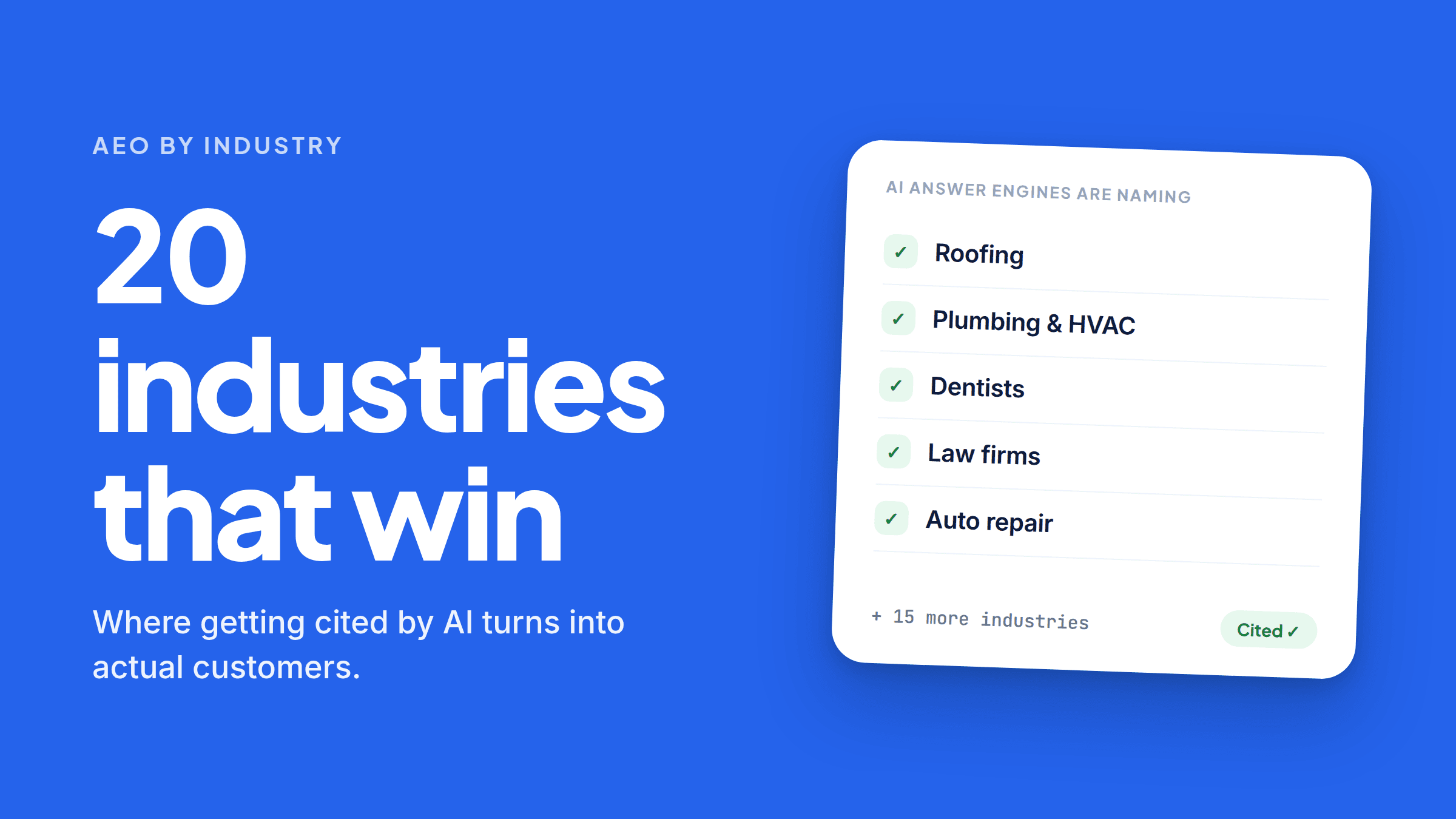
The 20 industries
Grouped by why AEO works there. Every one of these has customers who ask AI questions before they pick up the phone.
Home services — urgent, local, high ticket
1. Roofing and exterior contractors. Storm damage, insurance claims, “how much does a new roof cost.” Urgent, expensive, and heavily researched — the strongest fit on this list.
2. Plumbing. “Who’s open on a Sunday” is a question with exactly one right kind of answer, and it names a business.
3. HVAC and heating oil. Repair-or-replace questions, efficiency rebates, emergency no-heat calls in January.
4. Electricians. Panel upgrades, EV charger installs, and “is this code” questions that reward a specific, factual answer.
5. Landscaping and lawn care. Seasonal, recurring, and defined by service area — an AI can only recommend you if it knows which towns you cover.
6. Pest control. People describe a problem (“small black ants in the kitchen”) and want a solution plus a company. Your answers can be both.
7. Cleaning services. Pricing structure, what’s included, whether you bring supplies. All questions, all publishable.
8. Moving and storage. High-consideration, one-shot purchases where people research hard and buy once.
Professional services — trust decided before the first call
9. Law firms, especially solo and small practices. Practice area plus location plus “do I even have a case” is one of the most common AI question shapes there is.
10. Accountants and bookkeepers. Deadlines, entity types, what your monthly fee actually includes.
11. Insurance agents. Coverage explanations are pure Q&A — the format is already right.
12. Real estate agents and brokerages. Local market questions, buying process questions, and “who should I work with in this town.”
13. Financial advisors. Fee structure and minimums are exactly the facts people want before they’ll book a call, and the ones most sites hide.
14. IT services and managed service providers. Small business buyers ask AI to explain the problem and recommend a vendor in the same breath.
Health and care — people research before they book
15. Dental practices. Insurance accepted, new patient availability, what a cleaning costs. This is the most-asked category in local health.
16. Veterinary clinics. Urgent, emotional, and full of “is this an emergency” questions where being the helpful answer wins the appointment.
17. Physical therapy, chiropractic, and med spas. Procedure explanations plus “who does this near me.”
18. Senior care and home health. The person searching is usually an adult child, doing careful research on someone else’s behalf, and reading everything.
Products and everything else
19. Restaurants, bakeries, and caterers. Dietary questions, custom orders, lead times, private events — all the things people ask an AI instead of calling to find out.
20. E-commerce and solo software businesses. Product comparison and “what’s the best tool for X” questions are being answered by AI right now, and the answer names specific brands.
Honorable mentions that behave the same way: auto repair shops, fitness studios, childcare and preschools, wedding and event vendors, salons, self-storage, and equipment rental.
The pattern across all 20
Look at what those industries have in common. Not one of them is winning because of a big ad budget.
They’re winning because the questions their customers ask are answerable with facts they already have. The service area. The price. The turnaround. The thing they explain on the phone every single day.
AEO isn’t a new marketing discipline you have to learn. It’s mostly the act of writing those answers down clearly and publishing them somewhere a machine can actually read — which means real, crawlable HTML on your own domain, not an accordion widget that loads after the page does.
SEO still matters. It’s the foundation, and a healthy site helps you either way. AEO is the next floor up: the layer that decides whether you’re the answer, not just a result.
Where FaqFlo comes in
FaqFlo does the four steps for you. It finds the questions people are actually asking AI about businesses like yours, drafts answers built to be quoted, gives you clean crawlable HTML to paste onto your own site, and then tracks whether you’re starting to show up in ChatGPT, Perplexity and Gemini.
If you’re in one of the 20 above, the fastest thing you can do today is check whether AI can see your site at all. That’s free, and it takes about a minute.
Frequently asked questions
Which industries benefit the most from AEO?
Local, high-consideration services benefit most — roofing, plumbing, HVAC, dental, legal, and accounting lead the pack. These are categories where customers ask questions before they buy and the AI has to name an actual business to be useful.
What if my industry isn’t on the list?
It probably still applies. The test isn’t your industry name, it’s whether customers ask questions before choosing you. If your phone gets the same five questions every week, you have everything you need for AEO.
Is AEO different for a roofer than for a dentist?
The mechanics are identical: publish clear, factual, crawlable answers on your own domain. What changes is the questions. A roofer answers about storm damage and insurance claims; a dentist answers about accepted insurance and new patient openings.
Do I need to stop doing SEO to do AEO?
No. SEO is the foundation and it still works — a fast, well-structured site helps both. AEO is the next floor up, aimed at getting quoted inside AI answers rather than ranked on a results page.
How do I know if AI is recommending my business today?
Ask ChatGPT, Perplexity and Gemini a few questions a real customer would ask and see whose names come back. FaqFlo does this check for you and tracks it over time, so you can see whether your visibility is improving instead of guessing.

Written by
Beau
👋 Hi, I’m Beau. I’ve spent almost 20 years in marketing — long enough to watch the whole game change more than once. I was there when SEO was the answer, then social, then content, and now the biggest shift yet: people asking AI instead of Googling. Somewhere along the way I got tired of watching good small businesses do everything “right” and still stay invisible to the tools that increasingly decide who gets found. That’s why I built FaqFlo — my mission is to help you grow your business in the modern world of AI, so you become the answer, not just another link nobody clicks.
Looking for something else?
Search the archive by title, summary, or the questions a post answers.